

You manage a building, an office complex, or a commercial property that never fully shuts down. Maybe it's a medical facility in Pasadena. Maybe it's a fitness center in West Hollywood or a co-working space in Santa Monica that hosts clients around the clock. Whatever it is, you have the same problem most 24-hour property managers face: when exactly is the right time to clean, and what kind of service actually makes sense for a place that's always running?
This is where many building and property managers get stuck. You know you need professional cleaning. But the decision between scheduling after-hours cleaning with Los Angeles providers versus hiring a team for true 24/7 janitorial services is not as simple as it sounds. Get it wrong, and you're either overpaying, disrupting operations, or ending up with a building that looks like it hasn't been touched since Tuesday.
Let's break it down the honest way, comparing what each option really delivers, what it costs, and when one is a better fit than the other.
The Real Problem: LA's 24-Hour Economy Doesn't Pause for Cleaning
Los Angeles is not a city that sleeps. Between entertainment industry productions running overnight in El Segundo, urgent care clinics operating around the clock in Los Angeles County, and tech companies with global teams in Culver City, the assumption that buildings go quiet at 6 PM simply doesn't hold up anymore.
And yet, most commercial cleaning contracts are still built around a traditional schedule: come in after the last employee leaves, clean for a few hours, and be gone before the morning shift. That model works well for a standard 9-to-5 office. But if your building has people in it at 11 PM, 2 AM, or all day Saturday, after-hours cleaning alone can leave real gaps.
According to data from the Bureau of Labor Statistics, roughly 15% of full-time workers in the U.S. work non-standard hours regularly. In dense urban markets like Los Angeles, that number climbs even higher when you factor in hospitality, healthcare, entertainment, and logistics sectors. So if you're managing a commercial property in LA and haven't thought seriously about your commercial cleaning schedules, you might already be behind.
What Is After-Hours Cleaning in Los Angeles?
After-hours cleaning refers to janitorial services scheduled outside of a business's normal operating hours, typically in the evenings or late at night. For most properties, that means a cleaning crew arrives between 7 PM and midnight, completes their tasks, and leaves before anyone shows up the next morning.
This is the most common model, and for good reason. It has real advantages:
It doesn't disrupt your team. Cleaners work in an empty building, so they can vacuum, mop, and sanitize without getting in anyone's way.
It's typically more affordable. Standard after-hours scheduling means you're not paying a premium for crews who have to work around live operations.
It's easier to manage. You hand over access at a set time, the job gets done, and you check the results in the morning.
For a standard office in Pasadena or a retail suite in Santa Monica that closes at 9 PM, after-hours cleaning Los Angeles providers are often the right and most cost-effective choice.
But this model has a real weakness when your building doesn't actually empty out.
Where After-Hours Cleaning Falls Short for 24/7 Operations
Here's the problem nobody talks about plainly: if your building has employees, patients, customers, or tenants present at 10 PM, a traditional after-hours crew can't do most of their work.
Think about what that means practically. Common areas are still occupied. Restrooms can't be taken offline for deep cleaning. Hallways are in use. High-touch surfaces that accumulate bacteria and grime throughout the night are getting touched again and again before anyone sanitizes them.
A 2023 study published in the American Journal of Infection Control found that high-touch surfaces in occupied commercial buildings can accumulate contamination within 30 to 60 minutes after cleaning. For a property where people are moving around at 3 AM, an 8 PM cleaning visit isn't doing nearly as much as you'd hope by morning.
Beyond hygiene, there's an operational issue. If a cleaning crew shows up at 10 PM and your building still has a skeleton crew working, they either have to work around people, delay their start, or skip certain areas entirely. That leads to inconsistent results and frustrated tenants.
What 24/7 Janitorial Services Actually Look Like
True 24/7 janitorial services aren't just about having a phone line available around the clock. They mean your cleaning provider has staff scheduled across multiple shifts, with the ability to place crews in your building at any hour based on your operational needs.
For a high-traffic 24-hour property, this might look like:
- Daytime porters handling common areas, restrooms, and high-touch surfaces during peak hours
- Evening crews completing deeper cleaning tasks as foot traffic slows
- Overnight crews handling floor care, trash removal, and supply restocking
This kind of layered approach to commercial cleaning schedules is standard in industries like healthcare and hospitality, but it's increasingly relevant for any commercial property in Los Angeles that operates beyond traditional hours.
The benefit is real-time responsiveness. If a restroom needs attention at 1 AM, someone can address it. If a spill happens in a lobby at midnight, it gets handled. You're not waiting until the morning and hoping tenants don't notice.
Comparing the Costs: After-Hours Cleaning vs. 24/7 Coverage
Let's talk numbers, because this is usually where the conversation gets murky.
Standard after-hours cleaning rates in Los Angeles for commercial properties typically run between $0.10 and $0.25 per square foot per visit, or roughly $30 to $65 per hour, depending on the provider, scope of work, and frequency. A medium-sized office in Los Angeles, say around 5,000 square feet, cleaned five nights a week, might cost between $800 and $1,500 per month.
24/7 janitorial services cost more, but the premium varies significantly depending on how the coverage is structured. If you add a daytime porter to an existing evening cleaning contract, you're typically looking at an added $1,200 to $2,500 per month for a dedicated part-time porter in a mid-size building. Fully staffed, around-the-clock coverage for a large commercial property can run considerably higher.
Here's a rough cost comparison to orient your planning:
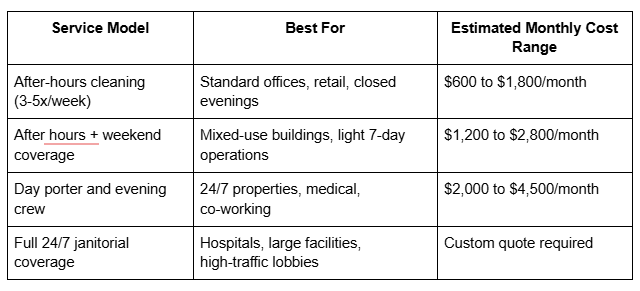
These numbers are estimates based on industry averages for the Los Angeles market and will vary based on square footage, scope, and provider. Always request a walkthrough-based quote from your cleaning vendor.
One thing worth noting: after-hours scheduling does sometimes carry a small premium over daytime rates because of the shift differential for workers, but the bigger cost driver for 24/7 coverage is simply the volume of labor hours involved.
Security and Access: The Part Most Managers Overlook
This is the piece that gets glossed over in most cleaning conversations, and it shouldn't.
When you schedule after-hours cleaning in Los Angeles, you're granting access to your building when most of your staff is gone. That means:
- Key management and access codes are being shared with cleaning crews
- Your security cameras and alarm systems need to be coordinated with cleaning schedules
- Liability exposure increases if something goes wrong in an empty building
Reputable commercial cleaning companies handle this professionally. They use signed access agreements, bonded employees, background-checked staff, and documented entry and exit logs. But you need to ask about these things specifically. Don't assume.
For 24/7 operations, this dynamic actually gets easier in some ways. Because someone is always in the building, cleaners are working in an occupied environment with natural oversight. But it introduces a different concern: vetting a cleaning company that will have staff regularly working alongside your employees, clients, or patients requires a higher standard of background screening and professionalism.
When evaluating any provider for after-hours cleaning Los Angeles contracts, ask directly:
- Are all employees background checked?
- Are you bonded and insured with at least $1 million in general liability coverage?
- How is access documented and managed?
- Who supervises overnight crews?
A good cleaning company won't hesitate to answer any of these clearly.
Which Model Is Right for Your Property in LA?
Here's a simple way to think through the decision:
Choose standard after-hours cleaning if:
- Your building is genuinely empty for at least 6 to 8 hours each night
- You don't have restroom or high-touch area complaints during operating hours
- Your budget is a primary constraint right now
Choose 24/7 janitorial services (or a hybrid model) if:
- Your building has staff, customers, or patients present past 10 PM most nights
- You manage a medical facility, fitness center, hotel, or other hospitality property
- You've had tenant or employee complaints about cleanliness during the day
- You're managing a high-traffic property in a dense area like West Hollywood or El Segundo, where appearances directly affect tenant satisfaction
Most building managers in Los Angeles County end up somewhere in between. A solid evening cleaning contract paired with a day porter who handles the common areas during peak hours covers a lot of ground without requiring full 24/7 staffing.
What the Trends Tell Us About Where Commercial Cleaning Is Heading
The commercial cleaning industry in the U.S. is projected to grow to over $117 billion by 2030, according to IBISWorld industry data. One of the clearest drivers of that growth is the shift toward more flexible, demand-responsive cleaning models, exactly the kind of coverage 24-hour businesses in Los Angeles need.
Post-pandemic expectations have also shifted. A 2022 Cushman and Wakefield workplace survey found that cleanliness now ranks among the top three factors tenants consider when renewing commercial leases. That's not just about aesthetics. It's about demonstrating that a building is actively managed and maintained.
For property managers and building owners in Los Angeles, that means your commercial cleaning schedules are increasingly a part of your value proposition to tenants, not just a back-office operational expense.
The Bottom Line for Los Angeles Property Managers
There's no universal right answer here, but there is a clear framework for thinking it through.
Start by being honest about when your building is actually occupied. If it's genuinely a 9-to-5 operation with a quiet evening, after-hours cleaning Los Angeles providers will serve you well at a reasonable cost. If your property runs around the clock or has consistent late-night activity, a hybrid model or true 24/7 janitorial services will deliver better results for your tenants and better protection for your property.
The cost difference is real, but so is the cost of getting it wrong: dissatisfied tenants, sanitation complaints, and the kind of reputation problems that show up in lease renewal conversations at the worst possible time.
Ready to Find the Right Cleaning Schedule for Your Building?
At MNZ Janitorial Services, we work with building managers, property managers, office managers, and landlords across Los Angeles County, including West Hollywood, Santa Monica, El Segundo, and Pasadena, to build cleaning programs that actually match how your property operates.
We don't offer one-size-fits-all contracts. We start with a walkthrough, understand your hours, your traffic, your tenants, and your budget, and build a schedule around that.
No pressure, no generic sales pitch. Just a clear assessment of what your building actually needs.
Transform your space into a clean and welcoming environment with MNZ. Contact us today to schedule a consultation and get a quote for our professional cleaning and maintenance services.
.jpg)


