
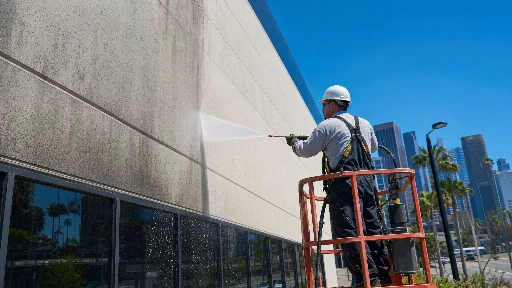
Commercial pressure washing for a Los Angeles building exterior typically runs between $0.08 and $0.35 per square foot, depending on surface type, soiling level, and access requirements. For a 10,000-square-foot parking structure or building facade, that puts most projects in the $800 to $3,500 range for a single service visit. The wide spread reflects real variables: a straightforward concrete apron is nothing like a three-story glazed facade with decorative scoring. And in Los Angeles, where buildings face salt air from the Pacific, diesel particulate from the 405, and seasonal Santa Ana wind-driven grit, pressure washing isn't optional maintenance. It's what keeps your asset from looking like a neglected one.
MNZ Commercial Cleaning Services has been handling pressure washing for Los Angeles commercial properties since 1979. This guide breaks down how costs are structured, what variables move the number up or down, and how to make sure you're comparing proposals that actually cover the same work.
Surface Material and Its Role in Commercial Pressure Washing Prices
Commercial properties in Los Angeles present a wide range of surface materials, and the surface material determines both the technique and the final price. Stucco is one of the most common exterior finishes on commercial buildings throughout the Valley and the Westside; it requires low-pressure or soft-wash technique to avoid erosion and paint separation. Siding panels, including fiber cement and wood composite siding common on retail and medical office buildings, need careful pressure control to prevent water infiltration behind the cladding. High-pressure washing on siding that wasn't designed for it causes long-term damage that far exceeds the cleaning cost. Standard concrete driveways and parking lot surfaces can handle significantly more pressure, but sealed or stamped concrete requires the same soft-wash consideration as facade surfaces.
Power washing and pressure washing are often used interchangeably, but power washing specifically refers to heated-water service, which is more effective for oil removal, heavy grease buildup, and algae. Algae buildup on shaded concrete, north-facing stucco, or parking deck surfaces is common in Los Angeles microclimates near the coast and in hillside locations. A professional pressure washing company should assess your building's surface materials and soiling conditions before quoting, not after the crew arrives.
How Commercial Pressure Washing Costs Are Structured
Most commercial pressure washing quotes come in as either a flat project fee or a per-square-foot rate. Understanding which pricing model you're looking at, and what it includes, matters more than the headline number.
Per-Square-Foot vs. Flat-Rate Pricing
Per-square-foot pricing is common for large, consistent surfaces like parking structures, loading docks, and concrete walkways. It scales predictably and lets you compare vendors on a common metric. The catch is that "per square foot" can mean different things: some vendors measure the surface being cleaned, others measure the building footprint, and some include dwell time with a cleaning solution while others quote water-only service.
Flat-rate pricing works better for complex jobs with multiple surface types, varied heights, or chemical pre-treatment requirements. A facade cleaning that includes a degreaser application, a pressure rinse, and a final detail pass is hard to scope per square foot because the time and chemical cost vary by condition, not by area. Get an itemized flat-rate quote that lists equipment, labor hours, chemicals, and any access fees separately.
Hourly Rates and Per-Square-Foot Pricing
Some vendors price commercial power washing by the hour rather than per square foot, particularly for smaller jobs or specialized surfaces. Hourly rates for licensed commercial pressure washing crews in Los Angeles typically run $150 to $250 per hour plus equipment costs. Whether hourly or per-square-foot, always ask what the final price includes and what triggers change orders. Parking lot cleaning with significant oil stains, for instance, often carries a surcharge if the original proposal didn't account for degreaser pre-treatment and hot-water service. Clarifying this upfront avoids surprises on the invoice.
Surface Type and Its Effect on Price
Concrete and asphalt, the most common surfaces in LA commercial parking areas and loading zones, come in at the lower end of the range, typically $0.08 to $0.15 per square foot for straightforward work. Brick, precast concrete panels, and architectural masonry cost more because they require lower pressure settings, more dwell time with chemical agents, and careful technique to avoid surface damage.
Glazed facades, metal cladding, stucco, and EIFS (exterior insulation and finish systems, common on 1990s and 2000s-era LA office buildings) require soft-wash or low-pressure techniques rather than traditional high-pressure washing. These surfaces can be damaged by high-pressure water, and improper technique can void facade warranties or trigger water intrusion problems. Choosing the right pressure washer settings for delicate surfaces and using degreasers where appropriate for soiling is part of what a professional commercial pressure washing company provides. Expect pricing in the $0.20 to $0.35 per square foot range for soft-wash work on these materials.
What Drives Costs Up on Los Angeles Commercial Properties
Several factors specific to the LA market add cost that a baseline square-foot rate won't capture.
Access and Height
A ground-level parking lot is the easiest and cheapest job. Any work above 10 to 12 feet requires boom lifts, scaffolding, or elevated pressure washing equipment. Rental and setup costs for aerial work platforms in Los Angeles typically add $300 to $800 per day to the project. Multi-story facades, parking deck levels above grade, and buildings with setbacks or obstructed access points all push cost up.
Water Recapture Requirements
Los Angeles sits in a water-sensitive region with strict stormwater regulations. The Los Angeles Regional Water Quality Control Board prohibits commercial pressure washing runoff from entering storm drains without capture and proper disposal. For most commercial jobs, this means your vendor needs wet-dry vacuum equipment, berms, and a compliant disposal method for the wash water. Vendors who skip this step are putting your property in violation of the Municipal Separate Storm Sewer System (MS4) permit. Water recapture adds $150 to $400 to a typical commercial pressure wash, but it's not optional in LA.
Grease and Oil Remediation
Loading docks, kitchen delivery areas, and parking structures near restaurants often need pre-treatment with commercial degreasers before pressure washing is effective. Hot water pressure washing, which uses water heated to 180 to 200 degrees Fahrenheit, is significantly more effective on grease and oil removal but also more expensive to operate. Expect a 20 to 40% cost premium for hot-water service on heavily soiled surfaces.
Frequency and Contract Structure
One-time service calls are always priced higher than recurring program pricing. A parking structure that might cost $2,500 for a one-time cleaning can often be brought into a quarterly maintenance program at $1,500 to $1,800 per visit, because the vendor can plan crew time and equipment deployment in advance. For Class A buildings in Los Angeles that need to maintain curb appeal for REIT reporting or tenant expectations, a service agreement almost always delivers better value than reactive single calls.
Pro tip: Schedule pressure washing for early morning, before business traffic peaks. Wet surfaces and equipment in traffic lanes create both safety hazards and tenant complaints. Most experienced commercial vendors will propose early-morning start times automatically, but confirm it in writing. A crew that starts at 10 AM on a Wednesday in a busy Century City parking structure is going to create problems.
Price Benchmarks by Service Type
Here's how typical commercial pressure washing jobs in Los Angeles are priced in 2026:
Concrete parking structures, per level: $400 to $1,200 per level depending on size and soiling. Expect the higher end for structures with significant tire marks, oil stains, or food service proximity. Power washing with heated water is standard for parking lot cleaning where built-up grease requires more than cold-water pressure.
Building exterior facade, per story: $500 to $2,000 per story. Single-story commercial buildings with straightforward brick or concrete block typically land under $800. Multi-story office buildings with architectural cladding, stucco, or siding and soft-wash requirements push to $1,500 or more per story.
Loading dock and dumpster pad deep clean: $350 to $900 per area, including degreasers as pre-treatment and hot-water service. Grease-heavy areas need hot water and oil removal chemistry, not just pressure.
Sidewalks, entryways, driveway aprons, and pedestrian hardscape: $0.10 to $0.20 per square foot. These are usually add-on line items to a larger building contract. Algae buildup on shaded walkways near building entrances is a common driver for more frequent service.
Graffiti removal: Varies widely by surface and paint type. Porous concrete may need chemical treatment before pressure washing is effective. Budget $150 to $600 for a typical graffiti remediation on a commercial surface. Painted surfaces require assessment before quoting to avoid damage to the underlying finish.
What a Good Commercial Pressure Washing Proposal Should Include
A bid that just says "$X to pressure wash the building" isn't a proposal. Before signing, confirm that your quote specifies the following.
Surface Scope and Access Method
The proposal should identify every surface to be cleaned, the square footage or unit count, and the equipment being used for each area. If aerial equipment is required, it should appear as a line item. Vague proposals hide the variables that drive overages.
Chemical Specifications
What pre-treatment chemicals are being used, at what dilution, and how will they be contained during application? This matters for Prop 65 compliance, for buildings with tenant outdoor areas, and for any surface with nearby landscaping or drainage. Any commercial power washing proposal for a property with stucco, siding, or other delicate surfaces should specify the PSI range and technique for each area.
Water Recapture and Disposal
The proposal should explicitly state how wash water will be contained and disposed of in compliance with LA's MS4 stormwater requirements. If it doesn't mention this, the vendor may be planning to let it run to the gutter, which is your liability, not theirs.
Insurance and Licensing
California requires contractors to hold a C-61/D-63 specialty license for pressure washing services above certain thresholds. Verify your vendor's license number through the California Contractors State License Board (CSLB) before signing. Also confirm general liability coverage of at least $1 million per occurrence and workers' compensation for all crew members working on your property.
According to BSCAI's 2026 industry data, labor accounts for 50 to 65% of a commercial cleaning contractor's revenue across all service types, including pressure washing. That means a bid that's dramatically lower than competitors often reflects either uninsured labor, skipped compliance steps, or equipment that won't perform reliably on your property.
FAQ: Commercial Pressure Washing Costs in Los Angeles
How often should a Los Angeles commercial building get pressure washed?
For most commercial buildings, quarterly service for high-traffic ground-level surfaces like parking areas, driveway aprons, and entryways is the right baseline. Building facades typically need annual or semi-annual service, depending on proximity to traffic corridors and exposure to salt air. Buildings near the 405, the 10, or within a mile of the coast accumulate grime and algae faster. Work with your cleaning vendor to assess frequency based on your specific location and building materials.
Does pressure washing damage building facades or landscaping?
High-pressure washing on the wrong surface absolutely causes damage. EIFS, stucco, siding, and aged masonry require low-pressure or soft-wash techniques to avoid damage to the surface finish or underlying structure. Landscaping near wash areas should be rinsed with plain water after service to remove chemical residue. A professional commercial pressure washing company will assess your surface material before quoting and specify the technique in writing. If a vendor doesn't ask about your facade material before quoting, that's a red flag.
Are LA properties required to capture pressure washing runoff?
Yes. The Los Angeles Regional Water Quality Control Board's Municipal Separate Storm Sewer System (MS4) permit prohibits commercial pressure washing runoff from entering storm drains. Your vendor is required to capture and properly dispose of wash water. Properties where runoff is allowed to flow to storm drains are in violation and can face fines. Confirm your vendor's water recapture method before work begins, and get it documented in the service agreement.
What's the difference between pressure washing and soft washing for commercial buildings?
Pressure washing uses high-pressure water (typically 1,500 to 3,500 PSI) to remove dirt, stains, and buildup mechanically. Soft washing uses low-pressure water combined with cleaning agents to break down soiling chemically before rinsing at low pressure. Soft washing is required for EIFS, siding, stucco, and any surface where high-pressure water could force moisture behind cladding or cause surface erosion. The choice of technique should be based on your building's materials, not just vendor preference or equipment availability. Power washing adds heated water to the equation, which helps with degreasers and oil removal on concrete and masonry surfaces.
MNZ Commercial Cleaning Services provides commercial pressure washing for Los Angeles office buildings, parking structures, retail properties, and multi-tenant commercial facilities. Our crews are licensed, insured, and trained on stormwater compliance requirements specific to the LA region. We've been serving commercial properties here since 1979. Call (818) 480-9316 or reach out online to get a proposal for your building.
Related Reading
How Should Class A Buildings Handle Parking-Structure Cleaning in Los Angeles?
What Does Commercial Cleaning Cost Per Square Foot in Los Angeles in 2026?
Transform your space into a clean and welcoming environment with MNZ. Contact us today to schedule a consultation and get a quote for our professional cleaning and maintenance services.
.jpg)


