
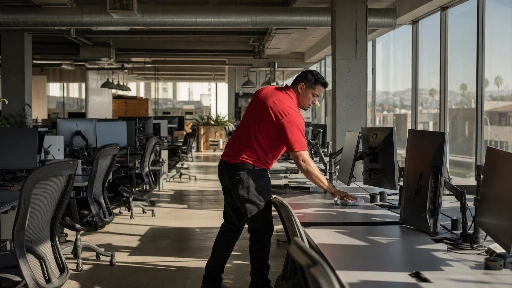
Cleaning a coworking or flex space at scale without member complaints comes down to one thing: timing. The ISSA's 2026 facility services benchmark reports that coworking facilities generate 40% more cleaning labor hours per square foot than traditional private offices, because the shared-surface turnover rate is dramatically higher. Hot desks, phone booths, conference rooms, and kitchens cycle through dozens of different users every day. A cleaning program built for a conventional single-tenant office will not hold up. The right program uses scheduled task blocks, mid-day attendant coverage, and a clearly documented cleaning plan your members can actually see. MNZ Commercial Cleaning Services has managed janitorial services and commercial office cleaning for shared-use facilities across Los Angeles, Southern California since 1979.
Why Standard Office Cleaning Schedules Fail in Coworking Environments
Traditional office cleaning runs on a simple model: clean after business hours, done. That model assumes a fixed tenant population using fixed workstations that stay clean between uses. Coworking spaces and flex office environments break every one of those assumptions. Shared workspace, hot desking, and flexible membership models mean the occupancy profile of your facility changes every hour.
A hot desk in a busy Los Angeles coworking facility might see eight different members in a single day. A phone booth gets used for dozens of calls. The shared kitchen runs from 7 AM through 8 PM. Conference rooms book back-to-back with no buffer time for cleaning between sessions. By the time your after-hours crew arrives at 7 PM, the facility has accumulated a full day of shared-surface contamination that members experienced all day. An executive suite or touchdown space compounds this: members using these spaces expect hotel-grade cleanliness, not standard office cleaning service.
Cross-contamination is an especially acute risk in shared office spaces. Without a structured disinfection protocol covering all high-contact touchpoints between user sessions, illness transmission spreads rapidly through a membership community. A professional cleaning company with a coworking-specific protocol addresses cross-contamination as a primary operational concern, not an afterthought.
The Member Complaint Cycle
Member complaints about cleanliness follow a predictable pattern. First comes the passive feedback: members bring their own wipes, clean their own desks visibly, or mention the kitchen to front desk staff. If nothing changes, that passive feedback becomes active complaints to the community manager. Then it shows up in member surveys and, eventually, on Google reviews. For coworking operators in Los Angeles, where the shared workspace market has abundant options, cleanliness complaints translate directly to churn and membership cancellations.
The way to break that cycle is to make cleaning visible, consistent, and member-oriented. That means members see it happening, it happens on a schedule they can predict, and the high-touch surfaces they care most about are addressed specifically by your commercial cleaning company or in-house janitorial staff.
The Three-Layer Cleaning System for Coworking Facilities
Effective coworking space cleaning runs on three synchronized layers: an overnight deep clean, daytime attendant coverage, and member-accessible spot-clean stations. Skipping any layer creates gaps that show up as complaints. This three-layer commercial cleaning approach is the standard recommended by ISSA for high-turnover shared office environments.
Layer 1: Overnight Deep Clean
The overnight janitorial program covers everything that needs time, equipment, or disruption-level noise: floor scrubbing, restroom deep clean, conference room disinfection, kitchen appliance cleaning, and trash consolidation. This is the full-reset that gets the shared workspace facility to a baseline each morning. Green cleaning products and microfiber systems reduce chemical residue while meeting disinfection standards.
Key overnight tasks for coworking and flex office facilities:
Layer 2: Daytime Attendant Coverage
This is the layer most coworking operators skip, and it is the source of most member complaints. A day porter or daytime cleaning attendant, typically working 3 to 4 hour blocks during peak hours, handles the mid-day accumulation that the overnight program cannot address. Day porter service is the backbone of any effective shared office cleaning program in Los Angeles.
Daytime attendant and day porter service tasks:
The visible presence of a daytime attendant does something beyond the cleaning itself: it signals to members that the facility takes cleanliness seriously. That perception matters as much as the actual cleanliness level in preventing complaints.
Pro tip: Give your daytime attendant a simple task checklist that doubles as a sign-off log. Post it in the kitchen or near the front desk where members can see it. A visible "Kitchen cleaned at 10:45 AM" timestamp changes the perception of a shared kitchen dramatically, even on days when usage is heavy.
Layer 3: Member-Accessible Spot-Clean Stations
The third layer puts the cleaning tools directly in members' hands. Spot-clean stations at every workstation cluster, in every conference room, and in the kitchen reduce the accumulation that builds between attendant passes. These are simple: a dispenser of individually wrapped disinfectant wipes, a small spray bottle of antimicrobial surface disinfectant, and a microfiber cloth. Members who want to sanitize their workspace before they sit down can do it without asking anyone.
This is not a replacement for professional janitorial service. It is a gap-filler that keeps your facility from failing between scheduled cleaning service intervals and reduces the number of complaints that come from members who had a bad experience the moment they sat down.
High-Touch Surface Protocols: The Specific Areas That Drive Most Complaints
Coworking member complaints cluster around a predictable set of high-touch zones. Addressing these specifically, with documented frequency and EPA-registered disinfectants, will resolve the majority of cleanliness friction in any shared office space. Infection control best practices from the CDC identify shared desks, keyboards, door handles, elevator buttons, kitchen faucets, and restroom fixtures as the highest-priority touchpoints in any workplace cleaning protocol.
Shared Kitchen
The kitchen is the single highest-complaint zone in any coworking facility or business center. The combination of food odors, dish accumulation, appliance residue, and countertop spillover creates conditions that deteriorate within hours. For a Los Angeles coworking space with 100 or more daily members, the kitchen needs professional attention at a minimum three times during the operating day: morning setup, midday reset, and end-of-day clean. The overnight janitorial crew handles the deep appliance clean. A commercial cleaning company serving coworking spaces should have a kitchen-specific protocol that covers food safety as well as cleanliness.
Conference Rooms
Conference rooms accumulate coffee cups, whiteboard marker residue, and surface contamination from back-to-back use. A room that's used from 9 AM to 5 PM without a cleaning reset between sessions ends the day with a full day of surface contamination on the table. The standard that works is a 10-minute reset between bookings when schedule gaps allow, and a full disinfection as part of the overnight program. For facilities that book rooms back-to-back with no gaps, a mid-day attendant pass between noon and 2 PM catches most of the accumulation.
Phone Booths and Focus Rooms
Phone booths have the worst air turnover of any area in a coworking facility. High usage and poor ventilation mean that disinfection frequency matters beyond surface cleanliness. The CDC's 2026 guidance on shared workspaces recommends disinfecting enclosed shared spaces at minimum twice daily during periods of heavy use. For Los Angeles County coworking and flex office facilities running high occupancy, that means morning and late-afternoon disinfection passes by the daytime attendant using an EPA-approved sanitization solution. Electrostatic disinfection of phone booths on a weekly basis can supplement surface wiping for a more thorough kill on high-contact surfaces.
Cleaning Plan Documentation: What Operators and Members Both Need
One of the fastest ways to reduce member complaints is transparency about your cleaning schedule and janitorial protocols. When members can see a posted cleaning schedule, a completed task log, or a QR-code link to the facility's cleaning plan, they have a different relationship with the facility's cleanliness. They know what's been done and when. Complaints tend to come when members feel they don't know whether anything is being maintained by the commercial cleaning service.
A basic cleaning plan document for a coworking or shared office facility should include:
According to BSCAI's 2026 client satisfaction survey, facilities that shared cleaning documentation with tenants or members reported a 34% reduction in cleanliness complaints compared to those that did not, with no change to the actual janitorial cleaning program. The documentation itself changes the perception.
Scaling Cleaning Across Multiple Coworking Locations in Los Angeles
For operators running two or more coworking or flex office locations across the Los Angeles metro area — whether in DTLA, West LA, Silicon Beach, the San Fernando Valley, or the South Bay — the challenge is consistency. A member who uses your Culver City location and your DTLA location expects the same cleanliness standard at both. That requires a commercial cleaning company or janitorial service contractor who can staff and supervise both consistently, run the same protocols at both, and report from both with unified documentation.
Multi-site operators should look for a vendor with demonstrated experience managing janitorial service programs across multiple commercial buildings and shared office spaces, a supervisory layer (not just crew), and a reporting system that rolls up across locations. The per-site cost for a well-structured multi-location commercial cleaning program is typically 8 to 12% lower than managing separate single-site vendors, because scheduling and supply logistics consolidate across the portfolio.
Standardized product kits help here too. When every location uses the same EPA-registered disinfectants, microfiber systems, and floor care products, crew members who rotate between sites already know the cleaning protocol. Training costs drop, onboarding new janitorial staff at any location goes faster, and you eliminate the inconsistency that comes from each site manager ordering cleaning supplies independently.
MNZ Commercial Cleaning Services manages janitorial and day porter programs across multiple commercial properties and shared office spaces throughout Los Angeles. If your coworking operation needs a commercial cleaning program built for shared-use environments at the scale you're running, book a walkthrough of your facility and get a custom cleaning proposal.
FAQ
How often should a coworking space be cleaned per day?
A coworking facility or shared office space with 100 or more daily members needs a minimum of three professional cleaning intervals per operating day: an overnight deep clean covering all surfaces, a daytime attendant or day porter program covering kitchens, restrooms, and high-traffic areas during peak hours, and a mid-afternoon reset pass. Phone booths and enclosed focus rooms should be disinfected at minimum twice daily during heavy-use periods. ISSA guidelines for high-occupancy shared workspaces support this three-interval cleaning frequency.
What's the biggest source of member complaints about coworking cleanliness?
The shared kitchen is consistently the highest-complaint area in any coworking space or flex office, followed by restrooms and conference rooms. The common thread is shared surfaces that accumulate visible contamination between cleaning passes. The fastest fix is adding a day porter with a defined kitchen circuit during peak hours, combined with member-accessible disinfectant wipe stations at each workstation cluster. A commercial cleaning company familiar with coworking environments knows how to structure this program.
How much does coworking space cleaning cost in Los Angeles?
A complete coworking cleaning program covering overnight deep clean plus 3 to 4 hours of daytime attendant or day porter coverage typically runs $4,000 to $8,000 per month for a 10,000 to 20,000 square foot shared office space in Los Angeles. Larger facilities with higher member counts fall in the $8,000 to $15,000 range. These figures assume a full three-layer janitorial service program. Overnight-only programs cost significantly less but generate proportionally more member complaints. Janitorial service for coworking spaces in Los Angeles typically runs higher than standard office cleaning due to the higher cleaning frequency required.
Can one cleaning vendor handle multiple coworking locations across LA?
Yes, and it's the better operational choice for multi-site operators across Los Angeles. A single commercial cleaning company that understands your cleaning standards and member expectations can apply consistent janitorial protocols across all locations, provide unified reporting, and coordinate supply logistics centrally. Multi-site contracts also typically come with better pricing than managing separate cleaning service vendors at each location.
Related Reading
What Cleaning Standards Do Class A Office Tenants in Los Angeles Expect?
Transform your space into a clean and welcoming environment with MNZ. Contact us today to schedule a consultation and get a quote for our professional cleaning and maintenance services.
.jpg)


