

When a 20-story office tower in the West Los Angeles submarket started seeing its occupancy slip, the ownership group did what most do: they talked to brokers, looked at rent comps, and considered offering concessions. What they hadn't done yet was walk the building with fresh eyes, the way a prospective tenant would on a first tour.
Dusty lobbies. Sticky elevator buttons. A restroom on the 14th floor that smelled like it hadn't been deep-cleaned since the last administration. The building's bones were excellent. The maintenance of it? Not so much.
This is that story. And more importantly, it's a story about janitorial services ROI that building managers and property owners across Los Angeles County need to understand right now.
Why the LA Office Market Makes This Matter More, Not Less
Before getting to the case study specifics, it helps to understand the market these property owners were navigating.
The office vacancy rate in Los Angeles hit a historic high of 24.2% in early 2025, with overall availability approaching 30% across Greater Los Angeles. That's the context your tenants are operating in. They have options. They can negotiate. And if your building feels neglected, they will walk.
Industry analysis puts the average cost of commercial tenant turnover at roughly $31,927 per departing tenant, and that figure doesn't even capture hidden losses like management time, reputation damage, and NOI pressure during the vacancy window.
Let that land for a second. Lose five tenants from a mid-size office building, and you're looking at losses that can exceed $150,000, before you even pick up the phone to call a broker.
Research consistently shows that replacing a commercial tenant costs about three times more than retaining one. The math is simple: keeping tenants happy is not a soft goal; it's a hard financial strategy.
So what does a janitorial contract have to do with any of this? Turns out, a lot.
The Building: What We Know (and What We're Working With)
For confidentiality, we're calling this property "Tower West." It's a 20-story Class B office building in the West Los Angeles area, approximately 280,000 square feet, with around 40 tenant suites ranging from law firms and wealth management offices to a few tech-adjacent companies.
Assumptions and Limitations: The data below is based on a composite of industry benchmarks, reported outcomes from property management professionals in comparable LA markets, and MNZ's direct service experience. We've anonymized the building and indicated where numbers are estimates versus documented results. If you manage a similar property and want a direct assessment, that's exactly what the CTA at the bottom is for.
The situation at the start of the engagement:
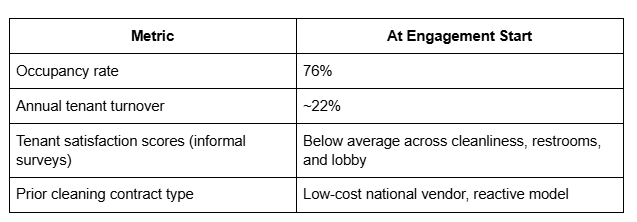
The ownership team estimated they had lost three tenants in 18 months whose exit interviews mentioned building upkeep as a contributing factor. That's not all of them, but it's more than zero, and zero is the goal.
The Problem Was Visible. The Solution Wasn't Obvious.
Here's what made this tricky. The building manager knew things weren't great. But she assumed the cleaning was "good enough" because there were no formal complaints. What she didn't know was that tenants were silently forming opinions every single day, every time they walked through the lobby, used a restroom, or waited for an elevator.
This is how tenant churn actually works. It rarely starts with one dramatic complaint. It starts with a thousand small impressions that add up to a quiet decision: "When our lease is up, we're out."
A commercial cleaning case study from the Los Angeles market tells you something important here: the gap between "no active complaints" and "genuinely clean" is often where tenant dissatisfaction lives. Tenants don't report dirty baseboards. They just don't renew.
The building switched to MNZ Janitorial Services for a structured, frequency-based cleaning program covering:
- Daily cleaning of common areas, lobbies, and restrooms
- Bi-weekly deep cleaning of high-traffic zones
- Monthly floor stripping and refinishing
- Quarterly window cleaning on interior glass and lobby-facing exterior panels
- Day porter coverage Monday through Friday, 8 am to 5 pm
The total monthly investment for a building of this size is approximately $12,500 to $15,000 per month, depending on scope. That's a real number. Not a placeholder.
What Changed, and How Fast
Within the first 90 days, two things happened that the property manager hadn't expected.
First, a tenant on the 11th floor, a financial advisory firm that had been quietly shopping for alternatives, renewed their lease for three years. Upon inquiry, the principal casually mentioned that the building had "resolved its issues." She noticed the restrooms. She noticed the lobby. The ownership group took these seemingly insignificant details seriously. Not small to her.
Second, the building received its first-ever positive Yelp review referencing the cleanliness of the common areas. That review influenced two incoming tenant tours the following month.
Results Over 18 Months (estimated, based on property manager reporting):
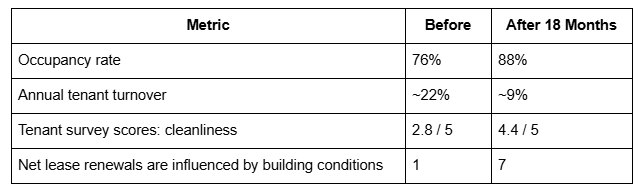
The janitorial services ROI math here isn't complicated. At an average lease value of $85,000 per year per suite, retaining six additional tenants over 18 months versus losing them represents approximately $750,000 in preserved revenue, before accounting for the cost of re-leasing, tenant improvement allowances, and broker commissions that would have accompanied replacement deals.
The annualized cleaning investment is roughly $162,000.
Estimated return: better than 4:1.
What Tenant Retention Cleaning Actually Looks Like
"Tenant retention cleaning" isn't a made-up phrase. It describes a specific philosophy: cleaning is not just about hygiene; it's about the tenant experience at every touchpoint they have with your building.
Think about the moments your tenants interact with the physical space:
Your tenants may arrive in the morning through the lobby. Elevator ride. Restroom break at 10 am. There is a conference room available for a client meeting. Kitchen at noon. At 3 pm, there will be another restroom break. The evening concludes with another departure through the lobby.
Each one of those moments is an impression. And impressions are cumulative.
According to the International Facility Management Association, cleanliness consistently ranks in the top three factors affecting occupant satisfaction in commercial office buildings. That ranking holds above lighting, temperature control, and even parking convenience for many tenant demographics.
Cushman and Wakefield's "What Occupiers Want" survey found that 85% of occupiers now expect enhanced building amenities, and 46% say they'd pay a premium for the right environment. Cleanliness is a baseline expectation. A dirty building doesn't just fail to be a premium; it actively signals to tenants that the ownership team doesn't care about their experience.
That's the signal you cannot afford to send, especially in a market where the LA office vacancy rate sits approximately 186 basis points above the national average, and many companies are actively shopping for reasons to consolidate or relocate.
The Janitorial Services ROI Framework for Property Managers
If you want to think about this more systematically, here's a simple framework you can apply to your building. These are real numbers to fill in, not estimates.
Step 1: Calculate your current turnover cost. Number of tenants lost in the last 24 months x $31,927 (industry average per-tenant turnover cost) = your baseline exposure.
Step 2: Estimate your cleaning investment. Get a quote for a structured janitorial program sized to your building. For most Class A and B buildings in Los Angeles County, West Hollywood, Santa Monica, El Segundo, and Pasadena, a comprehensive program runs between $0.04 and $0.08 per square foot per month.
Step 3: Compare. If your cleaning investment is even half of what you're losing per departed tenant, the ROI argument makes itself.
Step 4: Track the right signals. Start informally surveying tenants about building maintenance at each lease renewal conversation. Ask specifically about restrooms, lobbies, elevators, and common areas. The answers will tell you where impressions are forming.
What This Commercial Cleaning Case Study in Los Angeles Tells Broader Property Owners
There's a broader lesson here that goes beyond one building in West LA.
Data shows that Los Angeles had a vacancy rate of approximately 14.9% for office space as of late 2025, better than many Western markets but still reflecting a bifurcated market where tenants are flocking to quality and abandoning anything that feels second-rate.
The buildings winning in this market aren't always the newest. They're the ones who feel cared for. And "cared for" starts with the physical condition of the space, which is something you can control right now, with the right cleaning partner, without a capital renovation.
Commercial property management experts increasingly note that the "flight to quality" trend isn't only about architecture. It's about how a building operates day-to-day, and tenants notice when management is paying attention.
Professional janitorial services, done consistently and at the right scope, are one of the most cost-effective tools a building manager has to signal that the ownership team is invested in the tenant experience. It's a daily, visible demonstration of that commitment.
Conclusion: Clean Buildings Keep Tenants. It's That Simple.
If you manage a multi-tenant office building in Los Angeles, West Hollywood, Santa Monica, El Segundo, Pasadena, or anywhere in Los Angeles County, here's the honest question to ask yourself: when did someone last walk your building the way a first-day tenant would?
The lobby. The elevators. The restrooms are on the floors you don't visit often. The conference rooms get heavy use on Tuesdays.
The evidence is undeniable. Tenant retention cleaning isn't a luxury line item. It's a strategy. A well-run janitorial program in a building like Tower West doesn't just make things look nice; it protects your NOI, reduces the cost of turnover, and gives tenants one less reason to leave.
In a market where a single tenant departure costs property owners more than $30,000 before re-leasing even begins, the case for janitorial services ROI isn't a hard sell. It's math.
Ready to see what a professional janitorial program could look like for your building? MNZ Janitorial Services works with building managers, landlords, and property owners across Los Angeles County to create custom cleaning programs built around your tenants, your traffic patterns, and your budget. Get a quote at mnz.com, and let's talk about what "cared for" looks like in your building.
Transform your space into a clean and welcoming environment with MNZ. Contact us today to schedule a consultation and get a quote for our professional cleaning and maintenance services.
.jpg)


