
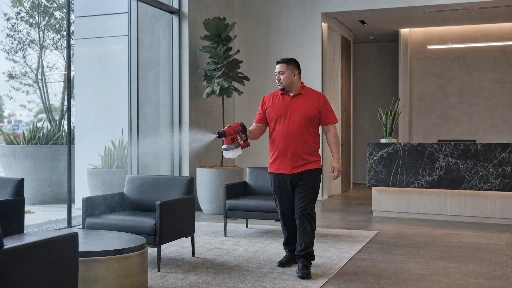
Multi-tenant commercial buildings should schedule electrostatic disinfection services when standard cleaning methods can't keep pace with shared-space germs and bacteria, when a confirmed illness event occurs among occupants, or when a high-density event significantly increases building traffic. The CDC's 2025 environmental cleaning guidance notes that electrostatic spray application reaches up to 99.9% of irregular surface area, compared to 70 to 85% for traditional cleaning methods. For office cleaning in towers, creative campuses, and mixed-use buildings across Los Angeles where dozens of tenants share lobbies, elevators, restrooms, and shared equipment, that coverage gap is the difference between containing an outbreak and spreading it.
What Is Electrostatic Spray Disinfection and How Does It Work?
Electrostatic spray technology works by charging disinfectant particles as they leave the nozzle. These positively charged disinfectant particles are attracted to surfaces, including the undersides, backsides, and crevices that conventional cleaning misses. The positively charged particles produce a mist that wraps around surfaces — door handles, chair undersides, HVAC grilles, grab bars, elevator button panels, and shared equipment that manual wiping cannot reach. This wrap-around effect is the core advantage of electrostatic disinfection over other disinfection methods that rely on direct-contact application.
This electrostatic cleaning approach doesn't change the chemistry of the disinfectant — it changes how thoroughly the charged disinfectant particles coat surfaces. A properly selected EPA-approved disinfectant, applied electrostatically to a clean surface, achieves the kill claims on its label. Applied over unclean surfaces, it delivers the same result as any disinfectant applied without prior cleaning: diminished efficacy. Commercial electrostatic disinfection services always follow, not replace, regular surface cleaning.
Comparing electrostatic disinfection methods to traditional cleaning methods
Traditional cleaning methods — manual wiping, mop-and-bucket disinfecting, spray-and-wipe protocols — achieve 70 to 85% coverage on complex surface geometry. Electrostatic spray reaches 99.9% because the charged disinfectant particles coat surfaces from all angles, including the wrap-around coverage that defines the disinfection method. For shared equipment like elevator call panels, restroom fixtures, break room appliances, and door handles that rotate through hundreds of daily contacts, that coverage gap matters. Electrostatic disinfection services close it.
Other advanced disinfection methods — UV-C light, fogging, and manual hydrogen peroxide wipe-down — each have specific applications. UV-C works well on exposed, line-of-sight surfaces. Traditional fogging distributes disinfectant but without the charged disinfectant particles that ensure surface adhesion. Electrostatic spray combines broad coverage with guaranteed surface contact, making it the preferred commercial disinfection service for multi-tenant buildings where consistency and documentation are required.
Limitations of electrostatic cleaning
Electrostatic cleaning is a surface-level disinfection tool. It doesn't filter air, doesn't penetrate fabrics, and doesn't address contamination inside HVAC ductwork. For buildings dealing with airborne pathogen transmission, pair electrostatic service with MERV-13 or HEPA filtration upgrades, air scrubbers, or UV-C air treatment. Maintaining workplace hygiene and cleanliness requires a layered approach — electrostatic technology is one layer, not a complete disinfection solution.
When Multi-Tenant Buildings Need Commercial Disinfection Services
After a confirmed illness event among tenants
A confirmed outbreak of a communicable illness is the clearest trigger for electrostatic disinfection services. Whether it's a COVID-19 cluster, a norovirus incident in a shared cafeteria, or a flu wave running through a high-density floor, OSHA's General Duty Clause requires employers to provide a workplace free of recognized hazards. When germs and bacteria have moved through a shared building, documented advanced disinfection provides concrete evidence to tenants, insurers, and regulators that the hazard has been addressed.
At MNZ Commercial Cleaning Services, our building services team has responded to illness-event calls from property managers across Los Angeles since 1979. The typical disinfection protocol: identify affected zones, complete a thorough surface cleaning pass first, then apply electrostatic spray disinfection with a dwell time appropriate to the pathogen. For COVID-19 and influenza A/B, most EPA-approved disinfectants require a 1 to 4 minute dwell. For norovirus, look for disinfectants with norovirus kill claims and a 3-minute minimum dwell.
Before and after high-density events
Building-wide events, tenant appreciation days, and conference events in shared spaces all bring high visitor traffic to lobbies and shared equipment. Scheduling electrostatic disinfection services before an event establishes a clean baseline. Scheduling commercial disinfection services after resets the germ and bacteria load before it migrates to tenant floors.
Property management companies operating Class A assets increasingly write commercial electrostatic disinfection services into their event-management procedures. Employees and customers in Class A buildings expect documented workplace hygiene and consistent cleanliness standards as a baseline for premium commercial space.
Seasonal schedules and routine cleaning cycles
Many facility managers schedule electrostatic disinfection services quarterly, with additional passes at the start of flu season (October through November) and at the conclusion of major tenant move cycles. Integrated with routine cleaning programs, this schedule keeps the surface germ load within safe limits without allowing buildup. Annual lease renewals often trigger a full common-area disinfection cycle: freshly documented disinfection records give tenants a concrete reason to renew.
Electrostatic Spray Technology: Logistics for Multi-Tenant Buildings
Coordinating access with tenants
Multi-tenant buildings add coordination complexity that single-tenant properties don't have: multiple lease agreements, multiple tenant-imposed restrictions, and multiple after-hours windows. The most effective approach designates common areas as primary scope and schedules individual tenant floors separately, with 30 to 72 hours advance notice per suite. Common areas, lobbies, elevator cabs, stairwells, shared restrooms, and shared equipment can almost always be handled outside business hours without tenant coordination.
Choosing disinfectant chemistry for safer environments
Not all EPA-approved disinfectants are appropriate for all surfaces. Quaternary ammonium compounds (quats) address most common germs and bacteria but can leave residue on certain finishes. Hydrogen peroxide-based disinfection solutions are effective against a broader pathogen spectrum and leave no residue. Citric acid-based formulations are gaining traction in LEED-certified commercial facilities where low-toxicity cleaning products and environmental compliance are requirements.
Request the EPA registration number and Safety Data Sheet from any electrostatic spraying service provider before they arrive. For high-traffic office cleaning and healthcare facilities, verify that your selected disinfectant solution carries kill claims for the specific pathogens of concern, including COVID-19, influenza, and norovirus. This documentation is standard practice and protects you with tenants, insurers, and regulators.
What a qualified electrostatic sprayer crew looks like
A qualified commercial electrostatic disinfection services crew carries properly calibrated electrostatic sprayer equipment (30 to 40 microns is the effective range for the mist that wraps around surfaces), uses EPA-approved disinfectants appropriate to the pathogens of concern, and documents the service with a written scope, product SDS, and application record. They must be trained on dwell times: wiping surfaces before the dwell period expires is one of the most common errors that reduces efficacy and negates the value of advanced disinfection.
A qualified electrostatic spraying service crew also trains on the limitation of the disinfection method: surfaces must be clean before electrostatic spray application. Germ-laden bioburden on unclean surfaces blocks the charged disinfectant particles from reaching the surface. This is why a complete electrostatic disinfection service always includes a pre-clean janitorial service step before the electrostatic sprayer is deployed.
What Commercial Electrostatic Disinfection Services Cost in Los Angeles
Electrostatic disinfection services for commercial buildings in Los Angeles typically range from $0.08 to $0.18 per square foot for common-area applications. Full-building service inclusive of individual tenant floors runs $0.12 to $0.25 per square foot, reflecting the coordination and access overhead. These rates reflect the BSCAI 2026 commercial cleaning labor benchmarks, where labor accounts for 50 to 65% of total service cost.
For a 100,000 square foot Class A office building, a common-area electrostatic spray pass typically runs $8,000 to $18,000 depending on scope. Frequency discounts are available for quarterly or monthly commitments, and portfolio pricing can reduce per-building costs for multi-property management clients.
When comparing bids, ask each electrostatic spraying service provider to specify areas covered (including door handles, elevator cabs, shared equipment, and corridor touchpoints), the disinfectant solution with EPA registration number, dwell time protocol, and crew size. A low-cost bid that excludes high-touch areas is a different product from a comprehensive commercial disinfection service. If you already work with a commercial janitorial services provider maintaining your property, coordinating electrostatic cleaning through the same provider reduces scheduling friction.
Frequently Asked Questions
How long does electrostatic disinfection service take for a commercial floor?
A 10,000 square foot commercial floor requires 30 to 60 minutes of active electrostatic spray application, plus dwell time of 10 to 30 minutes depending on the disinfectant used. For a full common-area pass on a 10-story building, expect a 4 to 8 hour service window depending on building configuration and crew size.
Can employees and customers stay in the building during electrostatic disinfection services?
Employees and customers should vacate the area being treated and remain out for the full dwell period. For common areas, this typically means restricting access for 30 to 60 minutes. Most electrostatic spraying service providers schedule cleaning during evenings or weekends to minimize workplace disruption. OSHA's General Industry standards require adequate ventilation during and after application of disinfecting agents.
Does electrostatic disinfection replace routine cleaning and janitorial services?
No. Electrostatic disinfection services are a supplemental layer, not a substitute for routine cleaning. Daily janitorial services, restroom cleaning, high-touch wiping on door handles and elevator buttons, and trash removal must continue at full frequency. Electrostatic cleaning works best on surfaces that have already been cleaned through regular janitorial services. Think of it as targeted disinfection layered on top of a solid routine cleaning program. These are complementary disinfection methods, not competing ones.
What EPA-approved disinfectants are used in an electrostatic spraying service?
EPA-approved disinfectants on List N are effective against SARS-CoV-2 and other pathogens. For commercial electrostatic spray disinfection, look for products with explicit label language approving electrostatic application and appropriate dwell times. Popular commercial electrostatic disinfection services use quaternary ammonium compounds, hydrogen peroxide-based disinfection solutions, and citric acid-based cleaning products safe for healthcare facilities and office cleaning environments. Your electrostatic spraying service provider should supply the EPA registration number and SDS before any application.
MNZ Commercial Cleaning Services has been providing commercial cleaning and disinfection to property managers, facilities directors, and building owners across Los Angeles since 1979. To discuss electrostatic disinfection services for your multi-tenant building, call (818) 480-9316 or visit Request a quote
Related Reading
What Cleaning Standards Do Class A Office Tenants in Los Angeles Expect?
Transform your space into a clean and welcoming environment with MNZ. Contact us today to schedule a consultation and get a quote for our professional cleaning and maintenance services.
.jpg)


