
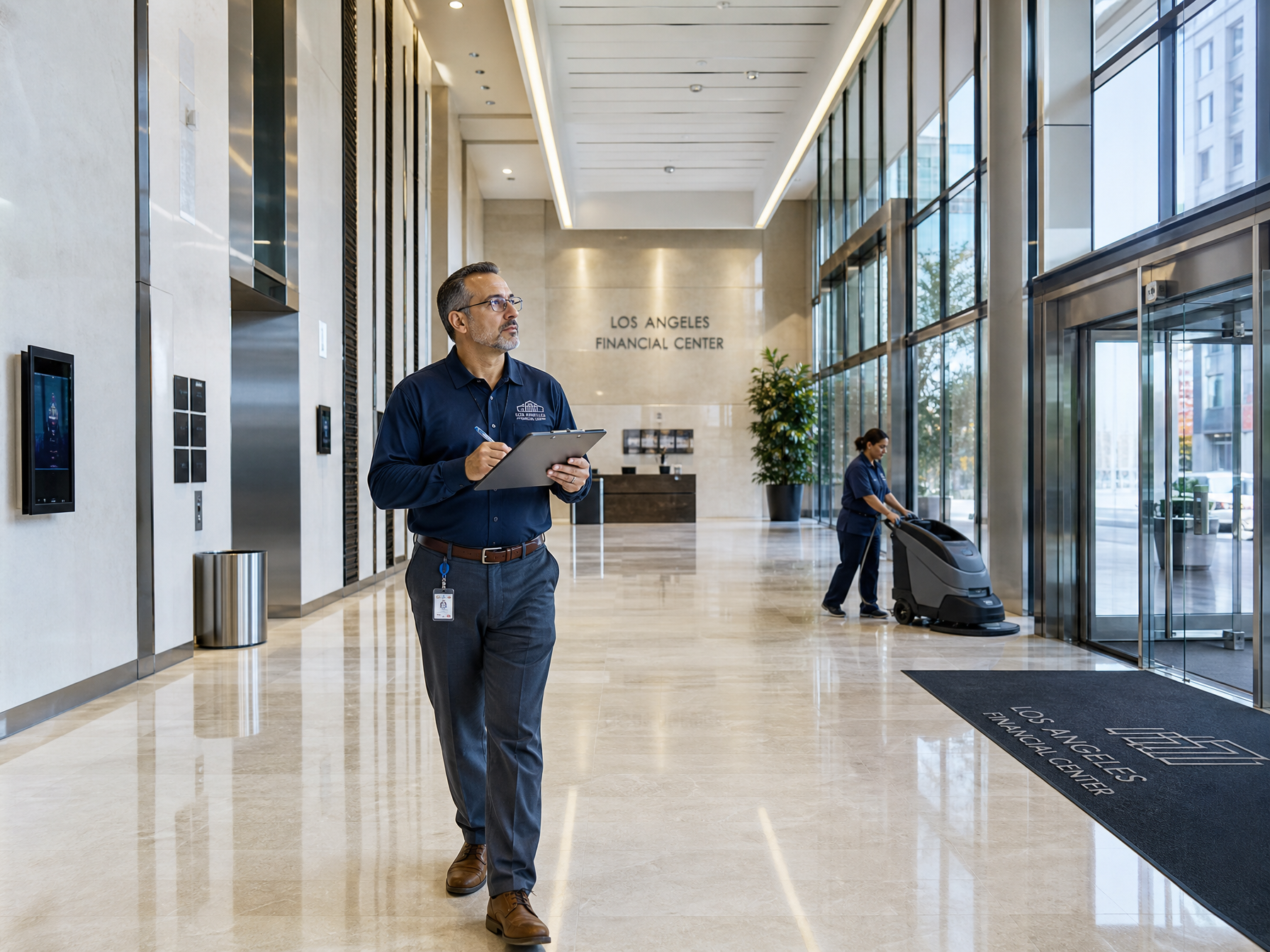
A facilities audit or inspection can surface thousands of dollars in deferred maintenance liability, code violations, or operational deficiencies in a matter of hours. For commercial building owners, property managers, and facility directors considering or managing commercial real estate in Los Angeles, CA, preparing a commercial building for a facilities inspection is not a reactive scramble. It's a systematic, documentation-driven property assessment process — the same due diligence that protects property owners investing in commercial real estate — and it begins weeks before an inspector, a lender's property condition assessor, or a building department official sets foot in your facility. The BSCAI reports that facility management labor represents 50 to 65 percent of building operating costs, which means inspection findings in that category can materially affect your NOI, your insurance premiums, and your building's market value. Here's what a thorough building assessment and inspection preparation process looks like for commercial buildings in Los Angeles and across Los Angeles County.
MNZ has provided commercial cleaning, janitorial services, and custodial services to office buildings and commercial facilities across Los Angeles, CA and Southern California since 1979. We serve Los Angeles and our service area covers Los Angeles County and surrounding communities. We offer deep cleaning, recurring cleaning programs, scheduled cleaning, and pre-inspection cleaning services designed to help facility managers and property managers present their buildings at their best. Contact us to schedule a cleaning assessment or to get a free quote or free estimate for pre-inspection cleaning services.
Understanding What Type of Facilities Audit or Inspection You're Preparing For
Not all facilities audits are the same, and the building inspection process differs materially by inspection type. The preparation strategy for a commercial property in Los Angeles, CA should track to the specific inspection scope. Common property types requiring facility inspections and facility assessments include office buildings, multifamily residential and mixed-use developments, retail centers, industrial properties, and special-purpose facilities — and each may require a different inspection framework. The four most common categories are: building department compliance inspections (fire, life safety, accessibility, certificates of occupancy), lender and investor property condition assessments (PCAs), tenant improvement and occupancy inspections, and internal or third-party operational facilities audits. A building department inspector focuses on building codes, code compliance, code violations, and permit status. A PCA assessor focuses on capital expenditure, deferred maintenance, and roof/MEP system condition. An operational audit focuses on documentation, vendor performance, and facility management protocols. Know your audience before you build your preparation checklist.
Understanding the condition of a property before an inspection cycle begins allows facility managers and building owners to prioritize remediation and avoid surprise findings in the final report. Every inspection type concludes with a final report that identifies deficiencies, assigns severity ratings, and establishes timelines for corrective action. Preparing the commercial property in advance of that final report — rather than reacting to it after the fact — is the single most effective strategy for managing inspection risk in a Los Angeles commercial building.
Documentation Preparation: The Foundation of Any Successful Facilities Audit
Facility inspectors and property condition assessors spend as much time reviewing documentation as they do walking the property. A well-organized document package reduces the time an inspector spends in your building, signals a professionally managed facility, and limits the scope of follow-up requests. Preparing a commercial building for a facilities inspection in Los Angeles, CA starts with assembling a complete document package — including building plans, floor plans, maintenance records, and previous inspection reports — at least 30 days in advance.
Building Permits, Certificate of Occupancy, and Code Compliance Records
Every commercial building and commercial space in Los Angeles, CA must maintain current certificates of occupancy for every tenant suite and common area configuration. Any tenant improvement permits — TI buildouts, relocations, added demising walls, new electrical panels — must be finaled with the City of Los Angeles Department of Building and Safety (LADBS) or the relevant jurisdiction before an inspection. Open permits and unresolved code violations are among the highest-risk inspection findings in a commercial building facilities audit. Pull your full permit history from LADBS, cross-reference it against your tenant improvement records, and identify every permit that was pulled but not finaled. Addressing open permits and code violations before the inspection converts potential major findings into pre-resolved items. Note that older buildings in Los Angeles may also carry seismic retrofitting requirements under city mandatory ordinances — the inspection report will flag any open compliance obligations. Local regulations in Los Angeles County — including the City's mandatory seismic retrofit program, LADBS code compliance requirements, and applicable fire code provisions — should be reviewed at the start of any pre-inspection preparation process.
Maintenance and Service Vendor Records
Inspectors and property condition assessors will ask for HVAC service logs, elevator maintenance certificates, fire sprinkler inspection reports, backflow prevention test results, and roof warranty documentation. Maintenance records for all major building systems — including HVAC equipment, electrical systems, mechanical systems, plumbing, and life safety — should be consolidated and organized. In Los Angeles, CA, fire sprinkler systems must be tested annually per NFPA 25 standards, and elevators must be inspected by the California Department of Industrial Relations. If maintenance records are not organized and accessible before the inspection, the auditor will note the gap as a deficiency even if the underlying work was performed. Create a single document binder or shared drive folder organized by system: HVAC, plumbing, electrical, fire protection, vertical transportation, roofing, and structural. Confirm that every vendor has returned a signed service report for each visit in the past 12 months. The goal is to produce a property condition report that demonstrates active, documented building management. A commercial property with strong preventive maintenance records will consistently perform better in a facilities audit than one that relies on reactive repairs.
Janitorial and Custodial Service Documentation
A recurring question in operational facilities audits and property condition assessments is whether cleaning and custodial services are being performed consistently and to a documented standard. Inspectors may ask for your cleaning service agreement, your cleaning checklist or cleaning schedule, and evidence of quality control inspections. A commercial cleaning company that provides documented inspection logs, signed service confirmations, and a written cleaning plan is significantly easier to audit than one that operates on a handshake. MNZ provides documentation of all cleaning services performed in commercial buildings and commercial spaces we service across Los Angeles County. Contact us if you need documentation support before a scheduled facilities audit or inspection.
Physical Inspection Preparation: What Inspectors Look at First
Documentation passes a desk review; the physical condition of your commercial building passes the site inspection. Inspectors assess building condition across all major systems — structural, mechanical, electrical, plumbing, envelope, and life safety. In Los Angeles, CA, where seismic codes, Title 24 energy efficiency compliance, and ADA accessibility standards all carry enforcement weight, the physical preparation phase requires a structured property assessment walkthrough before the inspector arrives. Facility managers and property managers should conduct a pre-inspection walkthrough using a checklist that mirrors the inspector's own scope. The findings from this walkthrough allow building ownership to make informed decisions about what to repair, what to disclose, and what to include in a corrective action plan. Property condition assessments also evaluate environmental conditions that affect building performance — soil stability, drainage patterns, and proximity to environmental hazards — and these should be reviewed for any known site-level concerns before the assessor's visit.
Life Safety Systems: Fire, Egress, and Accessibility
Los Angeles commercial buildings must maintain fully functional fire alarm systems, exit signage, emergency lighting, fire extinguisher service, and clear egress paths per NFPA 101 and the Los Angeles Fire Code. Walk every exit stairwell, confirm exit signs are illuminated, confirm emergency lighting activates on power failure, and verify that no storage has accumulated in egress corridors or stairwells. Fire extinguishers must show a current annual service tag. ADA accessibility compliance — door widths, ramp slopes, restroom fixture heights, accessible parking ratios — should be spot-checked against ADA Standards for Accessible Design. Deficiencies in life safety and accessibility are among the highest-severity inspection findings in any Los Angeles commercial building inspection. These are also the categories where code violations carry the most immediate enforcement risk.
Restroom Conditions and Plumbing Systems
Restrooms are among the first spaces a facilities inspector physically checks in a commercial building. Inspectors look for functioning fixtures, proper water pressure, compliant ADA fixtures, ventilation, and evidence of regular maintenance. A commercial building in Los Angeles, CA that has restrooms showing deferred maintenance — leaking faucets, stained grout, non-compliant grab bar placement, cracked tile — will receive deficiency citations that require corrective action. Pre-inspection restroom preparation should include a deep clean of all restroom fixtures and surfaces, caulking inspection and repair, fixture function testing, and verification that all grab bars, toilet heights, and sink clearances meet ADA requirements. MNZ's pre-inspection deep cleaning services cover restrooms comprehensively — contact us to get a free quote for this scope.
HVAC, Mechanical, and Electrical Systems
Property condition assessors rate HVAC equipment and mechanical systems by age, building condition, and remaining useful life. Major systems in Los Angeles commercial buildings — HVAC, electrical systems, plumbing, and fire suppression — are all scored in both facility assessments and property condition assessments for capital planning purposes. In Los Angeles, CA, rooftop package units typically have a 15 to 20 year service life, and older buildings may face additional requirements tied to energy efficiency upgrades under Title 24. A pre-inspection HVAC service call by your licensed contractor should confirm that filters are clean, coils are operational, refrigerant charge is documented, and all units have current service records. Electrical panels should be inspected for open knockouts, non-compliant breaker labeling, and evidence of prior unauthorized work. Plumbing backflow preventers must carry current test certifications per Los Angeles County requirements.
Exterior, Roof, and Common Areas
The building's exterior and roof are significant components of a property assessment and building assessment for commercial buildings in Los Angeles, CA. Inspectors will assess the building envelope condition — roof membrane, drainage, penetration flashing, exterior cladding, and window systems — for deferred maintenance and remaining useful life. Property managers should pull the current roof warranty, confirm it is assignable to a buyer if the building is in a pre-purchase or acquisition review, and have a licensed roofing contractor provide a written condition assessment in advance. Exterior concrete, expansion joints, caulking at windows and curtain wall, and structural integrity concerns should also be documented. Parking areas and parking structures are scored separately — post-tensioned concrete decks require specialized inspection by a licensed structural engineer. Clean, well-maintained lobbies, corridors, and common areas communicate active facility management. A pre-inspection deep clean of all common areas, lobbies, elevator cabs, and high-traffic areas dramatically improves the visual presentation of the facility during the inspector's walkthrough.
Cleaning and Custodial Preparation for a Los Angeles Commercial Building Inspection
The physical condition of a commercial building during a facilities audit or inspection is partly a function of how well the building has been maintained on a day-to-day basis — and partly a function of what cleaning and custodial preparation happened in the 48 to 72 hours before the inspector arrived. Both matter. A building with regular inspections and a strong recurring cleaning program will require less pre-inspection remediation. A building with inconsistent janitorial services will need a more intensive pre-inspection deep clean to present well.
Pre-Inspection Deep Cleaning Scope for Commercial Buildings
A proper pre-inspection deep clean of a commercial building in Los Angeles, CA should cover: hard floor scrubbing, buffing, or recoating depending on floor type; carpet cleaning in all common areas and high-traffic corridors; restroom deep cleaning including grout, fixtures, and walls; elevator cab deep cleaning and inspection of threshold plates and door tracks; lobby glass, stone, and tile restoration cleaning; stairwell cleaning including handrails, landings, and wall surfaces; and cleaning of high-touch surfaces throughout the building including door handles, elevator buttons, and light switches. The scope should be proportional to the building's square footage, number of tenants, and the type of inspection. For buildings with food service or break room facilities, kitchen exhaust hood cleaning documentation should be current before the inspection. Contact us for a pre-inspection cleaning assessment and a free quote or free estimate for your property in the Los Angeles, CA area.
Restroom and Fixture Pre-Inspection Checklist
In the 24 to 48 hours before a facilities audit or inspection, every restroom in the commercial building should be serviced to a deep-clean standard: all fixtures scrubbed and sanitized, high-touch surfaces — door handles, faucets, flush valves, and paper dispensers — disinfected, floors mopped and grout cleaned, mirrors polished, walls spot-cleaned, and all dispensers restocked to full. Any minor fixture deficiencies — a loose grab bar, a slow drain, a running toilet — should be repaired before the inspection. Small deferred maintenance items in restrooms are disproportionately cited in facilities audits because they are visible, simple, and signal a pattern of neglect. We serve Los Angeles and can deploy pre-inspection cleaning teams across Los Angeles County on short notice — contact us to schedule a cleaning program before your next audit or inspection.
Documenting the Cleaning Program for the Inspector
When a facilities auditor asks about custodial services and janitorial services, the most compelling answer is a binder of documentation: a signed cleaning contract with scope, a cleaning checklist tied to each building area, quality control inspection logs for the past 12 months, and a cleaning schedule that specifies frequency for each building zone. If your commercial cleaning company cannot provide this documentation, that is both a preparation gap for the current inspection and a vendor management gap you should address. MNZ provides written cleaning plans, signed service confirmations, and quality control documentation for all commercial buildings and commercial spaces we service across the Los Angeles area. Contact us to request documentation support or to discuss upgrading your cleaning program before your next inspection.
Working with Your Building Operations Team Before the Facilities Audit
Facilities audits and inspections expose the existing conditions of a commercial building on a day-to-day basis, not just what can be staged for one morning. The preparation process for a commercial building in Los Angeles, CA should involve your entire building operations team — property management, engineering and maintenance, janitorial and custodial services, and any relevant vendors — at least 30 days in advance. The ultimate goal is to help property owners and building owners make informed decisions about capital planning, deferred maintenance prioritization, and long-term return on investment in building infrastructure.
Pre-Inspection Vendor Coordination
Contact every major service vendor — HVAC contractor, elevator maintenance company, roofing contractor, fire sprinkler testing company, and commercial cleaning company — and confirm that all outstanding service reports, inspection certificates, and compliance documentation are current and can be produced for the inspector. Identify any work orders that were submitted but not closed, and either close them or document why they are pending. A work order management log that shows active management of building systems and major building systems issues is a positive finding in an operational audit. An absence of a work order system, or a backlog of unresolved work orders, is a risk flag for any property condition assessment — particularly for multifamily, mixed-use, or large commercial real estate portfolios. Any active code violations or open compliance citations should be listed in the pre-inspection vendor coordination package with a status and expected resolution date.
Engineering and Maintenance Pre-Inspection Walkthrough
Your chief engineer or facilities manager should conduct a documented pre-inspection walkthrough using a checklist that covers every major building system: HVAC operation and filter status, electrical systems condition, mechanical systems function, plumbing systems including backflow prevention, life safety system operation, elevator function and documentation, and roof and exterior condition. Every deficiency identified in the pre-inspection walkthrough should be assigned to a vendor with a resolution date. Any deficiency that cannot be resolved before the inspection should be acknowledged in a written corrective action plan that you can present to the auditor. Inspectors and property condition assessors give more credit to a building management team that has identified and documented building condition deficiencies than to one that appears surprised by them. For buildings in downtown LA or elsewhere in Los Angeles County, this building assessment walkthrough typically takes one to two days for a mid-size commercial office building.
Frequently Asked Questions:
Facilities Audit and Inspection Preparation in Los Angeles
For a pre-purchase property condition assessment tied to a commercial real estate acquisition or financing, start 60 days out. For a building department compliance inspection or fire inspection, 30 days is a reasonable preparation window. For an internal operational audit or facility assessment, 21 days is sufficient if your documentation and vendor relationships are already well organized. The longer your preparation window, the more opportunity you have to resolve code violations, deferred maintenance, and documentation gaps before the inspection rather than receiving citations in the final report. Contact us today to schedule a pre-inspection cleaning assessment and get a free quote for your Los Angeles property.
Life safety systems — fire alarm, egress, sprinklers, emergency lighting — get the highest scrutiny in any building department or fire inspection. Property condition assessors focus on roof condition, HVAC equipment age and remaining useful life, deferred maintenance across all major systems, and open permits or code violations. Operational auditors focus on documentation: maintenance records, inspection reports, vendor contracts, and work order systems. Unlike residential inspections, commercial building inspections involve a broader scope of building systems and code compliance obligations under local regulations. In all cases, visual building condition and quality of the documentation package significantly affect the auditor's overall assessment.
A pre-inspection deep clean should cover hard floors, carpets, restrooms, elevator cabs, lobbies, stairwells, and high-touch surfaces throughout the building. High-traffic areas — lobbies, restrooms, elevator banks, and conference rooms — should be brought to a deep-clean standard, not just a nightly maintenance standard. The scope varies by building condition and square footage. MNZ offers pre-inspection deep cleaning services for commercial buildings and commercial spaces across Los Angeles, CA and Los Angeles County, from downtown LA to the San Fernando Valley. Contact us to schedule a cleaning program and get a free estimate. We serve Los Angeles and our service area covers the greater Los Angeles area.
Provide a written cleaning contract that specifies scope and frequency, a cleaning checklist tied to each area of the building, and quality control inspection logs from your commercial cleaning company. If your janitorial services vendor cannot provide signed service confirmations and inspection records, that is a gap you should address before the audit. MNZ is a licensed and insured commercial cleaning company you can trust — we provide complete cleaning documentation for all commercial buildings we service. Contact us to discuss documentation requirements for your upcoming facilities audit or inspection.
Yes, materially. Property condition assessors score deferred maintenance partly based on visual evidence of neglect. A commercial property with visibly dirty restrooms, stained carpets, and poorly maintained lobbies signals to a PCA assessor that other, less visible maintenance may also be deferred. A pre-inspection deep clean does not repair a structural integrity deficiency or resolve code violations, but it ensures that the building condition reflects its actual maintenance status — not a skewed impression created by accumulated soil, staining, or neglect. MNZ brings decades of commercial cleaning experience serving Los Angeles, CA buildings across all property types: office buildings, multifamily residential, retail centers, mixed-use, and industrial properties. Contact us to schedule a cleaning program or to get a free quote or free estimate today.
If you're preparing a commercial building in Los Angeles, CA for a facilities audit, a property condition assessment, or a building department inspection, MNZ Commercial Cleaning Services can support your preparation with pre-inspection deep cleaning, custodial services, and complete cleaning documentation for your property. Contact us at (818) 480-9316 to get a free quote or free estimate. We serve Los Angeles and our service area spans Los Angeles County and the greater Los Angeles region.
Related Reading
How to Write a Commercial Cleaning RFP for Los Angeles Properties (With a Bid Comparison Scorecard)
What Should a Commercial Cleaning SLA Include to Hold Your Vendor Accountable?
Transform your space into a clean and welcoming environment with MNZ. Contact us today to schedule a consultation and get a quote for our professional cleaning and maintenance services.
.jpg)


