

You have probably walked into a building and decided within thirty seconds whether you wanted to be there. Maybe the lobby smelled stale, the floors were dull, or the bathrooms were just one visit away from a health code conversation. You turned around, or, if you were a tenant already, you started looking for somewhere else to be.
That snap judgment happens every single day in office buildings, medical complexes, and multi-tenant properties across Los Angeles County. And it costs building owners real money.
This post is about the connection between clean buildings and the financial performance of commercial properties. It is not a soft argument about "impressions." It is backed by data, and the numbers are clearer than most property managers expect.
The Problem: Vacancy Costs More Than You Think
Here is the thing: most building owners focus on rent per square foot. Here is what they sometimes underestimate: the total cost of losing a tenant.
A BOMA International study found that the average cost to replace a commercial tenant, factoring in vacancy time, tenant improvement allowances, leasing commissions, and lost rent, runs between $50 and $150 per square foot, depending on the market. Los Angeles sits at the higher end of that range. For a 3,000 square foot suite, that is potentially $150,000 to $450,000 in replacement costs.
So what makes tenants leave?
According to the BOMA 2023 Experience Exchange Report, the top three reasons commercial tenants do not renew come down to unresponsive building management, unresolved maintenance issues, and poor building condition and cleanliness. Two of those three tie directly to how consistently the building is maintained.
The problem gets worse when you look at what tenants actually say they want. A survey by Kingsley Associates, one of the largest commercial tenant satisfaction research firms in the country, found that cleanliness of common areas ranked as the number one driver of overall tenant satisfaction, ahead of security, amenities, and even parking.
You read that right. Clean buildings outrank everything else in tenant satisfaction scores.
Why This Hits Different in Los Angeles
Los Angeles is a competitive leasing market. West Hollywood, Santa Monica, Pasadena, and El Segundo all have their own micro-market dynamics, but across the board, tenants in 2025 and 2026 have options. The post-pandemic flight to quality is real. Companies that are asking employees to come back to the office are picking buildings that justify the commute, and cleanliness is part of that justification.
CBRE's 2024 Americas Office Occupier Sentiment Survey reported that 78% of tenants said building amenities and maintenance quality now factor into lease renewal decisions more than they did before 2020. That is not a temporary trend. It reflects a structural shift in what the office is expected to do.
Property managers in El Segundo and Pasadena tell a consistent story: buildings that kept maintenance and cleaning standards high throughout and after the pandemic filled vacancies faster and held stronger rents than those that cut back.
What Regular Commercial Janitorial Services Actually Do for Retention
Here is the practical side of this. Consistent commercial janitorial services are not just about appearances. They affect the physical condition of the asset over time. Let me walk through the specific levers.
Tenant Complaints Go Down
When cleaning is consistent and professional, the volume of maintenance calls and tenant complaints drops. Building Management Solutions, a property management consulting firm, has reported that properties with scheduled janitorial programs see roughly 30 to 40% fewer tenant complaints related to building condition compared to properties relying on reactive cleaning. Fewer complaints means less friction in the management relationship, and that translates to smoother renewals.
Lease Renewal Rates Climb
The Building Owners and Managers Association published data showing that buildings rated "excellent" on cleanliness in tenant satisfaction surveys renew leases at rates 12 to 18 percentage points higher than buildings rated average or below. On a 10-unit building in Los Angeles, that difference could mean two or three additional lease renewals per cycle, compounding year over year.
New Tenant Attraction Is Faster
First-tour conversion matters. When a prospective tenant tours a building that smells clean, has bright lobbies, and shows no deferred maintenance, the decision timeline shortens. Property managers in West Hollywood who work with reliable commercial janitorial services consistently report that well-maintained buildings lease faster, sometimes 20 to 30 days faster than comparable properties in the same submarkets.
The Property Valuation Connection You Cannot Ignore
Here is where it gets really interesting for building owners and landlords. Commercial property is valued primarily on net operating income. NOI goes up when rents are stable or growing and vacancy is low. It also goes down when operating expenses balloon because of neglected maintenance.
There are two ways regular commercial janitorial services directly impact NOI and, therefore, property value.
First: Reduced capital expenditure
Floors, carpets, HVAC systems, restroom fixtures, and elevator interiors all degrade faster without routine cleaning and maintenance. The International Facility Management Association estimates that deferred cleaning and maintenance increases long-term capital costs by 15 to 25% compared to properties on regular programs. In real terms, you pay a few thousand dollars a month for janitorial and avoid a $40,000 carpet replacement or a $25,000 restroom renovation years earlier than necessary.
Second: NOI-driven cap rate compression
If your building's NOI is $600,000 and market cap rates in your Los Angeles submarket are 5.5%, your building is worth roughly $10.9 million. If you can reduce vacancy by even half a percentage point through better tenant retention and raise effective rents slightly because your building commands premium positioning, you might push NOI to $630,000. At the same cap rate, that is worth $11.45 million. That is a $550,000 increase in asset value from operational discipline, and a meaningful piece of that discipline is consistent building cleanliness.
Real estate advisors in Los Angeles County, including those at JLL and Cushman & Wakefield, regularly note that Class A and Class B buildings competing for the same tenants live or die on operational consistency. Clean buildings are not just nicer. They are categorically more competitive assets.
What "Regular" Actually Means in Practice
One of the most common mistakes building managers make is treating janitorial as a once-a-week checkbox. That is not commercial janitorial services. That is the bare minimum, and it does not produce the results described above.
A well-structured program for a multi-tenant commercial building in Los Angeles typically looks like this:
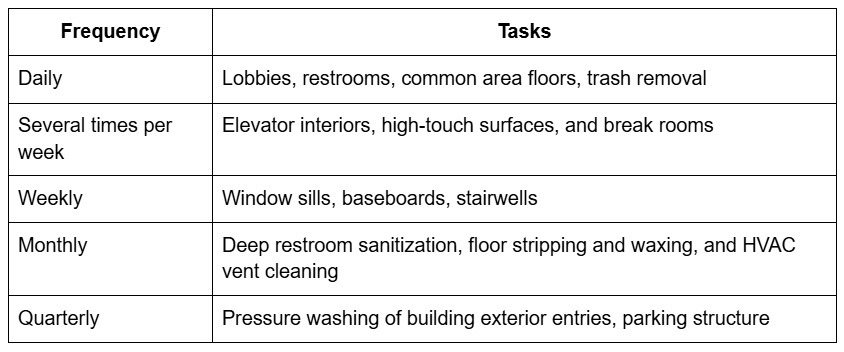
The specific frequency depends on traffic volume and building type. A 50-person office suite in Pasadena has different needs than a 200,000 square foot multi-tenant tower in downtown Los Angeles. But the principle is the same: scheduled and consistent beats reactive every single time.
"The buildings that consistently score highest on tenant satisfaction surveys are the ones where tenants never have to think about cleanliness because it is always handled," says a facilities operations manager quoted in a 2023 BOMA best practices report. "It becomes invisible in the best possible way."
Commercial Janitorial Services as a Competitive Strategy in the LA Market
Think about the submarkets MNZ serves: Los Angeles, West Hollywood, Santa Monica, El Segundo, and Pasadena. Each of these is a market where tenants have real choices. A creative agency in West Hollywood has viable alternatives within a five-mile radius. A tech company in El Segundo can stay or cross town. They are evaluating your building against others.
A clean building signals something specific to those decision-makers: it says management cares about the space, management is responsive, and this is a professional operation.
According to CoStar Group's 2024 national tenant survey data, buildings that scored in the top quartile for maintenance and cleanliness achieved average rental rates 8 to 12% higher than buildings in the bottom half of the same size and class category in comparable metro markets. If you are managing a 20,000 square foot building at $3.50 per square foot per month, and you can command $3.78 because your building is consistently well-maintained; that is nearly $7,000 in additional monthly gross income, or over $82,000 per year.
That is the competitive strategy. It is boring, but it works: show up every day, keep the building clean, and capture the premium.
How to Evaluate Whether Your Current Commercial Janitorial Services Are Doing the Job
Most building managers find out their cleaning program is falling short when a tenant complains. By then, the damage is usually already underway. Here is a better approach:
Use a quarterly inspection checklist
Walk every common area, restroom, lobby, and stairwell with specific criteria. Rate each on a 1 to 5 scale. A score below 3.5 on average should trigger a conversation with your provider.
Review tenant satisfaction surveys
If you are not sending annual or semi-annual satisfaction surveys to tenants, start now. Ask directly about the cleanliness of common areas. The Kingsley Associates survey model is a useful benchmark. Anything below a 4.0 out of 5.0 on cleanliness means you are likely losing points that matter.
Track complaint frequency
Log every call, email, or comment related to building condition. A well-run building should see near-zero cleaning-related complaints after the first few months of a consistent program.
Compare your provider to what is available
The LA County commercial cleaning market includes many options. If your current provider cannot give you a documented service schedule, inspection logs, and a consistent crew, you are probably not getting the results your building deserves.
Conclusion: Clean Buildings Perform Better, Full Stop
This is not a complicated argument. Buildings where tenants feel comfortable, see consistent upkeep, and never have to think about restroom conditions or dirty lobbies hold tenants longer, attract new ones faster, and command better rents. The data from BOMA, CoStar, Kingsley Associates, and IFMA all point in the same direction.
You are managing an asset that is worth millions of dollars. The operational investment in quality commercial janitorial services is a fraction of that value, and the return, measured in reduced vacancy, better lease renewal rates, and higher property valuations are some of the clearest ROI calculations in commercial real estate operations.
If you manage properties in Los Angeles County, West Hollywood, Santa Monica, El Segundo, or Pasadena, and you are not confident your current cleaning program is protecting the value of your asset, now is a good time to change that.
MNZ Janitorial Services works with building managers and property owners across Los Angeles County to build customized cleaning programs that protect asset value and keep tenants happy. If you want to talk through what a consistent program looks like for your specific building, get a quote here or call us at (818) 480-9316. No pressure, just a straightforward conversation about what your building actually needs.
Transform your space into a clean and welcoming environment with MNZ. Contact us today to schedule a consultation and get a quote for our professional cleaning and maintenance services.
.jpg)


