

Commercial kitchens must abide by health codes established by federal, state, and municipal organizations to maintain hygienic and safe conditions. These rules are intended to protect the public's health and avoid foodborne illnesses. These codes must be followed by any facility that serves food. You put everything into your restaurant. You invest in your restaurant's menu, service, and atmosphere. But here is the thing most restaurant owners and property managers find out the hard way: none of that matters if a health inspector walks in and your kitchen does not hold up.
LA County runs one of the toughest inspection programs for food facilities in the country. A single failed inspection can result in a public score drop, a temporary closure, or worse, a story spreading on Yelp before your staff even has a chance to fix the problem. What inspectors primarily focus on is your kitchen cleanliness.
So let's talk about what actually needs to happen, specifically what restaurant cleaning in Los Angeles requires at the commercial level, and how you can stop worrying about your next inspection.
Why LA County Health Inspections Are No Joke
The Los Angeles County Department of Public Health conducts unannounced routine inspections of all food facilities, typically one to three times per year, depending on your facility type. They use a grading system (A, B, or C), and that letter grade must be posted visibly at your entrance.
According to the LA County Environmental Health website, inspectors evaluate more than 50 items across food storage, food handling, equipment cleanliness, pest control, and sanitation practices. Any "major" violation, which includes issues like improper sanitation of food contact surfaces, can dock serious points from your score.
What often confuses people is that routine cleaning does not equate to inspection-ready cleaning. Wiping counters and sweeping floors every night will not cut it. What inspectors are looking for goes much deeper, and that is exactly where professional commercial kitchen janitorial services come in.
The Most Cited Violations in LA County Restaurant Kitchens
Before you can fix the problem, you need to know what it is. These are the areas LA County inspectors flag most often in commercial kitchens:
Grease buildup on hood systems and exhaust filters: Such accumulation is one of the top violations and also a fire hazard. Hood systems need to be cleaned to bare metal on a schedule based on your cooking volume, typically every one to three months for high-volume fryers and grills.
Improper sanitation of food contact surfaces: Cutting boards, prep tables, slicers, and similar surfaces must be washed, rinsed, and sanitized using approved chemical concentrations. Inspectors test sanitizer strength on-site.
Floors, walls, and ceiling in the cooking area: Grease splatter that builds up over time on walls and floor-wall junctions is a major flag. These need to be scrubbed with degreasers regularly, not just mopped.
Walk-in cooler and freezer cleanliness: Condensation buildup, mold on gaskets, and spilled liquids that are not addressed—these are all inspection red flags inside cold storage units.
Floor drains: Blocked or dirty floor drains are a common citation. They accumulate food debris and bacteria fast, especially in high-volume kitchens.
What Health Code Cleaning Services Actually Cover
If you are a property manager or building owner with a restaurant tenant, understanding what real health code cleaning services include is important. You need to know whether your tenant is staying compliant and whether your property could face any liability tied to facility conditions.
A proper deep cleaning for a commercial kitchen typically covers:
Hood and exhaust system degreasing: This involves removing filters, soaking them, and scrubbing the entire duct system to remove grease buildup. A professional team uses commercial-grade degreasers, not the general-purpose stuff.
Deep oven and fryer cleaning: This is not just wiping down the outside. It means the full interior cleaning of ovens, the removal and degreasing of fryer baskets and pots, and cleaning the burner areas.
Walk-in cooler and freezer scrubdown: Every shelf, wall surface, floor, and door gasket gets cleaned and sanitized. This procedure prevents mold growth and keeps temp logs accurate.
Floor drain cleaning: Drains get flushed, scrubbed, and treated with enzyme-based cleaners to break down organic buildup.
Prep surface and equipment sanitation: Every food contact surface gets wiped down, washed, and sanitized to the concentration levels that LA County requires.
Walls, ceilings, and light fixtures: Grease splatter on hard-to-reach surfaces above prep areas gets addressed, since inspectors check these too.
This level of work is why restaurant cleaning in Los Angeles requires a team that specifically understands food facility compliance, not just general office or building cleaning.
How Often Does a Restaurant Kitchen Need Deep Cleaning?
Many people tend to make incorrect guesses about this. Here is a realistic schedule based on cooking volume and LA County requirements:
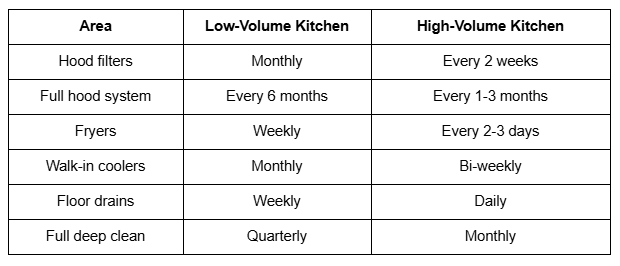
These are general guidelines. Your specific schedule will depend on your cooking method, hours of operation, and what you cook. A pizza restaurant has different grease output than a deep fryer-heavy fast casual concept.
A Quick Inspection Prep Checklist (Print This Out)
If your next LA County inspection could be any day (and it could), here is what your kitchen should be able to pass right now:
- Hood system cleaned to bare metal; there was no visible grease on the filters
- All sanitizer buckets at correct concentration (typically 200 ppm for chlorine, 200-400 ppm for quaternary ammonia)
- Food contact surfaces are visibly clean and free of debris or residue
- Walk-in interiors free of mold, standing water, or spills
- Floor drains cleared and free-flowing
- No grease accumulation on walls behind cooking equipment
- All cleaning logs are up-to-date and accessible
If you cannot check all of these right now, you are at risk.
What Los Angeles Property Managers Need to Know
If you own or manage a building in Los Angeles, West Hollywood, Santa Monica, El Segundo, or Pasadena that houses a restaurant tenant, you probably already know that tenant issues become yours fast.
An LA County closure notice on a storefront affects foot traffic and raises questions from other tenants, and it can pull your property into the spotlight for the wrong reasons. Some lease agreements require tenants to comply with local health codes, but if they don't, you may be the one getting calls.
Working with a professional commercial kitchen janitorial provider gives you a way to stay informed and stay ahead. Some property managers include scheduled deep cleaning as a condition of their food service leases. Others simply have a trusted vendor they can refer tenants to when things look like they are slipping.
Either way, the smartest move is building that relationship before there is a problem.
The Real Cost of Skipping Professional Cleaning
Let's be honest about the numbers for a moment.
A professional deep clean for a commercial kitchen in the Los Angeles area typically runs between $500 and $2,000, depending on size, cooking volume, and how long it has been since the last proper cleaning. A monthly or quarterly contract brings that cost down significantly.
Compare that to the cost of a closure, even a 24-hour temporary closure, which can mean thousands of dollars in lost revenue, staff wages for idle hours, and potential legal fees if the violation is serious. A Forbes analysis of restaurant failures consistently points to operational compliance failures as one of the top preventable reasons food businesses lose their licenses.
How MNZ Helps Restaurants Stay Compliant in LA County
MNZ Janitorial Services works with food facility operators and property managers across Los Angeles County, including West Hollywood, Santa Monica, El Segundo, and Pasadena, providing commercial kitchen janitorial services that are built around health code requirements, not just general cleaning standards.
Our team understands what an LA County inspector is looking for, and we schedule and document deep cleaning work so that your kitchen has a paper trail to show compliance. That documentation matters because inspectors can and do ask how frequently certain areas have been cleaned.
Whether you manage a restaurant space or operate one, cleaning services for health code compliance should not be something you scramble for right before an inspection. The system should operate seamlessly in the background, ensuring you stay out of trouble and maintain an A grade.
Conclusion: Don't Wait for an Inspector to Tell You There's a Problem
If your kitchen relies on nightly wipe-downs to stay compliant with LA County health standards, you have a gap in your plan. Real compliance requires scheduled deep cleaning, documented sanitation procedures, and a team that understands what restaurant cleaning in Los Angeles actually demands.
The good news is that getting there is not complicated. It just requires the right partner.
Ready to get your kitchen or restaurant property inspection-ready? Contact MNZ Janitorial Services today for a free walkthrough and quote. We serve restaurants, property managers, and building owners across Los Angeles, West Hollywood, Santa Monica, El Segundo, and Pasadena.
Transform your space into a clean and welcoming environment with MNZ. Contact us today to schedule a consultation and get a quote for our professional cleaning and maintenance services.
.jpg)


