

If you manage a warehouse in Los Angeles, you have probably called a cleaning company, described your space, and received a quote. The crew arrived, cleaned the floors, emptied the trash cans, wiped down the break room, and then left. It looked okay on the surface. But a few weeks in, you noticed the grease stains were back near the loading dock. The concrete floors smelled like chemicals and motor oil. The restrooms were clean, but the production area still felt grimy.
Here is what happened: you hired a commercial cleaning company to handle an industrial cleaning job. That is one of the most common and most expensive mistakes that warehouse managers in Los Angeles, West Hollywood, Santa Monica, El Segundo, and Pasadena make every year.
This post breaks down the real difference between the two so you know exactly what to ask for before you sign any contract.
Why This Confusion Is Costing You Money
Let us start with the problem because it is bigger than most people realize.
According to a 2023 report by the International Sanitary Supply Association (ISSA), improper facility cleaning costs U.S. businesses an estimated $21 billion per year in lost productivity, premature equipment wear, and compliance violations. A big chunk of that comes down to a mismatch between the cleaning scope and the type of facility being cleaned.
Warehouses are not offices. Warehouses face daily challenges such as heavy foot traffic from forklifts and pallet jacks, grease and oil buildup near machinery, dust from raw materials or packaging, and surfaces that withstand significant wear and tear. When you send a standard commercial cleaning crew into that environment, you are not just getting an incomplete job; you are potentially creating safety hazards.
OSHA's General Industry Standards (29 CFR 1910.22) require that "all places of employment, passageways, storerooms, service rooms, and walking-working surfaces be kept in a clean, orderly, and sanitary condition." That standard applies to your warehouse. Training for office work does not equip a crew to meet this standard.
What "Commercial Cleaning" Actually Covers
Commercial cleaning is the standard service most people picture when they think about a cleaning company. It is built for offices, retail spaces, medical suites, and multi-tenant buildings. The scope usually includes:
- Vacuuming and mopping floors
- Restroom cleaning and restocking
- Trash removal
- Surface wiping and disinfecting
- Glass and window cleaning
- Light dusting
Commercial cleaning teams use standard mops, microfiber cloths, and general-purpose cleaners. They are trained to work quickly, stay out of the way during business hours, and keep common areas looking presentable. For an office in West Hollywood or a retail space in Santa Monica, that is exactly what you need.
But bring that same crew into a 50,000-square-foot distribution warehouse in El Segundo, and they are going to struggle. This isn't due to their lack of skill, but rather because the nature of the job is fundamentally different.
What Industrial Cleaning Los Angeles Warehouses Actually Need
Industrial cleaning of Los Angeles warehouses requires a different category of service. It handles the kind of grime, residue, and buildup that commercial cleaning products and methods cannot touch.
Here is what genuine warehouse janitorial services should cover:
Floor care at an industrial level: Warehouse floors accumulate oil, grease, rubber marks from forklifts, and heavy dust. Cleaning them properly requires industrial floor scrubbers, degreasers, and sometimes pressure washing. A standard mop is not going to do it.
Equipment and machinery cleaning: Conveyor belts, shelving systems, and machinery surfaces collect dust and debris that affect both safety and performance. This job requires specialized tools and cleaning agents.
Dock and loading area sanitation: Loading docks see some of the heaviest contamination in any facility. Diesel residue, spilled freight, and constant outdoor exposure make these areas genuinely hazardous if they are not cleaned to industrial standards.
Hazardous material handling: Depending on what your warehouse stores or processes, cleaning crews may need to be trained to handle chemical residue, biological waste, or other regulated materials safely.
High-surface and ceiling cleaning: Dust accumulates on rafters, overhead shelving, and ceiling equipment. Standard commercial crews do not have the equipment or training for heights.
A Side-by-Side Look at Commercial vs. Industrial Cleaning
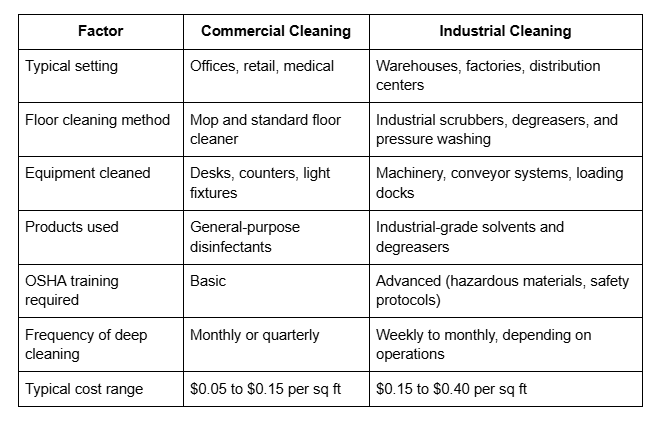
Cost figures are general estimates for the Los Angeles market and vary by facility size, condition, and cleaning scope.
The Mistake That Compounds Over Time
Here is what makes this problem worse: facility managers often do not realize the mismatch right away. The warehouse looks "clean enough" after each visit. Trash is out, restrooms are fine, and floors are damp-mopped. But the grease buildup on the loading dock keeps getting layered over rather than removed. The forklift paths accumulate a slippery film that poses a slip hazard. The high shelving never gets touched.
After six months, you are faced with a workers' compensation claim resulting from a slip and fall incident. Or you fail a surprise inspection and get cited for a safety violation. Or your facility starts smelling offensive enough that your team and clients are uncomfortable.
That is not a cleaning problem at that point. That is a liability problem. And it started the day you hired the wrong type of service.
A warehouse manager in Pasadena once told us they had gone through three commercial cleaning companies in two years, each one seemingly doing the job until the problems piled up. When they finally switched to a contractor with actual warehouse janitorial services experience, the turnaround was immediate. The crew came in with industrial scrubbers, degreased the loading dock, and put together a maintenance schedule that kept the facility compliant and clean. The manager said it was the first time they stopped thinking about cleaning altogether.
That is what the right service does. It disappears as a problem.
How to Tell If You Are Getting the Right Service
Before you hire any cleaning company for your Los Angeles warehouse, ask these five questions directly:
1. Do you have experience with warehouse or industrial facilities? Ask for references from similar facilities, not just office buildings. Commercial vs. industrial cleaning is a real distinction, and experience matters.
2. What equipment do you bring for floor maintenance? If they say mop and bucket, that is your answer. A real industrial cleaning provider brings walk-behind or ride-on scrubbers, automatic floor machines, and wet-dry vacuums at a minimum.
3. Are your crews trained for OSHA compliance in industrial settings? This is non-negotiable. Cleaning crews in industrial environments need to understand hazard communication, proper chemical handling, and safety protocols.
4. How do you handle loading docks and high surfaces? These are two areas that standard commercial crews skip. If the answer is vague, the service is not built for your facility.
5. Can you put together a written cleaning scope specific to our warehouse? A professional industrial cleaning Los Angeles provider will assess your space and write a scope of work. If they hand you a generic price per square foot with no site visit, be cautious.
What Good Warehouse Janitorial Services Look Like
A strong warehouse janitorial services contract covers three categories: routine maintenance, periodic deep cleaning, and on-call response.
Routine maintenance happens daily or several times a week and includes restroom cleaning, trash removal, general floor sweeping, and break area maintenance. This is the baseline that keeps the facility functional.
Periodic deep cleaning happens monthly or quarterly and covers floor scrubbing, degreasing high-traffic zones, cleaning shelving and equipment surfaces, pressure washing loading docks, and sanitizing all touchpoints.
On-call response means your contractor can respond to spills, unexpected contamination, or inspection preparation on short notice. This is especially valuable if your warehouse handles time-sensitive freight or has regulatory requirements.
Together, those three elements make up a program that actually protects your facility, your team, and your compliance record.
The Bottom Line on Commercial vs. Industrial Cleaning
Commercial cleaning is not inferior; it is just built for a different environment. Offices in Los Angeles need commercial cleaning. Warehouses in Los Angeles need industrial-grade service. Getting that wrong is a major problem. It creates safety risks, compliance issues, and ongoing costs that pile up fast.
If you manage a warehouse in Los Angeles County, whether in West Hollywood, Santa Monica, El Segundo, Pasadena, or anywhere across the region, the first step is finding a service that actually understands your facility type. Ensure that the service provider does not treat your warehouse as if it were a large office.
The good news: you won't have to think about this once you have the right contractor.
Get the Right Clean for Your Warehouse
MNZ Janitorial Services works with warehouse managers, building managers, and property managers across Los Angeles County. We understand the distinction between a merely clean-looking warehouse and a truly clean one, and our crews are prepared to achieve the latter.
If your current cleaning contract is not cutting it, or you are setting up a new facility and want to get it right from day one, reach out to us at mnz.com. We will walk through your space, put together a real scope of work, and give you a clear quote with no guesswork.
Get a Free Quote from MNZ Janitorial Services
Transform your space into a clean and welcoming environment with MNZ. Contact us today to schedule a consultation and get a quote for our professional cleaning and maintenance services.
.jpg)


