

If you manage a building in Los Angeles, compliance is probably on your radar, but have you considered the connection between your janitorial crew and your OSHA obligations? People often overlook that aspect.
Here's the reality: OSHA isn't just concerned about construction hazards and heavy machinery. It also holds employers, building managers, and property owners accountable for maintaining a sanitary, hazard-free workplace. And when something goes wrong, the question investigators ask isn't just "what happened?" It's "who was responsible for maintaining this space?"
That's where professional janitorial services in Los Angeles become more than a convenience. They become a compliance tool.
Why OSHA Compliance Starts With Your Cleaning Program
Most building managers think about OSHA in terms of hard hats and safety signs. But OSHA's General Duty Clause (Section 5(a)(1)) requires employers to provide a workplace free from recognized hazards that are likely to cause death or serious physical harm. Dirty, cluttered, or improperly sanitized spaces absolutely qualify.
The specific standards that overlap with janitorial responsibilities include the following:
- OSHA 1910.141: Sanitation standards covering toilet facilities, potable water, and general housekeeping
- OSHA 1910.22: Walking-working surfaces, which includes keeping floors clean and dry to prevent slip-and-fall incidents
- OSHA Bloodborne Pathogen Standard (1910.1030): Applies when restrooms or shared spaces could expose workers to biological material
According to the Bureau of Labor Statistics, slips, trips, and falls account for about 18% of all workplace injuries, and many of those happen in office settings. Wet floors, improper trash removal, cluttered emergency exits, and restrooms that aren't up to sanitation standards are all things a trained janitorial team is supposed to catch and fix before they become a liability.
A 2022 report from the National Safety Council found that workplace injuries cost U.S. employers more than $167 billion annually, much of it from preventable incidents tied to poor housekeeping and building maintenance. If you're managing a commercial property in West Hollywood, Santa Monica, or Pasadena, those numbers aren't abstract.
The Hidden Compliance Risks Property Managers Overlook
Let me be honest with you: most OSHA violations in office settings aren't dramatic. Heavy equipment isn't causing harm to anyone. The violations are quieter, and they build up slowly.
Think about these common scenarios:
Scenario 1: A janitorial worker uses the same mop in a restroom and then in the break room. Cross-contamination. OSHA 1910.141 violation potential.
Scenario 2: A cleaning company uses an unlabeled spray bottle with a chemical inside. If a tenant or employee asks what's in it and there's no Safety Data Sheet (SDS) nearby, you could have a Hazard Communication Standard (HazCom) issue on your hands.
Scenario 3: Wet floor signs aren't posted during evening cleaning. Someone slips at 7 PM when they come back to the office. Now you're looking at a workers' comp claim and potentially an OSHA recordable incident.
None of these is dramatic. All of them are common. The effectiveness of your janitorial services in Los Angeles hinges on their training, documentation, and accountability.
According to OSHA, the top violations in office environments consistently include inadequate housekeeping, failure to maintain clear exits, and improper chemical storage. The positive news is that a professional janitorial provider addresses all three as part of standard operations, assuming you've hired the right one.
What Compliant Janitorial Services Actually Look Like
There's a big difference between a cleaning service that shows up and mops the floors and one that's actively supporting your compliance posture. Here's what the latter looks like in practice.
Proper Chemical Handling and SDS Documentation
A compliant janitorial services team maintains Safety Data Sheets for every chemical they use. This isn't optional. OSHA's HazCom standard (29 CFR 1910.1200) mandates that employees who may encounter hazardous substances have access to SDS sheets. If your cleaning crew uses industrial disinfectants, floor strippers, or mold-killing agents, that documentation needs to be on-site and accessible.
Ask your provider: Do you maintain an SDS binder or digital log on-site? If they look at you blankly, that's a problem.
Restroom and Sanitation Frequency Logs
OSHA 1910.141 doesn't just say restrooms should be clean. It specifies that they must be maintained in a sanitary condition. For buildings with 36 or more employees, that means a minimum of two toilets per gender, and they must be functional and clean.
Compliant janitorial teams keep restroom cleaning logs, typically with timestamps and initials. This creates a paper trail that can protect you during an inspection or in the event of a complaint.
Wet Floor and Slip Prevention Protocols
It sounds basic. But a lot of cleaning companies skip wet floor signs or use them inconsistently. A professional team should have a clear protocol: signs go up before mopping starts, they stay up until floors are dry, and they're placed at entry points, not just in the immediate area being cleaned.
For multi-tenant buildings in El Segundo or Pasadena, where foot traffic patterns can vary widely, this protocol is especially important during morning cleaning windows.
Biohazard and Bloodborne Pathogen Training
If your building has shared restrooms, gyms, locker rooms, or health-related tenants, OSHA's Bloodborne Pathogen standard may apply to your janitorial team directly. They need to know how to handle bodily fluid cleanup, what PPE to use, and how to dispose of contaminated materials properly.
This is one area where cutting costs with an uncertified cleaner can create serious legal exposure. A trained commercial cleaning provider should have documented BBP training for relevant staff.
OSHA Compliance Is Also a Tenant Retention Issue
Here's something a lot of property managers don't consider: your tenants care about cleanliness, too.
After 2020, workplace cleanliness became a top concern for office tenants. A 2023 BOMA (Building Owners and Managers Association) survey found that 74% of office tenants rated building cleanliness and maintenance as a top factor in lease renewal decisions. That number has only held steady since then.
A visibly clean building, consistently maintained restrooms, and a documented sanitation schedule provide a competitive advantage. Especially in markets like West Hollywood or Santa Monica, where tenants have options.
On the flip side, a single slip-and-fall incident or a health department complaint related to sanitation can damage your property's reputation and your relationship with tenants quickly. Buildings that lack documented cleaning protocols are also harder to defend in litigation.
The bottom line: OSHA compliance isn't just a regulatory checkbox. It's tied to asset value, liability protection, and tenant satisfaction.
What to Look for When Hiring Janitorial Services in Los Angeles for Compliance
If you're evaluating providers, here's a simple checklist you can use:
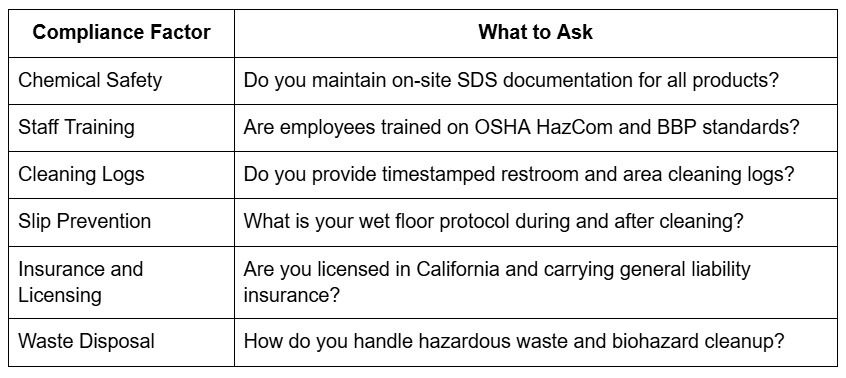
Any provider worth hiring in Los Angeles County should answer all of these without hesitation. If they can't, that gap in their process is your liability.
The Los Angeles Regulatory Layer You Can't Ignore
The California Department of Industrial Relations operates Cal/OSHA, which adds its own layer on top of federal OSHA standards. Cal/OSHA requirements are often stricter than federal standards, and they apply to all employers in the state, including building management companies.
Cal/OSHA's Injury and Illness Prevention Program (IIPP) requirements mean that if your building employs staff directly, or if your cleaning contractor's employees are considered part of your site's workforce, you may have IIPP obligations that include sanitation and housekeeping protocols.
Cal/OSHA fines for serious violations can reach $25,000 per violation. Willful or repeated violations can result in much higher penalties. Getting the cleaning side of compliance right matters more, not less, for multi-tenant properties in Los Angeles, where dozens of workers from different tenants share common spaces.
This is precisely why experienced janitorial services in Los Angeles who know California's specific requirements are worth the investment.
A Quick Benchmark: What Industry Data Tells Us
To give you a realistic picture, here are a few benchmarks from the cleaning and facilities management industry:
- Office buildings that implement documented daily cleaning programs report 20 to 30% fewer slip-and-fall incidents annually (ISSA, the worldwide cleaning industry association, 2023)
- Buildings with professional janitorial providers are 3x more likely to pass Cal/OSHA inspections related to sanitation without any citations, compared to those relying on in-house or informal cleaning arrangements
- The average cost of a single workplace slip-and-fall claim in California is approximately $40,000 to $60,000 when factoring in medical costs, workers' comp, and legal fees
Paying for a professional, compliance-trained janitorial provider looks a lot different when you put it next to those numbers.
Conclusion: Your Cleaning Crew Is Your First Line of Compliance Defense
You can have the best lease agreements, the sharpest building policies, and the most thorough tenant screening process. But if the restrooms aren't maintained, the floors are a slip hazard, and your cleaning team can't produce an SDS sheet when asked, you have a compliance gap that can cost you.
For building managers, landlords, office managers, and property managers across Los Angeles County, from Pasadena to El Segundo to Santa Monica, the right janitorial partner does more than clean. They document, they train, they follow protocols, and they help protect your property, your tenants, and your liability exposure.
At MNZ Janitorial Services, we've worked with commercial properties throughout Los Angeles County and understand California's compliance requirements from the ground up. We train, document, and equip our teams to support your OSHA and Cal/OSHA obligations, ensuring your building looks good.
Ready to close your compliance gaps? Get a free quote from MNZ Janitorial Services today at mnz.com and find out what a truly compliance-ready cleaning program looks like for your building.
Transform your space into a clean and welcoming environment with MNZ. Contact us today to schedule a consultation and get a quote for our professional cleaning and maintenance services.
.jpg)


