
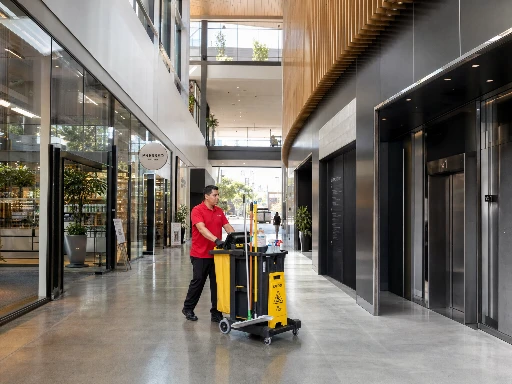
A mixed-use property in Los Angeles, CA doesn't behave like a single-use building, and treating it like one is how janitorial programs fail. When a ground-floor restaurant shares a lobby with four floors of office tenants, and a residential community sits above both, the cleaning needs of each use type run on different timelines, generate different waste streams, and require different staffing configurations. The same flat-rate nightly service that might work for a pure office block leaves the retail common areas dirty by 10 a.m. and the residential lobby unattended all day.
Mixed-use properties are increasingly common across Los Angeles, from the mixed retail-office towers in downtown to the live-work-play developments along the Westside, Mid-Wilshire corridors, and nearby beach communities. Commercial cleaning companies that specialize in this property type build programs that account for each use type's separate timeline and standards, rather than averaging them into one generic scope. For property owners and managers across California who depend on consistent service to protect their building investment, a layered approach is the operational foundation of any well-run cleaning project.
Why Mixed-Use Properties Require a Different Janitorial Services Approach
A traditional office building cleaning program assumes one primary tenant type, one soil load pattern, and one post-business-hours window. Mixed-use properties break all three assumptions at once.
Retail and restaurant tenants generate high volumes of foot traffic throughout the day, produce food waste and spills that require immediate response, and often have morning opening routines that require the space ready before the building's other tenants arrive. Office tenants expect consistent overnight cleaning and midday common-area maintenance. Residential tenants, where present, expect the lobby, mailroom, elevator, and shared amenity spaces to be clean around the clock, not just on weekdays.
Managing those three timelines with a single crew on a single shift is the source of most complaints in poorly managed mixed-use buildings. The answer is a layered janitorial services program that assigns crew, shift timing, and task scope to each use type rather than blending them. The detail matters: a program that looks complete on paper but misassigns rooms or shift windows leaves visible gaps every morning. Regular review of each zone's coverage keeps the solution working as the building's use patterns change.
Mapping Service Zones in a Mixed-Use Los Angeles Commercial Property
Zone mapping for mixed-use properties follows the same logic as single-use commercial buildings, with one important addition: the zone boundaries have to account for the transitions between use types, particularly the shared lobbies, elevators, and pathways that multiple tenant types move through simultaneously. A thorough walkthrough and zone review before the cleaning project begins is the step that prevents scope gaps later.
Retail and Restaurant Common Areas: Continuous Coverage Required
Ground-floor retail and food-and-beverage spaces require the most intensive and most continuous janitorial service in a mixed-use property. Spills happen during business hours. Food waste accumulates by the hour. Common restrooms serving retail customers need porter checks every one to two hours, not just nightly commercial cleaning service. Trash receptacles in high-traffic retail corridors fill faster than standard commercial office waste cycles assume.
For mixed-use properties with significant retail or restaurant presence in Los Angeles, a day porter dedicated to the retail and common-area space is standard operating practice, not an optional upgrade. That porter handles restroom checks, spill response, entrance tidying, and trash management throughout the day, while the nightly crew follows with a full cleaning pass after retail close. Reliable floor care throughout the day prevents the kind of buildup that a nightly pass alone cannot correct.
Office Tower Floors: Predictable Patterns, Standard Protocols
The office floors in a mixed-use property behave much like those in a standalone commercial building, with one exception: the access windows are tighter. When the retail and residential programs share elevator banks, the nightly cleaning crew for office floors may need to stagger their schedule to avoid bottlenecks at the freight elevator.
Standard commercial office cleaning protocols apply: nightly vacuuming and mopping, restroom deep cleaning, trash removal, high-touch surface disinfection, and periodic services like carpet extraction and interior window cleaning on a quarterly rotation. The frequency matrix for office floors follows the zone-based model used in Class A commercial buildings throughout the LA area.
Residential Lobbies and Shared Amenities: A Third Standard
When the mixed-use property includes a residential component, the lobby, mail area, package room, fitness center, and residential elevator require a cleaning standard aligned with tenant lease expectations, which differ from commercial ones. Residential tenants are home in the evenings, on weekends, and during holidays when commercial spaces are quiet. The cleaning program has to accommodate that visibility.
Residential lobby cleaning in a mixed-use Los Angeles building typically includes a morning porter pass before business hours, a midday check, and an evening maintenance pass. The nightly deep cleanup follows building hours. Amenity spaces like fitness centers, resident lounges, and rooftop decks need their own frequency matrix based on actual use, not a default commercial schedule. For property owners managing buildings with residential components, consistent service in these shared spaces directly affects lease renewal rates and community trust.
Coordinating Multiple Crews and Shift Windows
One of the practical challenges in a mixed-use property is that three or four separate cleaning windows may be running simultaneously or in close sequence. Retail closes at 10 p.m. and needs a post-close pass. Office floors want overnight cleaning between 9 p.m. and 5 a.m. The residential lobby needs someone on site at 7 a.m. A single commercial cleaning company managing all three programs needs a clear crew assignment plan, strong communication between shift leads, and a property manager contact who can resolve scheduling conflicts quickly.
The alternative approach, splitting the contract between multiple vendors, solves the scheduling problem but creates a coordination problem. When a spill in the mixed-use lobby falls in the gap between the retail porter's shift and the office crew's start time, neither vendor's contract covers it. Single-vendor programs with clearly defined shift transitions, good responsiveness, and a point-of-contact structure prevent those gaps from becoming complaints. Choosing a dependable commercial cleaning service that provides consistent service as a complete solution is the difference between a building operation that runs smoothly and one that generates daily calls.
Pro tip: Ask any janitorial vendor bidding on a mixed-use scope to provide a shift diagram, not just a task list. A shift diagram shows which crew is on site at each hour, which areas each crew covers, and what the handoff protocol looks like when one shift ends and another begins. A vendor who can't produce one isn't thinking about the property the right way.
Compliance and Health Code Considerations for LA Properties
Mixed-use properties in Los Angeles can trigger multiple regulatory frameworks simultaneously, and the janitorial services program has to satisfy all of them. California compliance standards for commercial building operations add another layer of detail that property owners need to account for at the contract level, whether the project is a new mixed-use development or an existing building transitioning vendors.
Food Service and Health Department Standards
Any building with restaurant or food-service tenants adjacent to shared common areas is subject to LA County Department of Public Health inspection standards for those shared spaces. Grease and food residue tracked from a restaurant into a shared lobby can become a health code issue during a facility inspection. The cleaning scope for the transition zones between food service and common areas needs to reflect that standard, including more frequent mopping of the entry corridor and careful attention to door handles, trash areas, and any outdoor seating or exterior space that opens onto shared property.
Green Cleaning and LEED Requirements
Many mixed-use developments in Los Angeles pursue LEED certification at the whole-building level. When they do, the green cleaning requirements apply across all tenant types, including retail and residential, not just the office floors. Product selection, washing solution dilution ratios, and ventilation protocols during cleaning all need to comply with the applicable LEED credit requirements. A professional commercial cleaning company with green cleaning certification can manage this across multiple use types without requiring the property manager to track California compliance separately for each floor.
Waste Stream Separation
Los Angeles recycling and organic waste ordinances apply to commercial properties over a certain size threshold. Mixed-use buildings often qualify at the whole-property level even when individual tenant spaces would fall below it. The janitorial services program needs to include proper waste stream separation, with dedicated recycling and compost collection in each use-type area, and the cleaning company needs to be familiar with the city's current requirements rather than applying a generic trash-removal protocol.
Building the Janitorial Scope of Work for a Mixed-Use Property
A well-constructed scope of work for a mixed-use property lists each zone separately, with its own frequency matrix, task list, and crew assignment. Don't let a vendor combine them into a single line item. The scope should distinguish between the retail and restaurant common areas, the office tower floors, the residential lobby and amenities, the shared building-wide spaces like parking structures and loading docks, and the periodic specialty services that apply across all zones. Pricing should reflect each use type's actual service requirements, not a blended square-footage average that underserves one part of the building.
When reviewing your scope, account for seasonal variation in LA's operating environment. Wildfire season brings particulate into lobbies and exterior spaces that require more frequent maintenance than the baseline schedule. One-time projects — post-construction cleanup, pre-inspection deep cleans, tenant move-out restoration — should be priced separately from the recurring scope so they don't crowd out ongoing operational coverage. A thorough scope review at contract renewal is how property owners keep the program aligned with how the building is actually being used.
Standard commercial cleaning checklist items for each use type include:
- Retail and restaurant common areas (daily, multiple times): Porter checks every one to two hours, restroom restocking, spill response, trash removal, entry and corridor mopping, high-touch surface disinfection
- Office floors (nightly, with periodic services): Trash removal, vacuuming, mopping, restroom deep clean, high-touch disinfection, floor care including quarterly carpet extraction, periodic interior window cleaning
- Residential lobby and amenities (daily, with morning and evening porter passes): Lobby mopping, elevator interior cleaning, mailroom tidying, fitness room wipe-down, package room maintenance, trash removal
- Shared building infrastructure (weekly or periodic): Parking structure sweeping, loading dock cleanup, exterior pressure washing, stairwell maintenance, high-dusting above lobby fixtures
At MNZ, mixed-use buildings are a significant part of the commercial portfolio we serve across Los Angeles. Every client engagement starts with a use-type walkthrough that maps each zone, identifies the transition areas where multiple use types interact, and builds a shift diagram before any pricing conversation. MNZ's consistent service covers mixed-use developments from downtown through the Westside, Pasadena, and nearby LA communities. If you're a property owner or manager where the current janitorial services program isn't keeping pace with how the building actually operates, contact the MNZ team here to request a quote and schedule a scope review.
FAQ
Can one janitorial company handle all use types in a mixed-use building?
Yes, and for most properties it's the preferred structure. A single vendor managing retail, office, and residential cleaning under one contract creates cleaner accountability, smoother handoffs between crews, and a single point of contact for the property owner or manager. The key is confirming that the vendor has experience with all three use types, not just commercial office. Ask for references from mixed-use or multi-use properties specifically, not just standalone office buildings. Trust comes from a consistent service record across comparable project types, not just from the bid.
How does cleaning frequency differ between the retail and office portions of a mixed-use property?
Retail and food-service common areas typically require continuous day porter coverage during business hours, plus a full nightly cleaning pass after close. Office floors typically need nightly cleaning five days per week, with periodic services on a monthly or quarterly rotation. The retail portion generates significantly more real-time soil load and requires a more intensive daytime staffing model than the office floors.
What's the biggest mistake property managers make when setting up janitorial programs for mixed-use buildings?
Treating the whole building as a single scope. When a property owner or manager prices the cleaning contract based on total square footage without separating the use types, vendors can bid to the lowest common denominator. The office floors get priced as if they need retail-level service, or the retail common areas get priced as if nightly cleaning is sufficient. Either way, one part of the building ends up underserviced, and the complaints follow quickly. The solution is a zone-by-zone pricing review before any contract is signed.
Do residential tenants in a mixed-use building have different cleaning expectations than office tenants?
Yes, significantly. Office tenants evaluate cleanliness primarily during business hours and notice shortfalls in common areas they pass through at predictable times. Residential tenants evaluate cleanliness at all hours, including weekends and evenings, and have a much lower tolerance for visible soil in lobbies, elevators, and amenity spaces because those spaces are part of their home environment and community. Cleaning programs that treat residential and office standards as equivalent consistently generate complaints from the residential side.
Janitorial services for a mixed-use Los Angeles property aren't a variation on a standard commercial cleaning contract. They're a separate discipline that requires matching crew assignments, shift timing, and task scope to each use type on its own terms. MNZ Commercial Cleaning Services has been building dependable programs for mixed-use, multi-tenant, and specialty commercial properties throughout Los Angeles, Orange County, and the surrounding California market since 1979. If your current program is falling short somewhere in the building, let's walk it and find where the gaps are.
Related Reading
What Should an Office Cleaning Schedule Include for Los Angeles Commercial Buildings?
How Do You Manage Day Porter Services in a Class A Los Angeles Office Building?
Transform your space into a clean and welcoming environment with MNZ. Contact us today to schedule a consultation and get a quote for our professional cleaning and maintenance services.
.jpg)


