
You walk into your Los Angeles office building on Monday morning and notice fingerprints on the glass doors, trash bins overflowing in the lobby, and that familiar musty smell coming from the break room. Sound familiar?
Here's the thing: 83% of office workers say they'd think less of their employer if the workplace wasn't clean, and employees in cluttered offices are 77% less productive. But the real kicker? A study of Los Angeles office buildings found that proper cleaning protocols cut employee sick days by 30% and saved companies an average of $1,850 per employee annually.
So why do so many property managers struggle with this? Most "cleaning protocols" are generic checklists that fail to consider the unique challenges of Los Angeles, such as the year-round sunshine, constant construction dust in growing areas like El Segundo and Pasadena, and high tenant expectations in competitive markets like West Hollywood and Santa Monica.
This guide breaks down exactly what works in 2026 for Los Angeles County properties. You'll get specific protocols with frequencies, implementation steps, and real numbers so you can make decisions based on data, not guesswork.
Why Your Current Cleaning Protocols Probably Aren't Working
Let's address the crucial issue at hand. The janitorial services industry hit $108.3 billion in the US this year, yet 44% of facility managers report restroom cleaning as one of their top three problem areas.
Three common problems property managers face:
1. The "We've Always Done It This Way" Problem
Your cleaning crew hits the same spots at the same times every week. But office usage patterns changed post-pandemic. Some areas see triple the traffic; others sit empty. You're paying for deep cleans in conference rooms that nobody uses, while high-traffic areas like elevator buttons and shared kitchens need attention every four hours, not once a day.
2. The Cross-Contamination Disaster
Is cleaning the lobby with the same mop from the restroom a common practice? That's how germs spread faster than gossip in a WeHo coffee shop. Yet 68% of cleaning crews don't follow proper color-coding systems for equipment.
3. The Communication Breakdown
Your building manager, tenants, and cleaning crew all have different expectations. Nobody documented what "clean" actually means. So you end up with complaints like "the office doesn't smell fresh" or "there's dust on the vents" because "clean" means something different to everyone.
The fix? Protocols that are specific, measurable, and adapted to how your building actually gets used.
The Foundation: Understanding Cleaning vs. Sanitizing vs. Disinfecting
Before we get into protocols, let's clear up confusion that costs property managers money and credibility.
- Cleaning removes visible dirt and debris using soap and water. Think of it like sweeping crumbs off a counter.
- Sanitizing reduces bacteria to safe levels per public health standards. You're lowering germ counts, not eliminating everything.
- Disinfecting kills pathogens—bacteria, viruses, and fungi. A clean environment is what stops illness from spreading.
Protocol Category 1: High-Touch Surfaces (The 4-Hour Rule)
High-touch surfaces are your primary disease transmission points. We're talking door handles, elevator buttons, light switches, stair railings, and shared equipment like printers and coffee makers.
The Protocol:
Disinfect every 4 hours during business hours for high-traffic buildings. For standard traffic, twice daily (morning and midday).
Implementation Steps:
- Map your high-touch zones. Walk your property. Count how many people touch each surface per hour. Are the elevator panels in a 10-story building considered clean? That's 100+ touches per hour. File that under "needs frequent attention."
- Use EPA-registered disinfectants. Review the EPA List N. Products need proper contact time (usually 3-10 minutes) to actually kill germs. Is it appropriate to spray and then immediately wipe the area?
- Color-code everything. Red cloths for restrooms, yellow for kitchens, blue for offices, and green for general areas. No exceptions. Train your crew that using red anywhere but bathrooms means they're spreading fecal bacteria through your building.
- Document and verify. Use QR codes on surfaces. Crew scans after cleaning. You get timestamped proof of completion.
Protocol Category 2: Restrooms (The Non-Negotiable Daily Deep Clean)
44% of facility managers report that deep cleaning restrooms is one of their top three problem areas. Here's why: restrooms are judged harshly and used constantly, and if they're gross, that's what people remember about your building.
The Protocol:
Daily deep cleaning, midday touch-ups for high-traffic buildings, and weekly deep sanitization.
Daily Tasks (Every Morning):
- Empty trash and feminine hygiene receptacles
- Clean and disinfect toilets, urinals, and sinks
- Restock soap, paper towels, and toilet paper
- Mop floors with disinfectant
- Clean mirrors and fixtures
- Disinfect door handles and stall locks
Midday Touch-Up (High-Traffic Only):
- Quick counter wipe
- Restock supplies
- Spot mop if needed
- Empty overflowing trash
Weekly Deep Tasks:
- Scrub grout lines
- Clean vent covers
- Deep clean tile walls
- Check under sinks for leaks/clogs
- Disinfect stall walls top to bottom
Protocol Category 3: Floors (Your Building's First Impression)
Floors take the most abuse. Foot traffic, spills, and outdoor elements are tracked in—especially in LA, where we don't have weather transitions to naturally reduce dirt accumulation like rain or snow.
The Protocol by Floor Type:
Hard Surface Floors (Tile, VCT, and concrete):
- Daily: Dust mop and spot mop high-traffic areas
- Weekly: Complete wet mop with neutral pH cleaner
- Monthly: Strip and recoat (if needed)
- Quarterly: Deep scrub and reseal
Carpeted Floors:
- Daily: Vacuum high-traffic paths and building entrances
- Weekly: Complete vacuum, including under desks
- Monthly: Spot treat stains
- Quarterly: Hot water extraction (steam cleaning)
- Annually: Deep extraction with encapsulation
Entry Mats (Critical for LA):
Dust and dirt tracked in from parking lots can scratch floors and spread allergens. Your entry mat system should capture 80% of incoming soil in the first 15 feet.
- Daily: Vacuum commercial mats
- Weekly: Shake out and spot clean
- Monthly: Deep clean or replace rental mats
Protocol Category 4: Air Quality and HVAC (The Invisible Protocol)
Following the pandemic, tenant concerns shifted to indoor air quality. Poor IAQ causes headaches, fatigue, and respiratory issues. It also makes your building stink.
The Protocol:
Monthly:
- Replace HVAC filters (or per manufacturer spec)
- Check for visible mold or moisture issues
- Clean air vent covers and returns
Quarterly:
- Professional duct inspection
- Deep clean vent systems if needed
- Check HVAC drain pans
Annually:
- Complete HVAC system servicing
- Duct sanitization if you have moisture issues
LA-Specific Considerations:
Our perfect weather means HVAC systems run year-round, not seasonally. Filters clog faster. Dust from nearby construction (looking at you, every neighborhood in LA) means more frequent attention.
Protocol Category 5: Shared Spaces (Kitchens, Break Rooms, Lobbies)
These areas are hammered. Everyone uses them; nobody takes responsibility for keeping them clean.
Kitchen/Break Room Protocol:
After Lunch (11 am-2 pm):
- Wipe down counters and tables
- Empty trash if more than half full
- Spot clean spills
- Sanitize appliance handles (fridge, microwave)
Daily End-of-Day:
- Deep clean all counters and tables
- Empty and sanitize trash bins
- Clean the microwave inside and out
- Wipe down the outside of the fridge.
- Mop the floor.
- Clean coffee maker
Weekly:
- Clean inside fridge (post sign 24 hours before)
- Sanitize sink and faucet thoroughly
- Clean cabinet fronts
- Deep clean behind appliances
Monthly:
- Defrost/deep clean freezer
- Clean vent hood filters
- Move and clean under appliances
- Check for expired items in the pantry.
Lobby Protocol:
Your lobby is your building's handshake. Keep it spotless.
Multiple times daily:
- Empty trash receptacles
- Wipe down the reception desk
- Clean front glass doors (inside and out)
- Vacuum or sweep the entry area
Daily:
- Dust furniture and decorative items
- Clean directory boards
- Sanitize elevator call buttons
- Check lighting (replace dead bulbs)
Creating Your Customized Cleaning Schedule
Here's where generic checklists fail. Your building in El Segundo with 50 employees needs a different schedule than a 200-person office in West Hollywood.
Step 1: Audit Your Traffic Patterns
Count people. Track peak hours. Note problem areas. Do this for one full week.
Sample data to collect:
- Building occupancy by hour
- Restroom visits per day
- Kitchen usage peaks
- High-touch surface contact frequency
Step 2: Calculate Your Cleaning Load
Industry standard: one full-time cleaner per 30,000-35,000 square feet for standard daily cleaning.
Adjust based on:
- Traffic level (increase for high traffic)
- Surface types (carpet takes 2x longer than hard floors)
- Clutter level (messy tenants = more time)
- Detailed requirements (medical buildings need more)
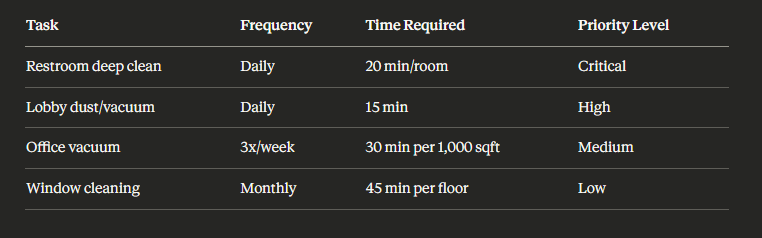
Step 3: Build Your Protocol Matrix
Create a simple chart:
Step 4: Document Everything
Write it down. Make it visual. Include photos of what "clean" looks like for each task. Your cleaning crew should be able to follow your protocol with zero guesswork.
Step 5: Implement Quality Control
Random spot checks. Tenant feedback forms. Photo documentation. Monitor complaints by area; if the same restroom receives three flags, it may indicate a protocol issue.
Technology Integration: 2025 Cleaning Management
32% of commercial cleaning companies plan to adopt new software and technology in 2025. Here's what actually helps property managers:
1. IoT Sensors in Restrooms
Sensors detect paper towel levels, foot traffic, and when cleaning is needed based on usage, not arbitrary schedules. Units cost $100-$300 per restroom, but they can cut supply costs by 20–30% and reduce complaints by half.
2. QR Code Task Verification
Cleaners scan codes at each location after completing tasks. You get real-time updates. No more "did they actually clean the third floor?" questions.
3. Automated Supply Ordering
Smart dispensers alert you when supplies run low. No more "we're out of toilet paper" emergencies.
4. Digital Inspection Checklists
Ditch clipboards. Use tablets or phones. Photos document before/after. Easier to track patterns and train new staff.
Dealing with Common LA-Specific Challenges
Challenge 1: Year-Round Dust
Solution: Increase frequency of dusting and air filter changes by 30% compared to national standards. Install better quality entry mats. Consider a professional mat rental service (they clean and rotate them weekly).
Challenge 2: Outdoor Access Areas
Patios, courtyards, and outdoor common spaces stay dirty longer in LA's dry climate. Dirt doesn't wash away.
Protocol: Power wash monthly (not quarterly). Spot clean high-use areas weekly. Control access during cleaning to avoid slip hazards.
Challenge 3: Water Conservation Requirements
LA's water restrictions affect cleaning protocols, especially for exterior maintenance.
Solution: Use low-flow spray bottles. Switch to dry vapor steam cleaners (uses 90% less water). Time exterior cleaning for early morning to minimize evaporation.
Challenge 4: Competitive Tenant Expectations
West Hollywood, Santa Monica, and DTLA tenants have seen high-end office spaces. They expect the same from you.
Solution: Add visible touches: Fresh flowers in the lobby (swap weekly), pleasant scent diffusers (not overpowering), spotless glass, and coordinated color-coded cleaning supplies that look professional.
What This Costs (Real Numbers for LA County)
Let's talk money. Here's what professional office janitorial services actually cost in Los Angeles County as of 2025:
Basic Nightly Cleaning (3-5x per week):
- $0.10-0.20 per square foot per cleaning
- 10,000 sq ft office: $1,000-2,000/month
- Includes: trash removal, restroom cleaning, vacuuming, and basic dusting
Comprehensive Daily Service:
- $0.15-0.30 per square foot per cleaning
- 10,000 sq ft office: $2,250-4,500/month
- Includes: All basic plus kitchen deep clean, high-touch sanitizing, floor care
Add-Ons:
- Window cleaning: $3-7 per window, monthly
- Deep carpet cleaning: $0.20-0.40 per sq ft, quarterly
- Floor strip/wax: $0.50-1.00 per sq ft, annually
- Day porter service: $18-25/hour
DIY vs. Professional Cost Comparison:
In-house cleaning staff:
- Salary: $35,000-45,000/year per cleaner
- Benefits: Add 30-40%
- Supplies: $200-400/month
- Equipment: $2,000-5,000 initial
- Training/management time: 5-10 hours/month
- Total cost for 10,000 sq ft: $50,000-65,000/year
Professional service:
- Total cost for 10,000 sq ft: $27,000-54,000/year
- No HR headaches
- No supply management
- Consistent quality
- Flexibility to scale
The break-even point? Buildings that are under 20,000 square feet almost always save money by outsourcing. Larger buildings can go either way depending on tenant requirements and existing management capacity.
Implementation Checklist: Your 30-Day Plan
Week 1: Assessment and Planning
- Conduct a full building walk-through
- Document current protocols (or lack thereof)
- Survey tenants about cleanliness concerns
- Calculate current costs
- Identify the 3 biggest problem areas
Week 2: Protocol Development
- Create a detailed cleaning schedule
- Document standards for each task (with photos)
- Select cleaning products and equipment
- Determine KPIs to track
- Set budget
Week 3: Training and Setup
- Train cleaning staff on new protocols
- Implement a color-coding system
- Install any technology (QR codes, sensors)
- Create a quality control checklist
- Communicate changes to tenants
Week 4: Launch and Monitor
- Begin new protocols
- Conduct daily spot checks first week
- Gather feedback from tenants
- Adjust based on early results
- Document what's working vs. not
30-Day Review:
- Compare KPIs to baseline
- Survey tenants again
- Calculate cost changes
- Adjust protocols as needed
- Set 90-day goals
Common Mistakes to Avoid
Mistake #1: Copying Another Building's Protocols
What works for a tech startup in Santa Monica won't work for a medical office in Pasadena. Traffic patterns, tenant types, and building layouts differ. Customize.
Mistake #2: Focusing Only on Visible Areas
Your lobby looks great, but the break room on the second floor is in poor condition. Tenant notice. Allocate resources based on usage, not just what visitors see.
Mistake #3: Changing Everything at Once
Rolling out 47 new protocols overnight overwhelms your cleaning crew and makes it impossible to identify what's actually working. The phase changes over 60-90 days.
Mistake #4: No Documentation
"Clean the offices" isn't a protocol. "Vacuum all carpeted areas in offices, empty trash cans, and spot clean glass surfaces, completed by 7 am daily" is a protocol.
Mistake #5: Ignoring Feedback
If three tenants mention the third-floor restroom smells unacceptable, investigate. Don't defend your protocol. Resolve the problem.
When to Hire Professionals vs. Manage In-House
Go professional. If:
- Your building is under 50,000 square feet
- You lack facilities management experience
- Tenant turnover is high
- You need flexible scheduling
- Staffing headaches aren't your thing
- You want predictable monthly costs
Manage In-House If:
- Your building exceeds 100,000 square feet
- You have experienced facilities staff
- Tenants have highly specific requirements
- You want direct control over every detail
- You already manage other building services internally
- Your team can handle HR, training, and supply chain
Hybrid Approach:
Many LA property managers use in-house staff for daily basics and contract specialized services (window cleaning, deep carpet work, and exterior maintenance) to professionals. This balances control with cost efficiency.
If you outsource, verify that providers have:
- General liability insurance ($2M minimum)
- Workers' comp coverage
- Bonding/theft coverage
- Green certification (if that matters to your tenants)
- Local references in similar LA buildings
Conclusion
Los Angeles office space is competitive. Tenants have choices. A clean building isn't just about health and safety; it's about showing respect for the people who work there.
The US janitorial services market is projected to expand from $336.27 billion in 2024 to $362.89 billion in 2025. Your building's cleanliness affects lease renewal rates, tenant referrals, and your reputation. Do it right, and you're the property manager everyone wants to work with. Cut corners and you'll fight tenant turnover and negative reviews.
The protocols in this guide work for real LA buildings dealing with real challenges: dust, high expectations, budget constraints, and year-round usage. Pick the sections most relevant to your property. Implement one category at a time. Track results. Adjust as needed.
Clean buildings aren't magic. They're the result of clear protocols, consistent implementation, and honest attention to what your specific property needs.
Ready to implement protocols that actually work? MNZ Janitorial Services has helped Los Angeles County property managers—from West Hollywood to Pasadena—implement cleaning protocols that reduce complaints, improve tenant satisfaction, and simplify management.
Transform your space into a clean and welcoming environment with MNZ. Contact us today to schedule a consultation and get a quote for our professional cleaning and maintenance services.
.jpg)


