
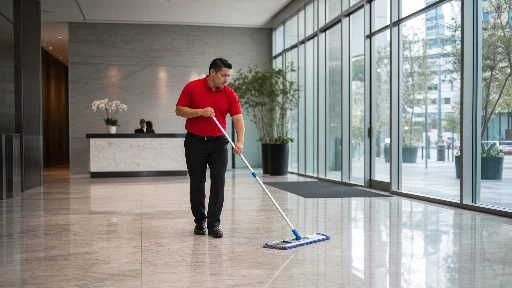
Office janitorial services for a Los Angeles commercial building typically cover daily restroom sanitation, trash removal, floor care, and common-area maintenance, plus periodic deep-cleaning tasks on a rotating schedule. According to the ISSA's 2026 Cleaning Industry Benchmarks, professional janitorial service runs about $0.12 to $0.18 per square foot per month for standard office environments. That number climbs when you add day porter coverage, specialized floor care, or high-frequency service for lobbies and shared amenity spaces. Here is what a solid janitorial program actually includes, and how to tell whether your current solution is covering the right ground.
The Core Services Every Office Janitorial Program Should Cover
A janitorial program is not a single cleaning pass. It is a layered solution of daily, weekly, and monthly maintenance tasks that keep a building consistently clean without letting anything fall through the cracks. Property managers and facilities directors who have dealt with vendor underperformance usually trace it back to the same root: the scope of work was not specific enough about what happens and when. Choosing a reliable provider who can tailor service to your building's actual needs is the most reliable way to maintain a consistently clean workspace.
Daily Tasks
Daily office janitorial service should include restroom cleaning and disinfection, trash and recycling removal from all workstations and common areas, restocking paper goods and soap, vacuuming carpeted areas and wet-mopping hard floors, spot-cleaning glass entry doors and elevator lobbies, and wiping down break room surfaces and kitchen appliances. These tasks happen every service night, or during building hours if you have day porter coverage.
Frequency matters more than most tenants realize. A 50,000-square-foot Class A office building in downtown Los Angeles with 200 daily occupants generates significantly more soil load than a suburban two-story building. The BSCAI (Building Service Contractors Association International) notes that labor accounts for 50 to 65 percent of a cleaning company's operating cost. That is why providers who cut hours tend to skip daily details first, and the building shows it fast. When you request a quote from a commercial janitorial provider, ask them to break out labor hours by task so you can see exactly where your budget is going.
Weekly and Periodic Tasks
Beyond the daily scope, a complete janitorial maintenance program includes weekly and monthly tasks that most building managers forget to specify in writing. A reliable provider will tailor these schedules to your building's soil load and usage patterns rather than applying a generic template. Weekly service should cover detail-vacuuming under furniture and along baseboards, disinfecting high-touch surfaces like light switches, elevator buttons, and door handles, and damp-wiping hard furniture surfaces. Monthly or quarterly tasks typically include high-dusting of ledges and HVAC vents, restroom tile scrubbing, interior glass cleaning, and carpet spot treatment.
Floor care sits in a category of its own. Hard-surface floors, whether polished concrete, VCT, LVT, or marble, each need a specific maintenance protocol. VCT needs stripping and waxing on a set cycle. Polished concrete needs periodic burnishing. If your current contract just says "mop floors," that is a gap worth addressing before a floor shows premature wear. A janitorial provider that specializes in commercial floor care will quote each floor type separately and build a maintenance calendar around each surface.
What Separates Basic Office Cleaning from Full Janitorial Services
People often use "office cleaning" and "janitorial services" interchangeably, but they are not quite the same solution. Basic cleaning is task-focused: someone comes in, runs through a checklist, and leaves. Full janitorial services are program-focused: your provider manages consistency across all service frequencies, tracks supply consumption, adjusts staffing for density changes, and keeps you informed about building conditions they notice during service rounds. The distinction matters because a reliable full-service provider can tailor the program as your workspace evolves, while a basic cleaning vendor typically cannot.
Day Porter and Continuous Coverage
Day porter services add a real-time maintenance layer during business hours. A day porter handles restroom restocking throughout the day, spill response, elevator cleaning after heavy-use periods, lobby touchups before VIP arrivals, and light trash pickups during the workday. For Class A office buildings in Los Angeles, day porter coverage is often what separates a building that feels well-maintained from one that does not, even when the overnight cleaning crew is doing excellent work.
Not every workspace needs day porter coverage, but multi-tenant buildings with shared amenities, food service areas, or high foot traffic through lobbies almost always benefit from it. We have managed day porter programs in Los Angeles office properties where a single porter handling four hours of midday coverage made a bigger visible difference than doubling the overnight crew. Ask your provider to tailor a porter schedule to your building's peak-traffic windows for the best results.
Consumables and Supply Management
A full janitorial contract should include consumable management: tracking usage of paper towels, toilet paper, hand soap, and trash liners, and keeping them consistently stocked. This sounds basic, but supply management is a common failure point. Restrooms that run out of supplies during business hours are a tenant satisfaction problem that falls back on property management, even when it is the janitorial provider's contractual responsibility.
Ask your provider how they track restocking. Some use route sheets and manual counts. Better operations use digital checklists tied to specific restroom locations, so there is a time-stamped log showing when supplies were last checked. That kind of accountability is worth asking for in writing. It builds the trust between property management and the janitorial team that makes a maintenance program run reliably over time.
What Los Angeles Commercial Buildings Specifically Need
Los Angeles commercial properties have a few environmental factors that affect janitorial scope. The dry climate means dust accumulation on surfaces and HVAC registers is faster than in humid markets. Wildfire seasons create periods when outdoor air quality is poor and fine particulates get tracked inside or pulled through ventilation systems. Buildings that host media, entertainment, or hospitality tenants often have irregular hours and event-driven cleaning needs. A provider that can specialize in these conditions and tailor the service solution accordingly is a more reliable long-term partner than one using a one-size-fits-all approach.
High-Foot-Traffic Lobbies and Common Areas
Lobby maintenance is a differentiator for Class A properties in Los Angeles. A lobby that looks polished at 7 a.m. but shows scuff marks and smudged glass by noon signals that cleaning frequency does not match foot traffic. The right solution is not always more overnight work. Sometimes it is scheduling a porter check-in at mid-morning and again after the lunch rush.
Hard-surface lobby floors, especially polished stone or large-format tile, amplify soil visibility. They need a daily wet-mop with an appropriate pH-neutral cleaner, not just a dry sweep. Buildings with revolving doors or high entry volume should consider matting systems that capture soil before it reaches the lobby interior. That is a facilities management decision, but a reliable janitorial provider who specializes in Class A properties should raise it proactively if they see the pattern.
Multi-Tenant Considerations
Multi-tenant buildings have an added complexity: cleaning scope varies floor by floor. One tenant may require a 5-night-per-week program with day porter hours. Another needs 3-night service with basic restroom and trash. Your janitorial provider needs to manage those service tiers consistently without the variation causing quality gaps in shared workspace areas like stairwells, elevators, and parking-level lobbies.
At MNZ Commercial Cleaning Services, we specialize in multi-tenant janitorial programs across Los Angeles and have managed these complexities since 1979. One thing we have learned: clear floor-by-floor scope documentation is not optional. It is the maintenance solution that prevents "we thought that was your tenant's responsibility" from becoming a recurring problem between property management and tenants. Trust the process of clear documentation and it pays off every time a tenant changes or service needs shift.
Pro tip: Request a separate scope-of-work document for each floor or tenant suite, not just a single building-level contract. When tenant turnover happens or service needs change, a floor-specific scope makes adjustments clean and avoids billing disputes.
How to Evaluate What Is Actually in Your Janitorial Scope of Work
If you are not sure what your current provider is contracted to do, the fastest solution is to ask for the documented scope of work, frequency matrix, and task detail. Many buildings operate on a contract that says "5 nights per week janitorial service" without specifying what tasks are included at each visit. That ambiguity is how service quality erodes without anyone being technically in breach of contract. A reliable provider should be able to produce this documentation immediately.
The Scope Document
A well-written janitorial scope of work includes a room-by-room or zone-by-zone task list, the frequency for each task (daily, 3x/week, monthly), which supplies the provider furnishes versus the building, the method for reporting issues or requesting additional service, and a walk-through or inspection schedule. Good providers tailor this document to your workspace from the first site walk. If your current contract does not have this level of detail, it is worth building it before the next renewal.
When MNZ takes over a building that has had service quality issues with a prior vendor, we almost always find the same thing: the scope was not written with enough specificity to hold anyone accountable. Reliable providers do not resist detailed scopes. They welcome them, because specificity removes the ambiguity about what "clean" means for each area of the building. That is how you build trust in a janitorial maintenance relationship.
Performance Metrics and Walk-Throughs
Quality assurance for janitorial services should include regular walk-throughs, ideally with both the janitorial provider's supervisor and the property manager or facilities director. A monthly inspection that scores specific areas creates a paper trail and gives the provider concrete feedback instead of vague complaints about quality. It also gives the provider something to improve against and builds the mutual trust that makes a long-term maintenance solution work for both parties.
CDC and OSHA standards for workplace sanitation provide a minimum baseline for restroom and food-prep areas in commercial buildings. Your janitorial provider should specialize in meeting or exceeding those standards and be able to confirm their protocols in writing. If they cannot, that is a red flag worth taking seriously before you renew. If they can, ask for the written protocol to confirm it is being followed in the field.
Frequently Asked Questions
How often should office janitorial services be performed?
Most commercial offices in Los Angeles run 5-night-per-week janitorial service, timed after business hours. Buildings with fewer occupants or lower soil load sometimes reduce to 3-night service. High-traffic floors or food service areas often need daily service plus daytime porter coverage. The right frequency depends on occupant density, the nature of the work being done, and tenant expectations set in the lease. A reliable provider will quote multiple frequency options and help you tailor the solution to your budget.
What is the difference between janitorial services and commercial cleaning?
Janitorial services typically refer to routine, scheduled maintenance cleaning: daily restroom service, trash removal, vacuuming, and floor care. Commercial cleaning is a broader term that can include project-based or periodic deep cleaning, post-construction cleanup, floor stripping and restoration, or pressure washing exterior areas. Many commercial buildings need both: a janitorial maintenance program for ongoing workspace upkeep and periodic commercial cleaning services for restoration work.
Do janitorial services include window cleaning?
Interior glass and partition cleaning is usually included in a standard janitorial scope. Exterior window cleaning, especially for mid-rise or high-rise buildings, is typically a separate contract requiring specialized equipment and OSHA-compliant rope access or scaffold procedures. If you are unclear on where your contract draws that line, ask for a written breakdown of interior versus exterior glass service and request a separate quote for exterior work.
What should a janitorial service checklist include?
A complete janitorial checklist covers restrooms (clean and disinfect fixtures, restock supplies, mop floors, empty trash), workspace areas (vacuum or sweep, dust surfaces, empty trash), break rooms and kitchens (wipe counters and appliances, clean sink, empty trash, mop floor), and common areas (vacuum or mop, clean entry glass, wipe elevator panels). It should also include frequency notes for periodic maintenance tasks like high-dusting, carpet spot treatment, and floor care cycles. A reliable provider will tailor this checklist to your specific building before the first service date.
MNZ Commercial Cleaning Services has provided office janitorial services to Los Angeles commercial buildings since 1979. If you are reviewing a vendor contract, planning a building transition, or setting up a janitorial maintenance program for the first time, call us at (818) 480-9316 or visit mnz.com to get a scope-of-work consultation and a quote tailored to your workspace.
Related Reading
What Should a Commercial Cleaning SLA Include to Hold Your Vendor Accountable?
What Should an Office Cleaning Schedule Include for Los Angeles Commercial Buildings?
Transform your space into a clean and welcoming environment with MNZ. Contact us today to schedule a consultation and get a quote for our professional cleaning and maintenance services.
.jpg)


