
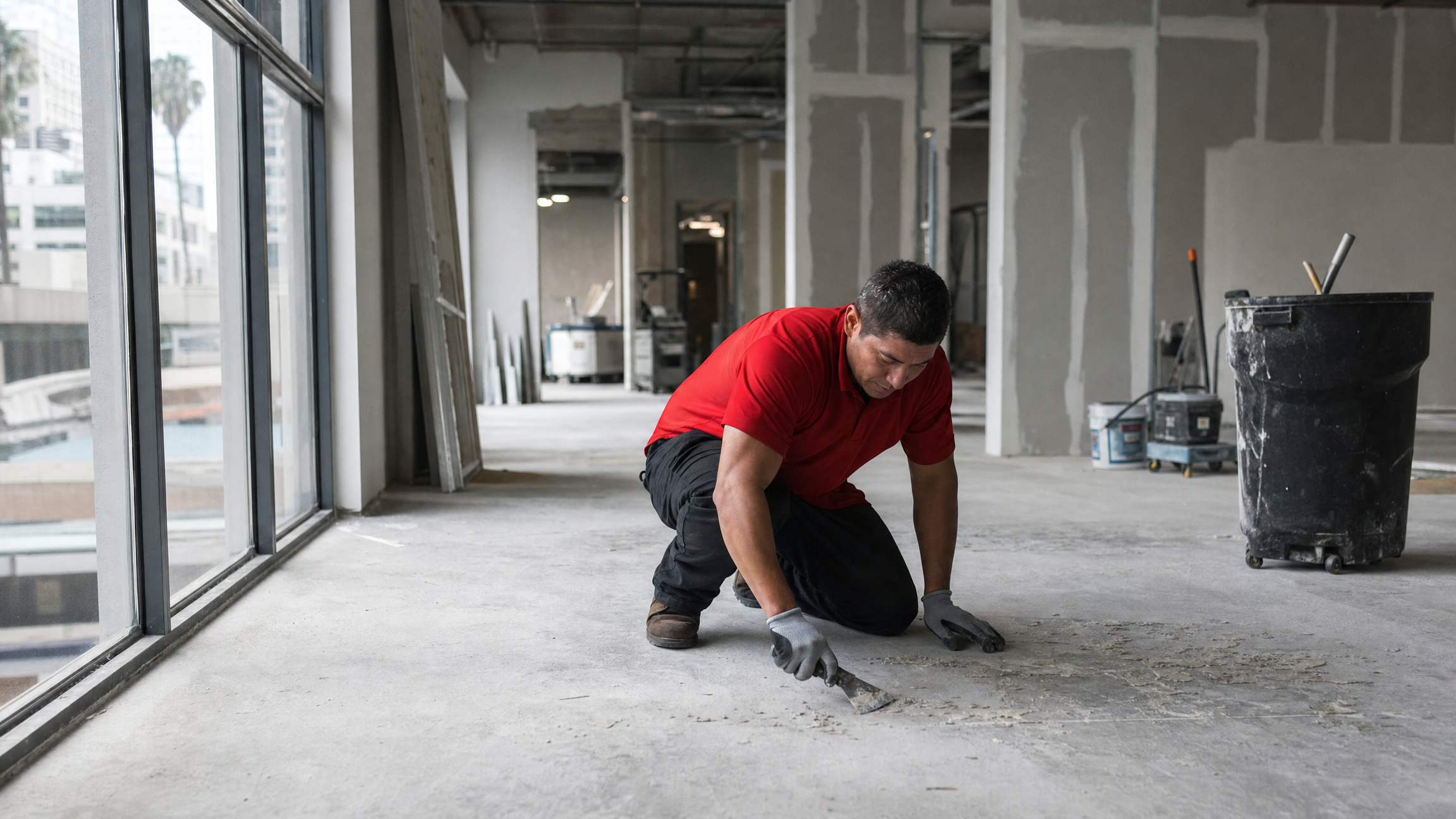
Post-construction tenant improvement (TI) cleanup in a Los Angeles commercial building typically costs between $0.25 and $0.50 per square foot for standard office build-out work, according to 2026 commercial cleaning benchmarks tracked by the Building Service Contractors Association International (BSCAI). Heavy demolition, multi-trade projects, or Class A properties with strict delivery standards can push that figure to $0.75 per square foot or higher. For property managers and facilities directors planning a TI project right now, knowing these numbers before the general contractor closes out keeps the cleanup from becoming an unbudgeted line item at the finish line.
What Post-Construction Cleanup Actually Involves
TI cleanup is not a standard janitorial visit. Contractors leave behind drywall dust, joint compound residue, paint overspray, adhesive on floors, sawdust, and a fine particulate layer that settles on every horizontal surface. A qualified post-construction cleaning crew handles all of it in a structured, multi-phase process that mirrors the GC's delivery schedule.
Phase 1: Rough Cleaning
Rough cleaning happens while trades are still on-site or wrapping up the final week. The crew removes large debris, sweeps and vacuums construction waste, and clears the space so finish work can continue. This is often included in the general contractor's scope, but it's worth confirming in your TI contract before signing. Many GC scopes say "broom clean" without specifying who provides the brooms.
Phase 2: Detailed Construction Cleaning
This is the core scope. Cleaning technicians wipe every surface: window frames and sills, baseboards, door frames, light fixtures, HVAC diffusers, electrical outlets, switch plates, and cabinetry interiors. Floors get scraped of adhesive and compound residue, then cleaned according to the finish type. VCT, polished concrete, carpet, and hardwood each require a different cleaning protocol and set of products. Glass gets cleaned inside and out. Restrooms are scrubbed from ceiling to floor drain.
Post-construction cleanup requires specialized equipment that standard janitorial crews don't carry. HEPA-filtered vacuums are essential for capturing fine silica dust and construction particulate before it recirculates through the building's HVAC system. Industrial floor scrubbers handle concrete and tile when conventional mops would spread contamination rather than remove it. Pressure washers and power washing equipment handle loading dock surfaces, exterior concrete, and any areas where contractor vehicle traffic left grease or grime. For high-bay spaces, telescoping tools and lift equipment reach ceiling-mounted fixtures that need to be wiped before the new tenant occupies the space. These are not optional upgrades for post-renovation cleaning or new construction cleaning: they are the baseline tools that separate a professional construction cleaning company from a standard janitorial service.
Phase 3: Final Punch-Out Cleaning
After the punch list walk with the GC and building representative, a final cleaning pass addresses any touch-up work that created new dust or debris. This is what prepares the space for the occupancy inspection and, critically, for the tenant's move-in day. Skipping or shortcutting this phase is how buildings end up with tenant complaints on day one.
What Drives the Cost Per Square Foot in Los Angeles
Several variables move the price up or down. Knowing them helps you scope the work accurately and compare bids fairly between vendors.
Project Type and Finish Level
A basic open-plan office TI sits at the lower end of the range. A law firm, financial services tenant, or Class A lobby build-out with high-end finishes, custom millwork, or polished concrete takes more time and care to clean. Medical, dental, or lab TI work adds another layer: clinical-grade disinfection of surfaces and careful handling of any materials that touched construction zones. The CDC and OSHA 29 CFR 1926 set baseline standards for construction site cleanliness, but healthcare facility finishes trigger additional requirements that standard construction cleaning doesn't cover.
Square Footage and Ceiling Height
The per-square-foot rate tends to drop slightly on larger projects because crew mobilization, travel, and setup costs are amortized over more billable area. Conversely, spaces with 14-foot ceilings or higher require lifts or extension equipment, which adds time and cost to every overhead surface. Factor this in when comparing bids on high-ceilinged creative-office or industrial-conversion TI projects.
How Much Dust the Project Generated
Drywall dust is the primary cleanup variable. Projects with significant demolition, spray texturing, or extensive patching create heavy dust loads that embed in HVAC systems and settle on every horizontal surface in the building. A heavily dusty space takes two to three times longer to clean than a light cosmetic TI with new drywall and minimal sanding. Confirm with the GC how much cutting and sanding occurred before finalizing your cleaning scope.
Timing, Access, and Building Logistics
Daytime cleaning during active construction requires coordinating around remaining trades. After-hours or weekend access, while more efficient for the cleaning crew, can add a premium if it triggers overtime rates or building engineering charges for after-hours HVAC. Properties that require badging, elevator holds, or loading dock scheduling windows add coordination time that shows up in the quote. Los Angeles high-rise buildings in DTLA and Century City typically have the most complex access requirements.
Specialty Scope Items
Some TI projects include scope beyond standard construction cleaning: pressure washing the loading dock after contractor vehicle traffic, stripping and waxing VCT before the tenant arrives, cleaning the parking structure, or applying a floor sealer as a final step. Each of these should appear as a named line item, not as a surprise add-on after the cleaning crew discovers it on-site.
Pro tip: Get the cleaning contractor on-site during the GC's pre-construction walkthrough, not after the project closes out. A 15-minute walk gives them an accurate scope, surfaces specialty finish items early, and prevents a low estimate that turns into a change order on the first day of cleaning.
Typical Cost Ranges for LA Commercial TI Cleanup in 2026
Here's how the numbers break down across common TI project types in the Los Angeles market:
Standard Office Build-Out
Light TI, open plan, standard finishes: $0.25 to $0.35 per square foot. A 5,000-square-foot suite runs $1,250 to $1,750 for the full three-phase cleaning scope. This is the most common scenario for mid-market office leasing activity in Los Angeles submarkets like the San Fernando Valley, Mid-Wilshire, and Culver City.
Class A or Upgraded Tenant Build-Out
Higher finish quality, custom millwork, polished concrete, or full-floor configuration: $0.35 to $0.50 per square foot. A 15,000-square-foot floor in a DTLA or Century City high-rise runs $5,250 to $7,500 for the complete cleaning scope, including glass, ceilings, and floor preparation for the tenant's Day 1 walkthrough.
Heavy Demo and Multi-Trade Projects
Significant demolition, heavy drywall work, or multi-phase TI with extended contractor duration: $0.50 to $0.75 per square foot. For a 25,000-square-foot project, budget $12,500 to $18,750 for cleaning. These projects almost always require HEPA vacuuming as part of the detailed cleaning phase to address fine particulate that standard vacuums don't capture.
Medical, Dental, or Lab Build-Out
Compliance-grade disinfection, HEPA filtration, and clinical surface protocols: $0.65 to $1.00 per square foot or higher, depending on regulatory requirements and the specific materials present. These projects require a cleaning partner who understands healthcare facility standards, not just commercial cleaning procedures.
What to Include in the Cleaning Scope
Property managers who've run multiple TI projects know that the scope document matters as much as the price. A vague "post-construction cleaning" line item in a GC contract produces vague results. Here's what a solid cleaning scope should name explicitly:
Surface-by-Surface Detail
Every surface type in the space should appear by name: glass (interior and exterior where accessible), metal door frames, painted drywall, millwork and cabinetry (interiors included), countertops, light fixtures, outlets, HVAC grilles and diffusers, and restroom fixtures from ceiling to floor drain. If a surface type isn't listed, it's negotiable after the fact, and you'll lose that negotiation on a tight move-in schedule.
Floor-Type Protocols
The scope should specify the cleaning method for each floor finish present: scrape-and-mop for VCT, dust-mop and damp-mop for polished concrete, extraction for carpet, and buffing for hardwood. VCT in particular often needs stripping and waxing as a separate line item when contractor traffic has dulled or contaminated the finish.
HVAC and Filter Handling
Construction dust finds its way into every diffuser and return. The cleaning scope should include wiping all registers, grilles, and diffusers. Filter replacement is typically handled by the building engineer separately, but confirm this in the turnover checklist so it doesn't fall through the cracks between the GC's close-out and the property manager's punch list.
Debris Disposal and Haul-Away
Confirm who provides trash collection and whether the cleaning crew hauls debris to the loading dock or if the GC's dumpster remains on-site through the cleaning phase. Getting this wrong means a loading dock dispute on day two of cleaning, and neither the GC nor the cleaning contractor will feel responsible for the mess.
How to Choose a Post-Construction Cleaning Company in Los Angeles
Not every commercial cleaning company is equipped to handle post-construction work. Standard janitorial services maintain buildings that are already clean. Post-construction cleaning services restore buildings from a construction site condition to a move-in-ready condition. These are different scopes requiring different training, tools, and project management capabilities.
When evaluating construction cleaning companies, verify the following before signing a contract. First, ask whether the company does post-construction cleaning regularly or only occasionally. Companies that handle construction cleaning as a specialty maintain the right equipment for the job: HEPA-filtered vacuums, floor scrubbers, adhesive removers, and glass cleaning tools. A general cleaning company that occasionally takes on construction cleanup work typically doesn't maintain this equipment and will produce slower, lower-quality results.
Second, confirm the company carries adequate insurance for construction site work. A construction cleaning crew working in a building under active or recently completed construction faces different liability exposure than a crew doing routine office cleaning. General liability insurance for commercial cleaning companies operating in construction environments should reflect this. Ask for a certificate of insurance naming the property owner as an additional insured before work begins.
Third, review the company's process for protecting existing finishes during post-construction cleaning. Improper technique on polished concrete, specialty stone, or hardwood can cause irreversible surface damage that costs far more to repair than the cleaning contract was worth. Ask how they approach each floor type present in your building and whether they use walk-off mats, padding on equipment wheels, and pH-neutral products where indicated.
Fourth, confirm the scope covers all three phases of a professional construction cleanup: rough cleaning, detailed cleaning, and final punch-out cleaning. A construction cleaning bid that covers only one pass is not a full construction cleanup scope. Many property managers discover mid-project that the "construction cleaning" they hired for was a single pass that leaves the space far short of move-in ready.
Fifth, request references from similar project types. A cleaning company experienced with medical TI build-outs, high-rise office towers, or creative office campus projects will understand the specific cleaning challenges those environments present. A company whose reference projects are all suburban strip-center retail spaces may not have experience with the access requirements, building systems, or finish standards common in Class A commercial construction in Los Angeles.
Post-construction cleaning services in Los Angeles range from small owner-operator crews to regional commercial cleaning companies with dedicated construction cleaning divisions. The right choice depends on project scale, finish complexity, and your building's access and scheduling requirements. For single-floor TI projects under 5,000 square feet with standard finishes, a smaller specialized crew may be efficient and cost-effective. For multi-floor, portfolio-wide, or high-complexity projects, a company with project management infrastructure and dedicated construction cleaning teams is usually the better fit.
How MNZ Handles TI Cleanup in Los Angeles
MNZ Commercial Cleaning Services has been handling post-construction cleanup for Los Angeles commercial buildings since 1979. Our construction cleaning crews are trained specifically for post-construction conditions. They carry the right tools for adhesive removal, specialty floor prep, and HEPA particulate capture. They work on a documented phase checklist rather than a general cleaning routine.
Every MNZ construction cleaning crew is background-checked. We carry general liability insurance and workers' compensation coverage, and we provide current certificates of insurance before any crew accesses your property. Class A building risk managers and general contractors require this documentation, and a licensed commercial cleaning contractor should be able to produce it on request. We operate under a valid business license for commercial cleaning services throughout the City of Los Angeles, LA County, and Southern California.
We work with property management companies, GCs, and facilities teams across Los Angeles, from office towers in Century City and Downtown to creative-office campuses in Culver City and Santa Monica. Our construction cleanup scope covers all three phases, a written surface-by-surface punch list, and a final walk with the building contact before we sign off. Post-renovation cleanup for a tenant improvement inside an occupied building is a different scope from ground-up new construction cleaning, and we quote them separately: renovation projects require protecting adjacent occupied spaces and building systems in addition to cleaning the TI suite itself.
Labor represents 50 to 65 percent of a commercial cleaning company's operating cost, according to BSCAI's 2026 industry data. That's why bids that look unusually low almost always mean fewer crew hours, fewer cleaning phases, or surfaces quietly removed from scope. We'd rather give you an accurate number upfront than issue a change order after the first day on-site.
FAQ: Post-Construction TI Cleanup in Los Angeles
How long does post-construction cleanup take for a 10,000-square-foot office TI?
Standard TI cleanup for a 10,000-square-foot space typically takes one to two full crew days, depending on project complexity and dust load. Heavy drywall work or specialty finishes can extend that to three days. We walk the space first and give you a time estimate before scheduling the crew so there are no surprises on the schedule.
Can the cleaning happen while the GC's punch list is still open?
Yes, and it often has to. We coordinate with the GC's superintendent to clean around open punch list items. The key is communicating clearly which areas are complete and which trades are still moving through. Final cleaning happens after the last trade exits the space and the GC signs off on completion.
Who is responsible for post-construction cleaning, the GC or the landlord?
This depends on the lease and the TI work letter. Many leases specify that the GC delivers the space "broom clean" and the landlord or tenant handles the final detailed cleaning. Some landlords handle full construction cleaning as part of their turnover standard. Check your TI work letter before assuming the GC has it covered, because "broom clean" and "ready for occupancy" are not the same standard.
Does MNZ handle construction cleanup for multi-floor or multi-building TI projects?
Yes. We regularly handle multi-floor TI projects for property management companies and portfolio owners across the Los Angeles market. We can phase the cleaning to match the GC's floor-by-floor delivery schedule and keep a single point of contact for the whole project, which matters when you're managing multiple stakeholders against a hard move-in date.
Ready to get a quote for your TI project? Call MNZ at (818) 480-9316 or reach out through our contact page. We'll schedule a site walkthrough, deliver a written scope with per-phase pricing, and make sure your space is ready for the occupancy inspection and tenant move-in.
Related Reading
What Does Commercial Cleaning Cost Per Square Foot in Los Angeles in 2026?
What Do Office Janitorial Services Include for a Los Angeles Commercial Building?
Transform your space into a clean and welcoming environment with MNZ. Contact us today to schedule a consultation and get a quote for our professional cleaning and maintenance services.
.jpg)


