
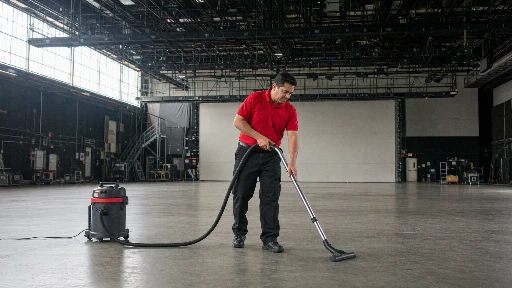
Soundstages and production offices need a cleaning approach that's completely different from a standard commercial building, and the stakes are higher than most facilities managers realize. A disruption during filming can cost $50,000 or more per unplanned hour on a mid-budget production. Dirt, debris, and cleaning crew disruptions can all trigger those delays. At MNZ Commercial Cleaning Services, we've worked alongside national broadcast networks and major studios for decades, and we've learned that getting this right requires specific protocols, flexible scheduling, and crews who understand how a live production environment works.
Why Soundstage Cleaning Is a Different Animal
A soundstage isn't just a large empty room. On any given day, it might hold multi-million-dollar camera systems, lighting rigs, custom set construction, period furniture, props, and live animals. The cleaning crew has to move through all of that without disturbing anything, and they have to do it fast, often between scenes or overnight before a 6 a.m. call time.
The core challenge is that production environments are dynamic. The set layout changes constantly. What was a clear aisle on Monday becomes a cable run on Tuesday. A cleaning contractor that can't adapt to that level of change creates friction on a set that can't afford friction.
Dust Control on Active Stages
Dust is the number one enemy of a working soundstage. It settles on camera lenses, clogs lighting equipment, and shows up on screen as a haze or grain that costs time in post-production. According to ISSA's 2026 Cleaning Industry Outlook, dust management in film production environments requires continuous low-dust protocols, including microfiber-only mopping, HEPA-filtered vacuums, and a strict no-blower policy on active floors.
The cleaning crew should never use backpack blowers on a soundstage. Dry-mopping with electrostatic microfiber heads traps particulate rather than redistributing it into the air. Every product the crew brings onto a working stage should be low-VOC and fragrance-free, because camera lenses and electrical equipment can be sensitive to chemical off-gassing, and anything with a strong scent disrupts the talent and crew environment.
Shoot-Around Scheduling: Working the Production Calendar
A professional cleaning operation for soundstage and production facilities runs on the production's call sheet, not a fixed schedule. That means the cleaning contractor has to receive and read the call sheet, know when the crew is on stage versus when the stage is dark, and be ready to execute a full clean in a compressed window.
Typical cleaning windows on a working production fall into three categories. First, overnight cleans, which happen between shooting days and address the full stage floor, all common areas, dressing rooms, and production offices. Second, turnaround cleans, which happen in the short window between a company wrap and the next company's setup, often only two to four hours. Third, episodic deep cleans between production blocks, where the crew can address equipment storage areas, greenrooms, and production trailers thoroughly.
Pro tip: Build a communication chain between the cleaning supervisor and the production's key PA or locations manager. A daily 8 p.m. text confirming the next day's access windows prevents the single most common cause of cleaning failures on a working stage: the crew showing up when the stage is locked for an unexpected late shoot.
Production-Office Cleaning: High Traffic, High Visibility
The production office is the nerve center of any film or TV operation. Writers' rooms, conference rooms where network executives walk in unannounced, wardrobe staging areas, and hair and makeup suites all sit under one roof. These spaces see more foot traffic per square foot than almost any other type of commercial environment, and they have to look polished at all times because clients, press, and network representatives visit without much notice.
Writers' Rooms and Conference Rooms
Writers' rooms typically accumulate paper, food containers, whiteboard residue, and coffee cups at an extraordinary rate, and they're often in use from early morning to late at night. The cleaning window is usually limited to 30 to 45 minutes during a lunch break or early in the morning before the room fills again.
Whiteboard cleaning deserves special attention. A whiteboard covered in story cards, episode arcs, or character maps can represent months of creative work. The cleaning crew should never erase or disturb a whiteboard in a production office. Wipe only the surfaces that are clearly marked for cleaning, and when in doubt, leave it alone.
Hair, Makeup, and Wardrobe Suites
Hair and makeup suites require sanitized surfaces consistent with California Department of Public Health guidelines for cosmetology environments. That means all work surfaces, chair arms, and mirror frames wiped with a quaternary ammonium disinfectant, floors cleaned with a hospital-grade solution, and garbage emptied and relined between every use period.
Wardrobe rooms have a different set of concerns. Costumes are expensive, often irreplaceable, and sometimes on loan from studios or costume houses. The cleaning crew should use only fragrance-free products in these spaces, and should never move, rehang, or touch any garment. Floor cleaning, surface cleaning, and trash removal only.
Greenrooms and Talent Spaces
Greenrooms and talent waiting areas need to be cleaned more frequently than standard offices because they're occupied by rotating groups of people throughout the day. At MNZ, our standard protocol treats these spaces as semi-public, meaning hourly spot checks during active production days and a full deep clean every evening.
According to CDC high-touch surface disinfection guidelines (2026 revision), door handles, light switches, remote controls, and arm rests should be disinfected at a minimum every four hours in high-traffic visitor environments. Production sets qualify as exactly that type of environment.
Specialty Areas: What Most Cleaning Companies Miss
Beyond the main stage and production office, a media campus has specialty areas that standard cleaning companies often underestimate or skip. These areas can become compliance and liability problems if not handled correctly.
Equipment Storage and Camera Prep Rooms
Camera prep rooms and equipment cages need to be clean in a very specific way. No liquids near optical equipment. No cleaning sprays applied directly in the space; instead, dry microfiber wipes only. Floors swept with electrostatic pads rather than wet-mopped. Any spill near optical or electronic equipment gets reported immediately to the equipment manager rather than cleaned without consultation.
The camera prep room isn't a room the cleaning crew should improvise in. The protocol should be written, agreed on with the production's equipment manager before the contract starts, and followed to the letter on every visit.
Sound Booths and Control Rooms
Sound booths have acoustic panels, custom flooring, and mixing consoles that can run over a million dollars. The cleaning protocol for these rooms is restricted: vacuum the floor using a HEPA unit only, wipe visible hard surfaces with a barely damp microfiber cloth, empty trash, and do nothing else without explicit clearance from the audio department head. Chemical sprays in a control room can damage console faders and buttons over time.
Exterior Lot Maintenance
On a larger media campus, exterior cleaning covers production parking, equipment staging areas, and exterior building facades. Pressure washing between productions keeps staging areas free of oil, tire marks, and debris from equipment moves. Day porter services during active production days manage the ongoing waste stream from catering, equipment packaging, and crew movements.
At MNZ, our commercial janitorial services for Los Angeles media properties combine daily porter coverage with scheduled deep cleans, keeping both the interior and exterior of a working campus at the standard that professional productions expect.
Staffing and Vetting for Production Environments
One area where production facilities differ sharply from standard commercial cleaning contracts is staffing. Most major studios and production companies require background checks on all vendors and their employees who work on site. Some require additional clearances for sets with confidential scripts or unreleased content. An experienced cleaning contractor for this vertical has to have a staffing model that can support background-check requirements without creating turnover problems.
Crew consistency matters enormously on a working set. A new face in the equipment room is a potential liability concern for the production. The cleaning contractor should assign the same core crew members to a facility for the duration of a production, with documented substitute protocols when a team member is unavailable. At MNZ, we've maintained this kind of crew consistency for our media and studio clients since our founding in 1979, which is part of why we hold long-term relationships with the same properties year after year.
BSCAI's 2026 labor data shows that cleaning companies with documented crew consistency programs have significantly lower client attrition in specialty verticals like media and healthcare, compared to contractors using a rotating pool model. Consistency isn't just a client preference; it's a business differentiator.
Frequently Asked Questions
Can a cleaning company work around an active shoot without disrupting the production?
Yes, but only if the crew is specifically trained for production environments and has a clear communication channel with the production's locations team. The cleaning supervisor needs to receive daily call sheets or production schedules and be flexible enough to shift access windows when shooting runs long. At MNZ, we build this coordination into every media campus contract from day one.
How do you clean a soundstage without damaging camera or lighting equipment?
The core rules are: dry cleaning methods only near equipment, no sprays or liquids near optical or electronic gear, HEPA vacuums rather than blowers, and any potential equipment contact gets escalated to the equipment manager before the crew acts. Protocols for each production environment get written and approved before the first cleaning visit.
What background check requirements do cleaning companies need to meet for studio work?
Requirements vary by studio and production. Most major studio lots require criminal background checks through an approved vendor, and some require drug testing. Confidential productions may add additional screening. A cleaning contractor working in this vertical should have an established HR process for screening and be able to produce documentation for every crew member on request.
How often should a production office be cleaned during an active shoot?
High-traffic areas like writers' rooms, conference rooms, and greenrooms should receive daily cleaning plus midday spot service during active shooting days. Hair, makeup, and wardrobe suites should be restocked and sanitized between each use period. Overnight deep cleans covering the full office footprint should happen every shooting day.
When a production office, soundstage, or full media campus needs a cleaning team that can work without getting in the way of the work, reach out to MNZ Commercial Cleaning Services. We've partnered with national broadcast networks and major studios for decades, and we understand that on a working set, the cleaning crew is part of the production team. Call us at (818) 480-9316 or contact us online to discuss your facility's specific requirements.
Related Reading
How Does High-Rise Window and Facade Cleaning Work on an LA Tower?
How Do You Clean Retail, Showroom, and Hospitality Spaces in West Hollywood?
Transform your space into a clean and welcoming environment with MNZ. Contact us today to schedule a consultation and get a quote for our professional cleaning and maintenance services.
.jpg)


