

There's a gap between what most building managers think sustainable maintenance means and what it actually looks like in practice.
Most people hear "sustainability" and picture a recycling program or LED bulb swaps. Those things matter, but they're not a strategy. A truly sustainable building maintenance plan encompasses every system in your property, and one of the most frequently overlooked components is your janitorial program.
If you're managing a commercial property in Los Angeles, West Hollywood, Santa Monica, El Segundo, or Pasadena, you're also operating under some of the toughest environmental regulations in the country. California's CALGreen building standards, LEED certification requirements, and local municipal waste reduction mandates don't give you a lot of wiggle room. But here's the thing: the buildings that take sustainability seriously aren't just compliant. They're more profitable, more attractive to tenants, and less expensive to maintain over time.
So let's talk about how green janitorial services actually fit into that bigger picture and what a real sustainable building maintenance strategy looks like when you put it all together.
Why Most Building Sustainability Plans Miss the Cleaning Layer
Here's a problem that comes up again and again: property managers put real effort into energy audits, water-efficient fixtures, and sustainable landscaping, and then hand off the cleaning contract to whoever gives them the lowest bid. The result is a building that scores well on paper but gets mopped with chemical-heavy products every night that off-gas VOCs (volatile organic compounds) into a space that's supposed to be healthy.
According to the U.S. Environmental Protection Agency, indoor air can be two to five times more polluted than outdoor air, and traditional cleaning products are a major contributor. For commercial buildings, where ventilation systems recirculate air across entire floors, that's a real problem for occupant health and for any sustainability claims you're making to tenants.
A 2022 report from the Building Owners and Managers Association (BOMA) found that 73% of tenants now consider sustainability features when deciding whether to renew a commercial lease. That number climbs even higher for Class A office tenants in urban markets like Los Angeles. So when your cleaning program works against your sustainability goals, you're not just missing an environmental benchmark but also compromising on eco-friendly cleaning. You're potentially losing tenants.
What Sustainable Building Maintenance Actually Covers
Sustainable building maintenance is a whole-building approach that incorporates environmentally friendly cleaning products. It means every system that keeps your property running, from HVAC filters to floor care to exterior pressure washing, operates with efficiency, reduced waste, and minimal environmental impact.
Here's a straightforward way to think about it. Your building has five maintenance layers:
- 1. Indoor air quality management. HVAC maintenance schedules, filtration standards, and the daily use of products, including cleaning solutions, fall under this category.
- 2. Water consumption. This category covers everything from low-flow restroom fixtures to the amount of water your cleaning team uses when they mop floors or clean exterior surfaces.
- 3. Waste reduction is a key component of sustainable practices. Recycling programs matter, but so does whether your cleaning supplier is delivering products in single-use plastic versus concentrated refillable containers.
- 4. Surface and material longevity. Harsh chemical cleaners degrade flooring, upholstery, and surfaces faster. Sustainable cleaning products actually extend the life of your building's materials.
- 5. Occupant health and wellness. This aspect is the one that ties back directly to your green janitorial services program. Fragrance-free, low-toxicity products reduce respiratory irritation, headaches, and sick days for the people inside your building.
Each of these layers connects to the others. When one is out of alignment, it creates problems across the board.
How Green Janitorial Services Connect to Building Performance
Think of your cleaning program as the nervous system of your sustainable building maintenance strategy. It touches every surface, every room, and every system in your property, usually more often than any other maintenance function.
A true green janitorial services program uses products certified by Green Seal, the EPA's Safer Choice label, or equivalent third-party standards. These certifications aren't just marketing. They require manufacturers to disclose every ingredient and prove that the product doesn't contain known carcinogens, hormone disruptors, or compounds that break down into hazardous substances.
But product certification is only one part of the picture. The processes matter just as much.
For example, microfiber cleaning tools use up to 90% less water and chemical solution compared to traditional mops and cotton cloths, according to research published by Kaiser Permanente's environmental health program. HEPA-filtered vacuums prevent fine particles from being redistributed into the air rather than captured. Daytime cleaning schedules, which some properties are shifting to, reduce the need for after-hours lighting and HVAC operation, cutting energy use.
When you add these process-level changes to certified product use, your cleaning program starts contributing measurably to your building's sustainability performance, not just staying neutral.
The LEED and CALGreen Connection Building Managers Need to Understand
If your property is pursuing LEED certification, or if you're managing a building that already holds it, your janitorial program directly affects your scores. LEED for Existing Buildings (LEED EB) includes credits specifically tied to green cleaning policies, sustainable purchasing, and occupant exposure to cleaning chemicals.
CALGreen, California's mandatory green building standards code, also includes requirements around indoor air quality that your cleaning products and methods affect. This isn't optional for properties in Los Angeles County. It's part of doing business in California.
For properties in El Segundo, Pasadena, and West Hollywood, local sustainability initiatives add another layer. The City of Los Angeles's Sustainable City plan, for example, sets targets around zero waste and emissions reductions that translate directly into how large commercial properties are expected to operate.
If your current janitorial contractor can't provide documentation of their product certifications, training protocols, and waste reduction practices, that's a problem. Not just for your sustainability goals, but for your compliance posture in relation to eco-friendly cleaning regulations.
A Real-World Benchmark: What Happens When You Align Your Cleaning Program With Your Sustainability Strategy
Let me give you an anonymized but realistic picture based on industry benchmarks in commercial cleaning services.
A mid-size office building in the Los Angeles metro area, roughly 80,000 square feet, switches from a standard janitorial contract to a certified green janitorial services program. Over 12 months, here's what the data typically shows:
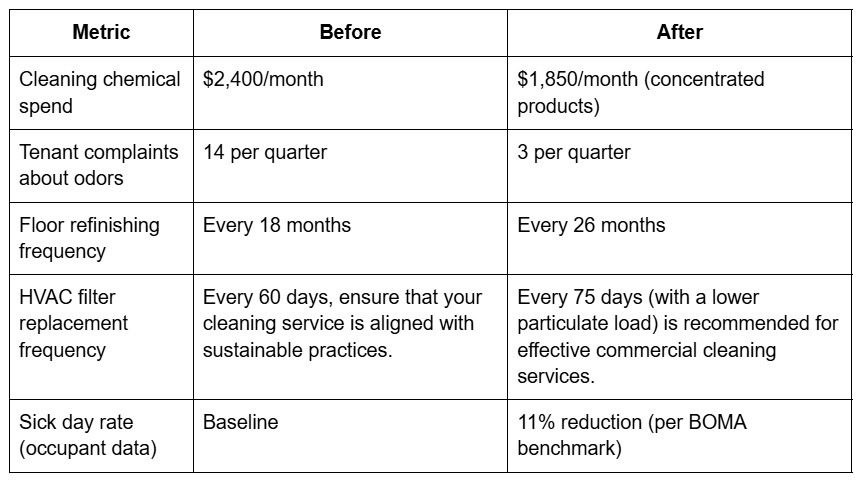
The floor refinishing number is worth pausing on. Harsh cleaning chemicals strip protective finishes faster. Extending your refinishing cycle from 18 to 26 months on a building with a significant floor area can save you thousands of dollars annually, and that's before you count the disruption cost to tenants during refinishing.
This argument often goes unheard: sustainable building maintenance represents an investment in environmentally friendly practices rather than a cost. It's a return on investment with a shorter payback period than most building managers expect when using sustainable practices.
How to Build This Into Your Maintenance Strategy: A Practical Framework
You don't have to overhaul everything at once. Here's a phased approach that makes sense for most property managers.
Phase 1: Audit your current cleaning program. Ask your current janitorial provider to show you their product list and certifications. If they can't point to Green Seal, EPA Safer Choice, or equivalent third-party certification for their primary eco-friendly cleaning products, you have a gap.
Phase 2: Align your janitorial scope with your sustainability goals. Write your cleaning contract scope to include specific sustainability requirements: certified products, microfiber equipment, HEPA filtration on vacuums, and waste diversion practices for cleaning supply packaging.
Phase 3: Connect your cleaning schedule to building systems. Talk to your HVAC maintenance team about how cleaning timing and products affect filter load and air quality. These two functions should be coordinated, not siloed.
Phase 4: Document everything. If you're pursuing LEED credits or responding to tenant sustainability questionnaires (increasingly common from corporate tenants), you need documentation. Your green janitorial services provider should be able to supply product data sheets for green cleaning products, training records, and service logs on request.
Phase 5: Review annually. Sustainability benchmarks change, California regulations evolve, and new products come to market. Build an annual review of your janitorial program into your broader building maintenance planning calendar.
What to Look For When Hiring for Sustainable Building Maintenance
Not every company that claims to be "green" actually is. Here are the questions to ask any janitorial provider you're evaluating for a property in Los Angeles County:
- What percentage of your cleaning products carry Green Seal or EPA Safer Choice certification?
- Do your staff receive training on low-chemical and low-water cleaning methods in your cleaning service?
- Can you provide product safety data sheets for every product used in our building?
- How do you handle cleaning product packaging waste?
- Do you have experience working with LEED-certified or LEED-pursuing buildings that prioritize green cleaning products?
- Can you support our sustainability reporting with service documentation?
A provider who can answer all of these questions clearly and without hesitation is a very different vendor from one who puts "eco-friendly" on their website but can't back it up.
Conclusion: Your Building's Sustainability Plan Has a Cleaning-Shaped Hole in It
The biggest takeaway here is simple. Sustainable building maintenance isn't something you achieve with one initiative. It's a system, and every part of it has to point in the same direction.
Green janitorial services aren't a nice-to-have add-on to your sustainability strategy. They're one of the most frequent and consistent touchpoints in your building, making them a high-leverage area for improvement.
If you're managing a property in Los Angeles, West Hollywood, Santa Monica, El Segundo, or Pasadena and you're ready to close the gap between your sustainability goals and your day-to-day operations, MNZ Janitorial Services can help. We work with building managers, property managers, landlords, and office managers across LA County to build cleaning programs that actually support whole-building sustainability goals, not just check a box.
Request a free consultation at mnz.com, and let's build a plan that works for your building.
Transform your space into a clean and welcoming environment with MNZ. Contact us today to schedule a consultation and get a quote for our professional cleaning and maintenance services.
.jpg)


