
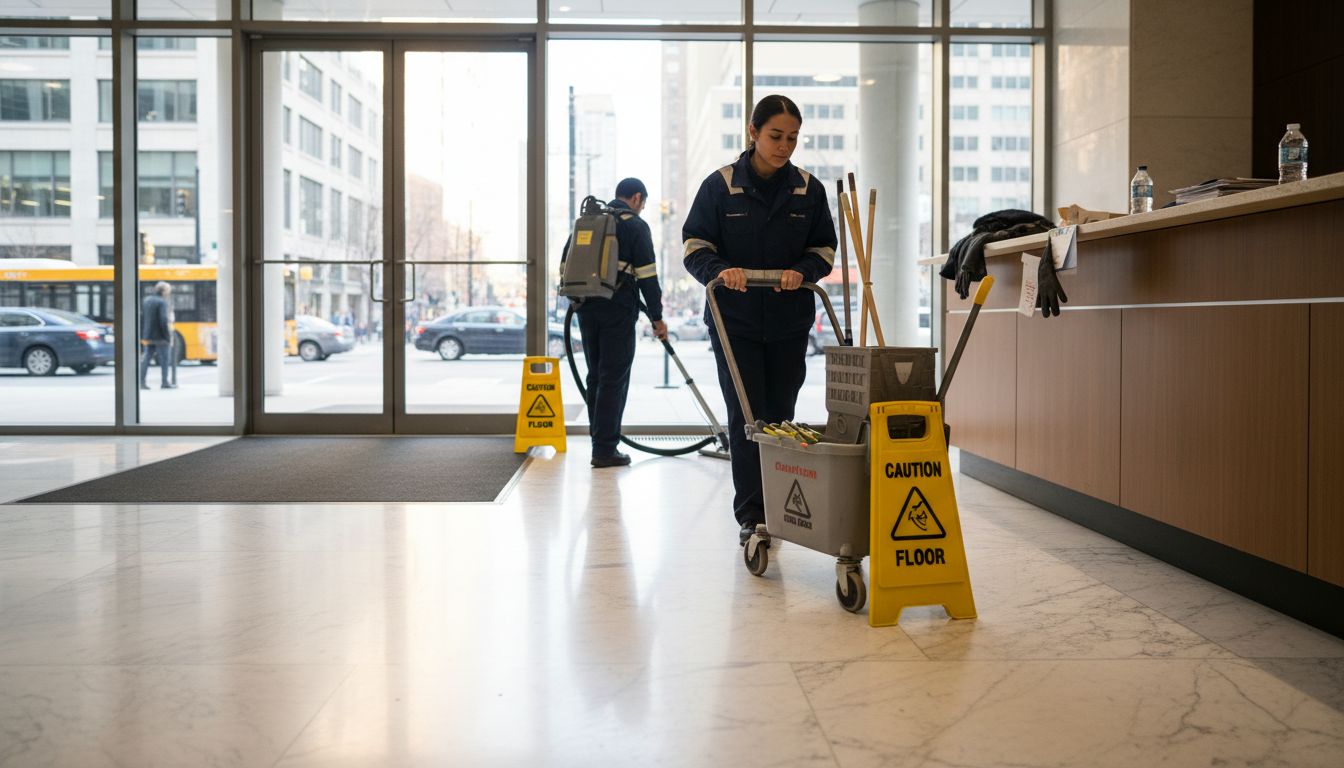
Maintaining a clean and hygienic workplace involves more than simply aesthetics. It impresses clients, shields workers from pathogens, and even increases productivity. In busy offices, hospitals, and retail establishments, maintaining cleanliness is essential. But not every company requires the same degree of cleanliness. This is where various kinds of commercial cleaning services are useful.
Here's the thing: most building managers don't realize until it's too late that not all commercial cleaning services are created equal. And choosing the wrong type can cost you thousands in tenant turnover, compliance violations, or emergency cleanup calls.
After working with numerous properties across Los Angeles County, from West Hollywood high-rises to El Segundo office parks, I've seen what happens when managers try to fit square pegs into round holes.
The commercial cleaning industry is projected to grow by 6.9% annually through 2030, reaching $616.98 billion globally. But here's what nobody tells you: this growth has created a confusing maze of service types, pricing models, and specialty offerings. Building managers in Los Angeles are confronted with unique challenges, including stringent California environmental regulations and post-pandemic hygiene expectations that have elevated the definition of "clean."
Let me break down the eight core types of commercial cleaning services you need to know about, which situations call for each one, and how to avoid the costly mistakes I've watched managers make year after year.
1. Standard Janitorial Services: Your Daily Bread and Butter
Think of standard janitorial services as your baseline. These are the regular, recurring tasks that keep your building functioning day to day.
What's included:
- Trash removal and recycling
- Vacuuming and mopping common areas
- Restroom cleaning and restocking
- Dusting surfaces and furniture
- Break room maintenance
- Light fixture cleaning
Who needs this: Literally everyone. Office buildings with 5,000+ square feet typically schedule janitorial services three to five times weekly. Smaller spaces might get by with twice-weekly visits.
According to recent industry data, 61% of cleaning companies prioritize new customer acquisition and revenue growth, which means there's fierce competition for your business. Use this to negotiate better rates and service guarantees.
Typical cost: $30-$50 per hour or $0.07-$0.15 per square foot for offices in Los Angeles County. Your mileage varies based on frequency and building complexity.
2. Day Porter Services: The Difference Between Good and Great
Day porters are your secret weapon for high-traffic buildings. Unlike night crew janitors who work after hours, day porters maintain cleanliness during business hours.
What they handle:
- Immediate spill response
- Continuous restroom monitoring
- Lobby and entrance maintenance
- Conference room turnover between meetings
- Supply replenishment throughout the day
- Quick touch-ups in high-traffic areas
Who needs this: Buildings with heavy foot traffic, multi-tenant properties, medical facilities, and any space where appearances matter during business hours. If you've got clients or visitors coming through daily, you need a day porter.
A building manager in Pasadena told me their day porter service reduced tenant complaints by 73% in the first six months. Why? Because problems got addressed immediately instead of waiting until the night crew arrived.
Critical consideration: Day porters typically work Monday through Friday, 8-10 hours per day. You're looking at a significant investment, but the return shows up in tenant retention and property value.
Typical cost: $15-$25 per hour plus benefits if you hire directly, or $25-$40 per hour through a service provider.
3. Deep Cleaning Services: The Reset Button
Regular janitorial maintenance maintains cleanliness. Deep cleaning restores it.
What receives the treatment:
- Carpet extraction and steam cleaning
- Hard floor stripping and waxing
- Ceiling and wall washing
- Behind-furniture cleaning
- Air vent deep cleaning
- Grout cleaning and sealing
Who needs this: Every commercial building, period. The question isn't whether you need deep cleaning, but how often. Most experts recommend quarterly deep cleans for standard office spaces, with high-traffic areas getting attention monthly.
Scheduling strategy: Don't wait until things look dirty. By then, you're dealing with damage, not just dirt. Schedule deep cleaning during slow periods or long weekends. Your tenants will notice, trust me.
I know one El Segundo property manager who schedules deep cleaning right before the lease renewal season. Smart move. Clean buildings photograph better and justify rate increases more easily.
Typical cost: $0.15-$0.40 per square foot, depending on the scope. Budget $3,000–$8,000 for a 20,000 square foot office space quarterly.
4. Specialty Cleaning: When Standard Won't Cut It
Some surfaces and situations demand expertise beyond general cleaning.
Common specialty services:
- Window cleaning (especially for multi-story buildings)
- Pressure washing for exteriors and parking structures
- Post-construction cleanup
- Medical facility sanitization
- Kitchen and restaurant deep cleaning
- Marble and stone restoration
Who needs this: It depends on your building's unique features. Do you have floor-to-ceiling windows? You need professional window cleaners with the right insurance and equipment. Historic building with marble lobbies? General cleaners can damage those surfaces within a few months.
Industry data indicates that a growing focus on improving indoor air quality will continue to drive commercial spending on cleaning services. This means specialized cleaning of air ducts and HVAC sanitization services are becoming standard, not optional.
Watch out for: Companies claiming they can do everything. Specialty cleaning requires specialty equipment and training. Too many janitorial companies have ruined marble floors by using the wrong cleaning solutions.
Typical cost: Highly variable. Window cleaning costs $5–$15 per pane. Pressure washing costs $0.15–0.75 per square foot. Get detailed quotes before committing.
5. Green Cleaning Services: Not Just for Tree Huggers Anymore
Green cleaning uses eco-friendly products and sustainable practices. And before you roll your eyes at the premium pricing, understand that California is pushing hard on environmental compliance.
What makes it different:
- EPA Safer Choice certified products
- Microfiber systems instead of disposable materials
- Low-water consumption techniques
- HEPA filtration vacuums
- Green Seal certification standards
Who needs this: Any building targeting LEED certification, properties with chemically sensitive occupants, and frankly, anyone who wants to avoid liability from harsh chemical exposure. Los Angeles County has some of the strictest environmental regulations in the country.
Typical cost: Usually 10-20% more than conventional cleaning, but savings on waste disposal and potential insurance premiums can offset the difference.
6. Disinfection and Sanitization Services: The Post-Pandemic Essential
These services go beyond cleaning to kill pathogens and reduce disease transmission.
What's involved:
- Electrostatic spray disinfection
- EPA-registered hospital-grade disinfectants
- High-touch surface protocols
- Air quality improvement treatments
- Antimicrobial coatings for long-term protection
Who needs this: Healthcare facilities, schools, gyms, and honestly, any building serious about keeping occupants healthy. The EPA estimates poor indoor air quality costs tens of billions yearly in lost productivity and medical care.
Remember when COVID hit, and every building scrambled to implement new protocols? The smart managers didn't panic because they already had sanitization services in place.
Frequency considerations: Basic disinfection should be part of your regular janitorial schedule. Deep sanitization happens quarterly or after illness outbreaks. You should prioritize emergency sanitization services.
Typical cost: $0.07-$0.25 per square foot for routine services. Emergency response services command premium rates, sometimes $0.50+ per square foot.
7. Floor Care Services: Protecting Your Biggest Investment
Your floors represent a massive chunk of your building's value. Treating them as an afterthought is expensive.
Service levels:
- Routine maintenance (sweeping, mopping, vacuuming)
- Periodic maintenance (buffing, spot treatment)
- Restorative maintenance (stripping, recoating, refinishing)
- Carpet cleaning and protection
Material-specific needs:
- VCT and vinyl: Strip and wax every 6-12 months
- Hardwood: Professional refinishing every 3-5 years
- Carpet: Deep extraction every 3-6 months
- Tile and grout: Seal annually, deep clean quarterly
Industry statistics indicate that the carpet and upholstery segment is the most profitable, experiencing the fastest growth from 2023 to 2030. Quality floor care directly impacts tenant satisfaction and retention.
Typical cost: $0.25-$0.75 per square foot for strip and wax. Carpet cleaning runs $0.15-$0.40 per square foot. Build this into your annual maintenance budget, not your emergency fund.
8. Emergency and Restoration Services: Your Safety Net
Sometimes disasters happen. Water damage, fire, vandalism, and biohazard cleanup. You need a rapid response.
What they cover:
- 24/7 emergency response
- Water extraction and drying
- Fire and smoke damage cleanup
- Mold remediation
- Biohazard and trauma cleanup
- Vandalism restoration
Who needs this: Everyone should have an emergency cleaning service on retainer. When a pipe bursts at 2 AM on a Saturday, you can't wait until Monday to start cleanup.
Response time matters: Every hour of delay in water damage response increases restoration costs exponentially. Response time often determines the difference between a $5,000 cleanup and a $50,000 disaster.
43% of industry leaders already leverage end-to-end business management systems, which means the best emergency services can dispatch immediately and track response in real time.
Typical cost: Expect $150-$500 per hour for emergency response, plus materials and equipment. Yes, it's expensive. But compared to tenant displacement, property damage, and insurance claims, it's a bargain.
Making the Right Choice: A Framework for Building Managers
Now that you understand the types, here's how to match them to your building:
Step 1: Assess Your Baseline Needs
- Square footage and layout
- Number of occupants and daily traffic
- Operating hours and access requirements
- Current pain points and complaints
Step 2: Factor in Your Building Type
- Class A buildings in Los Angeles need day porters and premium finishes
- Medical offices require specialized sanitization
- Industrial spaces need different protocols than corporate offices
- Multi-tenant properties benefit from visible daytime maintenance
Step 3: Calculate True Costs
Don't just compare hourly rates. Factor in:
- Frequency requirements
- Supplies and equipment
- Response time for issues
- Contract flexibility
- Insurance and bonding
Step 4: Test Before Committing
Start with a 3-6 month trial period. The cheapest option isn't cheap if you're replacing them every quarter. We've seen this pattern repeatedly: managers choose the lowest bid, experience problems within weeks, then pay premium rates to switch to a reliable service.
Step 5: Build a Tiered System
Most successful buildings use a combination:
- Daily/nightly: Standard janitorial
- Weekly: Specialty tasks (windows, detailed restroom cleaning)
- Monthly: Floor maintenance, deep touch-ups
- Quarterly: Deep cleaning and restoration
- As-needed: Emergency response and seasonal services
Red Flags When Choosing Services
Watch for these warning signs:
- They won't provide references: Any legitimate service should have a portfolio of similar buildings. If they hesitate, walk away.
- Insurance questions are dodged: Verify general liability coverage of at least $2 million and workers' compensation. Period.
- No written protocols: Professional services document their procedures. "We'll figure it out" isn't a plan.
- Rock-bottom pricing: If a quote is 40% below market rate, something's wrong. Either they're cutting corners, using cheap products, or they won't be around long.
- Inflexibility: Your needs will change. Services that can't scale up for special events or adjust schedules around your operations will create headaches.
The Bottom Line: Investment, Not Expense
Here's what I tell every building manager: proper commercial cleaning isn't a cost center. It's an investment that returns value through tenant retention, property preservation, and reduced emergency expenses.
The commercial cleaning services market is growing because building managers are finally recognizing this truth. The North American cleaning services market is expected to grow at a rate of 6.9% from 2025 to 2030, reaching $616.98 billion. This growth reflects the increasing understanding that building maintenance directly impacts bottom-line performance.
Your Next Steps
Start here:
- Audit your current situation. What's working? What complaints keep coming up? What's been deferred too long?
- Pricing out the right mix. Get quotes from three providers for each service type you need. Compare apples to apples.
- Check references obsessively. Call other building managers. Ask about responsiveness, quality consistency, and how they handle problems.
- Negotiate trial periods. Three months provides you enough time to evaluate without locking into a hazardous situation.
- Document everything. Create a cleaning specification document. When everyone knows the standards, accountability improves dramatically.
The types of commercial cleaning services available today give you powerful tools to maintain your building, protect your investment, and keep tenants happy. But only if you choose the right combination for your specific situation.
Take Action Now
Ready to upgrade your building's cleaning program? Here's what to do:
Contact MNZ Janitorial Services for your building assessment. We'll walk your property, identify your specific needs, and recommend the right combination of services, without the sales pressure.
We've been serving Los Angeles County, including West Hollywood, Santa Monica, El Segundo, and Pasadena, for years. We understand California compliance requirements, local labor markets, and what it takes to maintain properties in this competitive market.
Call us at (818) 480-9316 or visit our website to schedule your consultation. Let's build a cleaning program that actually works for your building, your budget, and your customers. You shouldn't have to choose between quality and affordability when it comes to your cleaning services. You shouldn't have to manage five vendors for five different services.
Transform your space into a clean and welcoming environment with MNZ. Contact us today to schedule a consultation and get a quote for our professional cleaning and maintenance services.
.jpg)


