

If you manage or lease a clinic, dental practice, or outpatient facility in LA, 2026 is not the year to “wing it” on sanitation. Regulations are tightening, inspections are getting stricter, and patients are more hygiene-conscious than ever. That’s why understanding Medical Office Cleaning Compliance: What Los Angeles Healthcare Tenants Must Know (2026 Update) isn’t optional—it’s essential.
From OSHA bloodborne pathogen standards to CDC infection control protocols and local public health mandates, healthcare facilities face higher scrutiny than standard commercial spaces. This means your approach to medical office cleaning in Los Angeles must go beyond basic janitorial tasks. You need specialized healthcare janitorial services that understand disinfection logs, biohazard disposal, and cross-contamination prevention.
In this 2026 update, we’ll break down the latest compliance requirements, explain how commercial cleaning compliance impacts your lease and liability, and show you how to protect your patients, staff, and reputation—without risking costly violations or shutdowns.
The Problem Most LA Healthcare Tenants Don't Know They Have
You manage a multi-tenant building in Pasadena. One of your tenants is a primary care clinic. You hired the same commercial cleaning crew that handles the legal offices down the hall. Everything looks clean. The floors are mopped, the trash is emptied, and the windows shine.
Then the clinic gets flagged during a Cal/OSHA site visit.
It turns out "clean" and "compliant" are two very different things in a healthcare setting, and the gap between them can cost you tens of thousands of dollars in fines, lost tenants, or worse, a patient safety incident tied back to your building.
This is a scenario that plays out more often than most property managers in Los Angeles, West Hollywood, Santa Monica, El Segundo, and Pasadena realize. LA County's Health Facilities Inspection Division is actively monitoring licensed health facilities across the region, so property managers should not guess on this in 2026.
So let's break it down clearly.
What "Standard" Office Cleaning Actually Covers (And What It Misses)
A typical commercial office cleaning contract covers visible cleanliness. Your crew vacuums carpets, empties wastebaskets, wipes down shared surfaces, cleans restrooms, and mops hard floors. That is exactly what your accounting firm or marketing agency needs.
A medical office is a different environment entirely.
The CDC's environmental cleaning guidelines clearly distinguish between "hotel clean," which is visually tidy, and "hospital clean," which is disinfected to medical standards. A surface can look spotless and still harbor MRSA, C. difficile, or other pathogens that pose real risk to immunocompromised patients, pregnant women, and the elderly who walk through those doors every day.
Here is what standard office cleaning almost always skips:
- Disinfection dwell time: EPA-registered, hospital-grade disinfectants must stay wet on a surface for a documented contact time—often 1–10 minutes, depending on the product—to actually kill target pathogens. Most standard cleaning crews wipe and move on.
- Zone separation and cross-contamination prevention: Medical offices require strict color-coding of cleaning cloths and equipment between patient care areas, restrooms, and administrative zones. Using the same mop across all areas spreads contamination.
- PPE protocols: Janitors in healthcare settings must wear gloves, masks, and, in some zones, gowns or face shields—not as optional items but as requirements under Cal/OSHA Title 8, Section 5193 (the Bloodborne Pathogens Standard).
- Biohazardous waste handling: Regulated medical waste, including sharps containers and blood-soiled materials, must be handled under documented procedures. Such handling is not standard practice for a general commercial cleaning crew.
What LA County and Cal/OSHA Actually Require for Healthcare Janitorial Services
This is a specific requirement that often catches most building managers in Los Angeles County off guard.
Cal/OSHA Title 8 Section 5193 covers any cleaning worker with "reasonably anticipated" exposure to blood or other potentially infectious materials (OPIM). According to Cal/OSHA's own FAQ, this explicitly includes housekeepers and janitorial workers in healthcare facilities, even if patient contact is indirect. Your cleaning contractor is legally responsible for maintaining an Exposure Control Plan, providing Hepatitis B vaccination to at-risk staff, and delivering documented annual bloodborne pathogens training.
If your healthcare janitorial services vendor cannot hand you those documents on request, that is a compliance gap sitting inside your building right now.
LA County's Health Facilities Inspection Division licenses and inspects non-County-operated health facilities across the region, which include medical offices, urgent care centers, dental practices, and outpatient clinics. Their inspections look at environmental sanitation as part of patient safety reviews. A complaint or triggered inspection can bring scrutiny not just to the tenant but to the building's maintenance practices.
The EPA Spaulding Classification is the framework that drives what disinfection level a surface requires in a medical office:
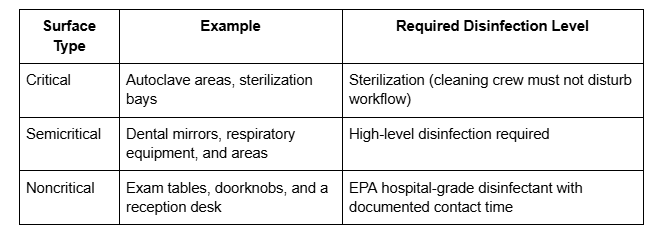
Most standard commercial cleaning uses general-purpose disinfectants that are not EPA List N or hospital-grade registered products. That distinction matters enormously, both to inspectors and to patient safety outcomes.
Documentation requirements are real and ongoing. Compliant medical office cleaning in Los Angeles means maintaining cleaning logs, product Safety Data Sheets (SDS), training records, and exposure control plan documentation. These are not one-time tasks.
The Right Way to Handle Medical Office Cleaning in Los Angeles
Here is what compliant healthcare janitorial services in Los Angeles look like in practice, whether your tenant is a solo dermatologist in West Hollywood or a multi-provider clinic in El Segundo.
1. Verify your vendor's credentials before anything else: Ask directly: Does your team have documented bloodborne pathogens training per Cal/OSHA 5193? Can you provide your current Exposure Control Plan? What EPA-registered products do you use in patient care areas, and what are the documented dwell times? If you get vague answers, that is your answer.
2. Insist on a zone-based cleaning protocol: Compliant medical office cleaning Los Angeles providers should use color-coded microfiber cloths and mops by zone, a clean utility area completely separated from soiled utility areas, and room-by-room documentation. Cross-zone contamination is one of the most common ways healthcare-associated infections (HAIs) spread in outpatient settings.
3. Require EPA-registered, hospital-grade disinfectants: Products must appear on the EPA's List N (effective against SARS-CoV-2) or carry hospital-grade registration. According to the CDC, organic matter on surfaces can deactivate cleaning agents, so the correct clean-then-disinfect two-step protocol is non-negotiable in patient areas.
4. Build cleaning frequency into your lease expectations: High-touch surfaces in medical offices include exam tables, doorknobs, light switches, blood pressure cuffs, reception desks, and waiting area chairs. These surfaces can require multiple daily cleanings, particularly during peak patient hours, not just a nightly sweep. As a property manager or building manager, understanding this expectation protects you from tenant disputes and from liability if a cleaning deficiency is traced back to inadequate vendor oversight.
5. Keep your records: Don't rely on your tenant to manage compliance documentation alone. Maintain copies of your janitorial vendor's training records, product logs, and incident reports for your building. This protects you in the event of an LA County inspection or a liability claim.
Why This Matters More in 2026 Than It Did Three Years Ago
A few trends are reshaping the stakes for commercial cleaning compliance in medical settings across Los Angeles County right now.
HAI rates remain a serious concern: The CDC reports that approximately 1 in 31 hospitalized patients acquires a healthcare-associated infection at any given time. While outpatient clinics face lower risk than hospitals, the CDC explicitly identifies exam rooms, shared waiting areas, and staff restrooms as vectors for cross-contamination when cleaning is inconsistent.
Healthcare tenants are paying closer attention to their building: Post-2020, medical tenants in LA, from West Hollywood to Pasadena, are more likely to ask building managers directly about janitorial vendor credentials before signing or renewing leases. Buildings that cannot document compliant healthcare janitorial services are seeing increased tenant turnover in medical suites.
Cal/OSHA enforcement does not slow down: A study cited by the International Janitorial Cleaning Services Association found that in ambulatory health care settings, there were 238 federal citations in a single fiscal year related to bloodborne pathogen violations, resulting in over $415,000 in fines. California's state plan, enforced by Cal/OSHA, can issue additional or more stringent penalties than the federal standard.
Getting ahead of this is not just about avoiding fines. It is about protecting the people in your building and your building's reputation as a place where healthcare tenants can operate safely and confidently.
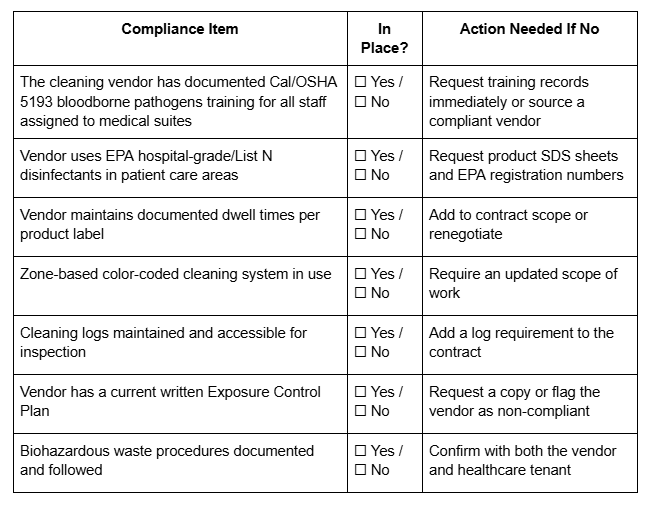
Quick Compliance Checklist for Building Managers and Property Managers
Use this as a starting audit tool. Assumptions are flagged below.
Conclusion: Compliance Is a Building Problem, Not Just a Tenant Problem
If you manage commercial real estate in Los Angeles County that includes any licensed healthcare tenants, the compliance picture for cleaning is your responsibility, too. Your janitorial vendor's credentials, their products, their protocols, and their documentation all connect directly to your liability exposure and your tenants' ability to operate safely.
The good news is that sourcing compliant medical office cleaning in Los Angeles does not have to be complicated. It requires asking the right questions, choosing vendors who understand healthcare environments, and keeping your records.
Ready to make sure your LA medical office building is covered?
MNZ Janitorial Services works with building managers, property managers, and office managers across Los Angeles, West Hollywood, Santa Monica, El Segundo, and Pasadena to deliver healthcare janitorial services that meet Cal/OSHA and EPA compliance standards. We possess the necessary credentials, training documentation, and protocols required by your medical tenants, as well as those needed to protect your building.
Get a free compliance consultation and cleaning quote at mnz.com
Transform your space into a clean and welcoming environment with MNZ. Contact us today to schedule a consultation and get a quote for our professional cleaning and maintenance services.
.jpg)


