
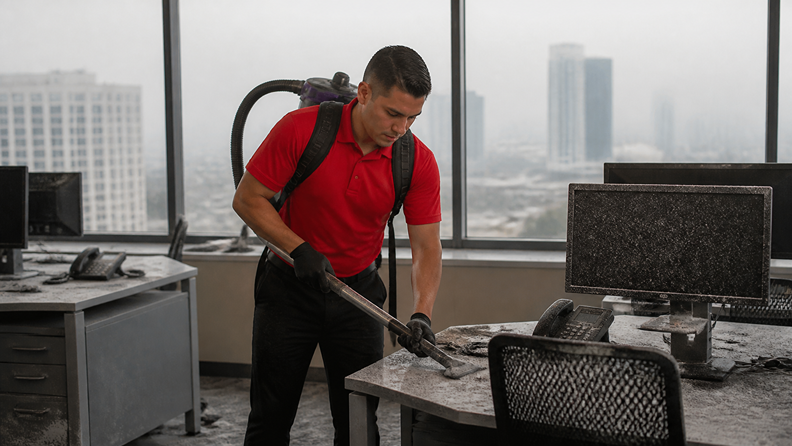
Wildfire smoke particles are smaller than 2.5 microns, which means they pass straight through standard HVAC filters and settle on every surface inside your building. ISSA's 2025 facility hygiene standards note that commercial buildings within 20 miles of a major wildfire event typically need a minimum of three to five professional cleaning passes before indoor particulate levels return to safe occupancy thresholds. That's not a quick wipe-down job. If you manage office space, a multi-tenant building, or a commercial property anywhere in the Los Angeles basin, here's exactly what proper wildfire smoke and ash cleanup involves, what it costs, and how to document everything for your insurance carrier.
Why Wildfire Smoke Is Harder to Clean Than You Think
The penetration problem
Standard building envelopes aren't airtight. Even with windows closed and HVAC systems off, PM2.5 particles, polycyclic aromatic hydrocarbons (PAHs), and benzene-range compounds enter through door gaps, elevator shafts, and ventilation openings. The result is invisible surface contamination across every room that shares an air supply with the exterior. Cal/OSHA's Wildfire Smoke Safety guidelines, updated in 2025, specifically note that indoor air quality can remain hazardous for weeks after outdoor air quality indexes return to normal, particularly in buildings without MERV-13 or higher filtration.
This isn't hypothetical. After the major Los Angeles wildfire events of 2025, building managers who assumed their properties were protected because windows stayed shut found contamination levels that required full professional remediation. The smoke doesn't wait for an invitation.
The compounds involved
Wildfire smoke isn't ordinary dust. It carries ash, charred organic material, heavy metals from burned structures, and chemical byproducts from burning plastics, roofing materials, and treated wood. The CDC has documented that post-wildfire ash residue can contain arsenic, lead, asbestos fragments, and persistent organic pollutants, all of which require specific handling protocols rather than standard commercial cleaning methods.
The oily, acrid residue wildfire smoke leaves on surfaces is especially stubborn. Standard cleaning products don't cut through it. You need the right chemistry, the right equipment, and a crew that knows the difference between cleaning the surface and actually removing the contamination.
The 6-Step Commercial Wildfire Cleanup Process
Step 1: HVAC isolation and filter replacement
Before anything else, shut down the HVAC system and seal return air vents with poly sheeting. If the system ran during or after the wildfire event, every filter, every duct interior, and every air handler surface is a contamination source. A qualified HVAC contractor needs to inspect and replace all filters, at minimum with MERV-13 units. High-rise buildings or those with sensitive tenants may require HEPA-grade upgrades. Large commercial systems with complex duct runs often need full duct inspection and professional duct cleaning as part of the scope, not just a filter swap.
Document the filter condition with photos before removal, because this evidence is critical for your insurance claim. Date-stamped photos of contaminated filters are one of the most straightforward ways to establish the scope of loss with your adjuster.
Step 2: HEPA vacuuming all surfaces
Here's where most facilities teams underestimate the scope. HEPA vacuuming needs to cover ceilings, light fixtures, window tracks, blinds, furniture surfaces, and every horizontal ledge you'd normally overlook. Standard vacuums don't capture PM2.5 particles. They re-suspend them, moving the problem from one surface to another. Every vacuum used on a wildfire-affected property should carry a true HEPA filter rated to 0.3 microns at 99.97% efficiency.
At MNZ Commercial Cleaning Services, our crews start with ceilings and work down, methodically, floor by floor. You don't skip steps. Skipping steps means you'll do the job twice.
Step 3: Wet wipe-down of all hard surfaces
After HEPA vacuuming, every hard surface gets a wet wipe-down with appropriate cleaning solutions. For most commercial finishes, a pH-neutral cleaner works well for general surface contamination. High-touch areas and visible ash deposits may require stronger degreasers or enzyme-based cleaners to address the oily residue that wildfire smoke leaves on glass and painted surfaces. The key here is to never dry-wipe, which smears the residue and drives particles deeper into the surface rather than removing them.
Step 4: Carpet and upholstery extraction
Carpet holds wildfire particulates at the fiber level. A standard hot-water extraction pass isn't enough here. You'll want pre-treatment with an encapsulating agent to trap odor-causing compounds, followed by heavy-duty extraction, and a second pass after dry time to confirm odor and particle levels have dropped. Fabric-covered furniture, acoustic ceiling panels, and fabric partitions all require the same treatment. Many building managers overlook fabric-wrapped furniture and acoustic tiles, and those items become re-contamination sources if you leave them.
Step 5: Commercial air scrubbing
Portable HEPA air scrubbers, also called negative air machines, should run continuously throughout the cleanup process. They pull air through the space and filter it, gradually reducing the particle load that settles back onto surfaces you've already cleaned. Depending on the building size, you'll need multiple units staged throughout the floor plates. For a typical 10,000 sq ft floor plate, plan on at least 3 to 4 units running for 24 to 48 hours after the primary cleaning pass is complete.
Pro tip: Don't just rent the units and place them randomly. Position air scrubbers at contamination sources first, near exterior doors, elevator lobbies, and HVAC returns, and create a negative pressure differential that pulls contaminated air toward your filtration units rather than pushing it through areas you've already cleaned.
Step 6: Post-cleanup air quality verification
The final step is air quality testing and surface testing before you bring tenants back. An industrial hygienist or environmental consultant can perform clearance testing to confirm PM2.5 counts and surface contamination levels are below OSHA and CDC thresholds. This testing generates the documentation you'll need to close out an insurance claim and give tenants genuine confidence that the space is safe to reoccupy. Don't skip this step. "We cleaned it" is not the same as "it tested clear."
What to Expect From a Professional Cleaning Team
Equipment and crew qualifications
A wildfire cleanup job for a commercial building isn't a standard janitorial crew with mops and spray bottles. The team needs industrial HEPA vacuums, negative air machines, personal protective equipment rated for wildfire particulates (N95 minimum, P100 preferred for heavy ash), and practical familiarity with the protocols Cal/OSHA requires under Title 8, Section 5141.1 for wildfire smoke remediation. Ask your service provider directly: have your crews done wildfire remediation before? Can you show me a scope of work from a comparable job?
Our crews at MNZ have been handling post-disaster commercial cleaning throughout the Los Angeles basin since 1979. We've worked through fires, floods, and construction disasters. The equipment list is substantial, and the crew experience is what makes the difference between a thorough job and one that needs to be redone.
Realistic timeline expectations
For a single-tenant office of 5,000 to 15,000 sq ft with moderate smoke impact, plan on two to three days of active cleaning, followed by 24 to 48 hours of air scrubbing, followed by clearance testing. Multi-story buildings or properties with heavy ash infiltration, especially those where the HVAC ran during the event, can run a week or longer. Any restoration company or janitorial service that quotes you a one-day turnaround for a building in a heavy-impact zone deserves serious scrutiny. Speed that sounds good often means corners that won't hold up to inspection.
How to Prioritize When a Whole Building Needs Attention
If you're managing a multi-tenant building or a portfolio property and the whole structure needs attention, work from most-to-least contaminated zones. HVAC zones that pulled outdoor air during the event get top priority. Ground-floor and roof-level spaces typically show higher contamination than middle floors. Common areas, lobbies, and elevator cabs see high foot traffic and will redistribute particulates to other floors if left unaddressed first. Tenant-occupied spaces should be sequenced so you're not creating cross-contamination as crews move through the building.
When multiple floors need simultaneous attention, you need enough crew members to work zones concurrently, not sequentially. A three-person crew tackling a 150,000 sq ft building one floor at a time is going to take weeks and cost you in lost rental income. This is one of the main reasons to work with a commercial cleaning provider that has the staff depth to scale up quickly when a widespread event hits.
For property managers overseeing multiple Los Angeles commercial properties affected by the same wildfire event, a centralized cleanup plan across the portfolio is almost always more cost-effective than managing each property independently. Ask your service provider about portfolio-level scheduling and volume pricing. We've structured multi-site remediation plans for property management companies across LA, and the coordination savings add up quickly when you're dealing with three or four buildings at once.
If you work with a commercial janitorial service provider who already maintains your properties on a scheduled basis, they're also the best first call after a wildfire event. They know your building layouts, they know your HVAC systems, and they can move faster because they're not starting from scratch on site assessments.
Keeping the Costs Realistic
Pricing ranges for LA commercial properties
Wildfire smoke remediation pricing varies based on the severity of ash infiltration, building size, HVAC system complexity, and the required air quality testing scope. For commercial office spaces with moderate wildfire smoke impact, you're typically looking at $0.35 to $0.75 per square foot for the full remediation scope described above. That's significantly higher than the $0.12 to $0.18 per square foot benchmark for standard commercial cleaning in Los Angeles (ISSA 2026), but the job is fundamentally different. Heavily impacted properties with visible ash deposits, prolonged HVAC operation during the event, or porous materials throughout can run higher. Get itemized bids from two or three qualified providers, and make sure the scope of work specifies equipment, crew size, and clearance testing so you're comparing the same deliverable.
Insurance documentation: what to capture before cleaning begins
Most commercial property policies cover wildfire smoke remediation as part of the covered cause of loss, but documentation is everything. Before cleaning begins: photograph all affected areas from multiple angles, document HVAC filter conditions and collect the filters for inspection, record any available air quality readings from during the event, and get your cleaning contractor to provide an itemized written scope of work before they start. Keep all receipts for filters, equipment rental, labor, and environmental testing. Your adjuster will want a clear before-and-after trail. Properties that document well recover faster and more completely through their insurance claims than those that clean first and document later.
Frequently Asked Questions
How long does wildfire smoke stay in a commercial building?
Without professional intervention, wildfire smoke odors and particulates can persist in commercial buildings for weeks to months. The smoke smell is caused by volatile organic compounds (VOCs) and fine particulates embedded in carpets, upholstery, HVAC ductwork, and porous surfaces. Opening windows and running standard ventilation doesn't meaningfully reduce contamination levels. Professional air scrubbing, surface cleaning, and HVAC remediation are required to bring indoor air quality back to acceptable thresholds.
Can tenants stay in the building while the cleanup is happening?
Generally, no. Active wildfire smoke remediation involves running equipment that stirs up particulates, and the cleaning chemistry in use creates conditions that aren't appropriate for building occupancy. OSHA's general industry standards require workers performing remediation to wear appropriate respiratory protection. Tenants should not be in the space during active cleaning passes. Clear the affected areas, complete the cleaning, run the air scrubbers for the required time, and then conduct clearance testing before allowing reoccupancy. Communicate a timeline clearly to your tenants upfront. Most understand the situation and appreciate transparency about the process.
What happens if the HVAC system ran during the wildfire event?
That's the most complicated scenario, and it's more common than property managers expect. When HVAC systems run while outdoor PM2.5 levels are elevated, they pull contaminated air through the ductwork and distribute it throughout the building. Every duct run, every supply diffuser, and every return grille becomes a contamination point. Simple filter replacement won't solve the problem. Full duct inspection and professional duct cleaning become part of the remediation scope, alongside all of the surface cleaning steps. If your system ran during a high-smoke period, involve your HVAC contractor in the assessment before any cleaning begins.
Does commercial wildfire remediation require any special certification?
California's Cal/OSHA Title 8, Section 5141.1 covers wildfire smoke safety requirements for workers, and commercial remediation firms operating in Los Angeles should be familiar with these rules. For complex contamination scenarios or institutional properties, some owners bring in a third-party industrial hygienist certified by the American Industrial Hygiene Association (AIHA) to design the cleanup protocol and verify clearance. For portfolio properties and large commercial buildings, this additional layer of professional oversight is worth the cost. It protects you legally, it protects your tenants, and it gives your insurance adjuster exactly what they need to process the claim cleanly.
Related Reading
These resources cover topics that property managers and facilities directors frequently ask about when managing commercial building maintenance in Los Angeles:
- Commercial Cleaning Pricing in Los Angeles: A Complete Cost Breakdown
- Office Cleaning Schedules: How to Set Up a Professional Maintenance Plan
MNZ Commercial Cleaning Services has served commercial property owners, facilities managers, and property management companies throughout the Los Angeles basin since 1979. Our crews are trained for post-disaster scenarios, scaled for multi-building portfolios, and available for rapid response after wildfire events. To learn more about our commercial janitorial services and post-disaster cleanup programs, call (818) 480-9316.
Transform your space into a clean and welcoming environment with MNZ. Contact us today to schedule a consultation and get a quote for our professional cleaning and maintenance services.
.jpg)


