

You've got a building to manage. Maybe it's a mid-rise office on Santa Monica Boulevard. Maybe it's a mixed-use retail space near Melrose. Either way, you're juggling tenant requests, lease renewals, city regulations, and a budget that never feels big enough.
When it's time to reduce expenses, commercial building maintenance is often the first area to be cut. It feels like the safe choice. Nothing is broken right now. Nobody's complaining. Why spend money you don't have to?
Here's the truth: that line of thinking is one of the most expensive mistakes a building manager can make in West Hollywood.
The Problem: Deferred Maintenance Feels Invisible Until It Isn't
There's a reason people put off maintenance. It doesn't hurt today. You skip the quarterly floor scrub, push back the restroom deep clean, let the HVAC filters slide another month, and nothing catastrophic happens. That silence feels like savings.
But what's actually happening underneath that silence? Grease is building up in the kitchen exhausts. Mold is starting to form in a neglected restroom corner. Grime is working its way into grout and flooring seams that are now harder to restore than they would have been six months ago.
The International Facility Management Association (IFMA) estimates that building owners incur deferred maintenance costs of approximately $2 to $4 for every $1 of maintenance they skip. That's not a rough estimate. That's a pattern the industry tracks across hundreds of commercial properties every year.
And this isn't just about floors and restrooms. It's about the full picture of what commercial building maintenance in West Hollywood actually protects: your property value, your tenants, your liability exposure, and your relationship with the City.
Agitate: What Neglect Actually Looks Like on a Real Balance Sheet
Let's put some numbers to this, because "it's expensive" is vague, and vague doesn't help you make decisions.
The Building Owners and Managers Association (BOMA) publishes annual reports on commercial property operations. Based on their benchmarks, here's how neglected maintenance tends to snowball:
Flooring and surfaces: A commercial floor that gets professionally cleaned and maintained regularly can last 10 to 15 years. The same floor without consistent care, especially in high-foot-traffic areas common in West Hollywood retail and office spaces, often needs full replacement within 5 to 7 years. The cost difference? Replacement runs $8 to $15 per square foot versus $0.15 to $0.40 per square foot for routine maintenance. For a 5,000-square-foot space, that's a $40,000 to $75,000 bill you could have mostly avoided.
Restroom neglect and liability: California's Department of Industrial Relations requires employers to maintain sanitary restroom conditions. If a tenant or employee files a complaint with Cal/OSHA, inspectors don't just slap a fine. They open an investigation. Fines for sanitation violations can start at $1,000 and escalate based on severity and repeat offenses. More importantly, unresolved restroom maintenance issues have led to lease terminations, which hit you far harder than any cleaning contract would have.
Tenant retention: The National Apartment Association and commercial leasing data consistently show that building condition ranks in the top three reasons commercial tenants choose not to renew. The average cost to replace a commercial tenant, counting lost rent, broker fees, tenant improvement allowances, and downtime, runs between 15% and 20% of annual lease value. For a $6,000/month tenant, that's $10,800 to $14,400 per vacancy. One lost tenant often costs more than a full year of professional building maintenance.
HVAC and air quality: The EPA has documented that poor indoor air quality reduces employee productivity by 6% to 9% and is linked to increased sick days. If your tenants are businesses with 50 employees, and each sick day costs roughly $250 in lost productivity, you're looking at a measurable financial drag on the people inside your building, and they know it, even if they can't fully articulate why they feel worse at work.
These aren't scare tactics. These are the numbers that property managers who have gone through deferred-maintenance crises wish someone had shown them earlier.
West Hollywood Has Its Own Set of Pressures
This part matters because commercial building maintenance in West Hollywood isn't the same as managing a property in a quieter suburb.
West Hollywood sits inside Los Angeles County but operates under its own municipal code. The City has specific sanitation and property maintenance ordinances, and the Code Compliance Division is active. Complaints from neighbors, tenants, or passersby can trigger inspections faster than you might expect in a more suburban jurisdiction.
Beyond code compliance, West Hollywood's commercial real estate market is competitive. Vacancy rates in the 90046 and 90069 zip codes have fluctuated, and tenants, especially in creative, entertainment, and tech-adjacent industries, have real options. A neglected lobby or a consistently unkempt common area is not a small thing. It's a first impression that your competition is quietly winning.
There's also the matter of foot traffic. West Hollywood commercial buildings often host retail, medical offices, salons, and food-adjacent businesses. These industries carry their cleanliness expectations from customers and clients, not just tenants. When your building doesn't support their brand standards, it becomes your problem during lease renewal conversations.
The Solution: Commercial Building Maintenance in West Hollywood as a Financial Strategy
Here's the shift in thinking that property managers who protect their assets make early: maintenance isn't an operating expense you minimize. It's a risk management tool you invest in.
When you put regular commercial building maintenance in West Hollywood on a consistent schedule, here's what you're actually buying:
Predictability. Regular monthly and quarterly maintenance helps catch problems while they're still small. A restroom grout issue spotted in February doesn't become a mold remediation project in July.
Documented due diligence. If a tenant ever claims the building contributed to a health issue, maintenance records are your defense. A building without documentation is a liability. A building with consistent service logs is a protected asset.
Tenant confidence. Clean common areas, maintain restrooms, and a building that smells and looks professional communicates to your tenants that you take the property seriously. That confidence translates into renewals.
Property value. Commercial appraisers assess condition alongside location and lease history. A well-maintained building in West Hollywood commands higher valuations, better refinancing terms, and stronger sale prices.
According to a 2023 report by Cushman & Wakefield on Southern California commercial real estate, buildings with documented preventive maintenance programs sold at an average 8% to 12% premium compared to comparable properties without consistent records.
What a Solid Maintenance Program Actually Looks Like
You don't need a 40-page operations manual. You need a schedule and a reliable partner. Here's a realistic framework for a West Hollywood commercial building:
Daily or high-frequency tasks: Restroom sanitation, lobby cleaning, trash removal, elevator interior wipe-downs, and common area spot checks. These are the things tenants notice every single day.
Weekly tasks: Window and glass surface cleaning, stairwell sweeping, entrance pressure washing as needed, and common kitchen or breakroom sanitation.
Monthly tasks: Deep floor care, including scrubbing, buffing, or machine cleaning, depending on surface type. HVAC filter checks. Exterior building perimeter walk.
Quarterly tasks: Deep restroom sanitation, including grout and tile treatment. Upholstery and carpet deep clean. Full exterior pressure wash if not completed monthly.
The process isn't complicated. What makes it work is consistency and accountability, which is why most building managers who have tried to handle this task with rotating in-house staff or on-call cleaners eventually move to a structured janitorial service contract.
The Real Cost Comparison, Laid Out Simply
Here's a side-by-side most building managers never see written out clearly:
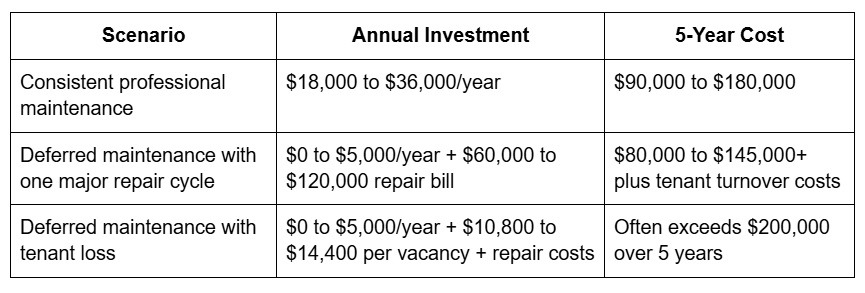
The math is not subtle. Consistent commercial building maintenance in West Hollywood doesn't just protect your building. It's often the lower-cost option when you account for what neglect actually triggers.
What Landlords and Property Managers in This Market Are Doing Right
The West Hollywood and broader Los Angeles County building managers who handle these situations well tend to share a few habits:
They don't wait for complaints. They build inspection into their calendar, not just their reaction to tenant calls.
They treat their janitorial partner as a property ally, not a vendor to minimize. When a professional cleaning team is in your building regularly, they become an early warning system. They notice the water stain before it's a leak, the tile crack before it's a trip hazard, and the odor before it's a complaint.
They keep records. Service logs, photos, and dated reports. Not because they expect a lawsuit, but because documentation is the single most underrated asset in property management.
Conclusion: The Buildings That Hold Their Value Are the Ones That Were Maintained
West Hollywood is a high-visibility, high-expectation market. Your tenants have choices. Your city has inspectors. Your property either protects its value or slowly erodes it.
The single most consistent investment that distinguishes high-performing buildings from those that struggle is not location, lease structure, or even rent pricing. It's whether someone is showing up consistently to maintain what you've built.
If you're a building manager, landlord, or property manager in West Hollywood, Santa Monica, Pasadena, El Segundo, or anywhere across Los Angeles County, and you're not confident your current maintenance program is actually protecting your asset, that uncertainty is worth acting on.
MNZ Janitorial Services works with building managers across the Los Angeles area to build maintenance programs that are consistent, documented, and matched to the actual demands of your property. We're not here to upsell you on services you don't need. We're here to help you protect what you've invested in.
Request a free quote and let's take a look at what your building actually needs.
Transform your space into a clean and welcoming environment with MNZ. Contact us today to schedule a consultation and get a quote for our professional cleaning and maintenance services.
.jpg)


