
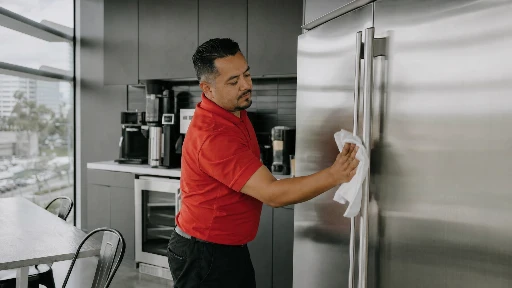
Break rooms and office kitchens in Los Angeles commercial buildings collect more bacteria per square inch than most surfaces tenants ever think about. NSF International's workplace hygiene research found that break room sinks rank as the single most germ-laden surface in the average office, with appliance handles close behind. According to the 2026 ISSA commercial facilities hygiene guidelines, food-contact surfaces in shared employee kitchens should be disinfected with an EPA-registered sanitizer at every cleaning visit. Professional break room cleaning services that go beyond the standard nightly routine are essential to maintaining employee health and food safety compliance across your Los Angeles office portfolio. At MNZ Commercial Cleaning Services, we've maintained commercial kitchen cleaning and break room programs for office portfolios, and break room cleaning in Los Angeles has been part of our core commercial cleaning work since 1979. The full scope of what these cleaning services should cover is longer than most property managers expect.
Why Break Rooms Need a Different Protocol Than the Rest of the Office
Regular office cleaning handles dust, trash, and floor maintenance. Break room cleaning requires food-safe disinfection, appliance servicing, and scheduled deep cleaning tasks that go beyond surface wiping. A standard janitorial contract that doesn't call out break room tasks specifically will almost certainly leave gaps: the inside of the microwave, the drip tray under the coffee maker, the gasket seal on the refrigerator, and the grease and grime that accumulate on the ventilation area above a hot plate.
For Class A buildings in Los Angeles, this matters for two practical reasons. First, your tenants use these spaces every day, and a dirty break room affects building cleanliness and generates tenant complaints faster than almost any other facility issue. A first impression of a grimy break room is hard to walk back once a prospective tenant has seen it. Second, commercial kitchens and food-preparation areas in offices fall under California Health and Safety Code Section 113700 through 114437, which means your building's food service area, even a shared employee kitchen, can be subject to inspection if reported. The cleaning standard isn't just "good enough": it's "compliant."
The Contamination Risk You Can't See
The most common contamination in office break rooms isn't immediately visible. It's the biofilm on sink drains, the dried food particles baked into microwave walls, and the coffee-oil residue coating espresso machine components. These don't look dirty, but they harbor bacteria that can cause genuine illness and spread cross-contamination throughout your office space. Per the 2026 ISSA guidelines, food-contact surfaces in shared employee kitchens require specific product selection and documented dwell time at every cleaning visit, not just when they appear soiled. Employee health depends on professional cleaning services that understand the difference between surface-level cleaning and true food sanitation.
What Separates a Compliant Program From a Basic Wipe-Down
A compliant break room program distinguishes between cleaning (removing visible soil), sanitizing (reducing bacterial count on food-contact surfaces to a safe level), and disinfecting (killing pathogens on high-touch non-food surfaces like handles and light switches). Your vendor should be doing all three, in the correct order, with the right products. Most standard janitorial services only cover the first. Professional cleaning services that specialize in commercial kitchen environments train their cleaning staff to apply the correct product at the correct concentration and dwell time, which is what actually protects employee health and keeps your building compliant with California food safety standards. Attention to detail at this level is what separates a thorough cleaning program from one that merely checks a box.
What a Complete Daily Break Room Cleaning Includes
Every service visit to your office break room or kitchen should complete the following before the cleaning crew moves to the next area. This is the minimum standard for a commercial property in Los Angeles County where tenants rely on shared food-prep space. Office cleaning services that skip or compress these steps leave your employees working in a kitchen that passes a casual glance but fails a sanitation check. Recurring services on a documented schedule are the only way to maintain the standard your tenants and insurers expect, and service visits should be timed around business hours to minimize disruption to common areas and tenant spaces.
Surface Cleaning and Sanitizing
- Wipe and sanitize all countertop surfaces using microfiber cloths with an EPA-registered food-contact sanitizer, observing label concentration and contact time
- Clean and disinfect the sink basin, faucet fixture handles, and drain rim
- Wipe down the exterior of all kitchen appliances: refrigerator, microwave, coffee maker, dishwasher, and toaster oven
- Clean the microwave interior: remove the turntable and wipe all interior walls and the door seal
- Wipe and sanitize the coffee station: drip tray, carafe seat, and external water reservoir if accessible
- Clean stovetop or hot plate surfaces if present
Touch-Point Disinfection
- Disinfect all high-touch surfaces: door handles, refrigerator pulls, microwave pad, dishwasher controls, and cabinet hardware
- Disinfect light switches and any shared control panels
- Wipe and disinfect table and chair surfaces if a dining area is present
- Clean and disinfect trash receptacle exterior and replace liner
Kitchen Floor Care
Break room and kitchen floors need more attention than standard office floors because of food spills, beverage drips, and tracked-in soil. Professional cleaning staff begin with sweeping to remove loose debris, then address any stains or dried spills before mopping with a food-safe disinfectant solution, working from back to front. Pay particular attention to the area directly in front of the refrigerator, under table legs, and along baseboards, where food debris and grime collect but are rarely visible at a glance. Proper kitchen floor care with the right cleaning solutions prevents slip hazards and reduces the bacterial load that accumulates even after a visual inspection suggests the floor looks clean and sanitary.
Pro tip: Schedule break room service as the last area of the floor before the evening cleaning crew leaves, not the first. Cleaning the break room early and then moving through adjacent offices means the next crew member to use the sink or coffee maker does so right after the rest of the floor has tracked additional soil back through the space. Saving break room service for last extends the clean appearance well into the morning shift, which is when tenants actually notice it.
Weekly and Monthly Deep Cleaning Tasks
Daily service keeps the break room functional and sanitary. Weekly and monthly deep cleaning tasks are where the real compliance and longevity work happens, and this is the layer most basic janitorial services skip entirely. A commercial cleaning company that includes documented recurring services in your service agreement gives you the accountability structure your property manager needs to verify the work is actually being done. Thorough cleaning on a recurring schedule is what prevents minor buildup from turning into a tenant complaint, a code violation, or a building maintenance issue that costs significantly more to address than the scheduled cleaning would have.
Weekly Deep-Clean Checklist
- Clean the refrigerator interior: remove all shelves and drawers, wash with warm soapy water and a food-safe sanitizer, check for expired items per a posted disposal policy
- Descale the coffee maker per the manufacturer's process (Los Angeles water has moderate hardness, and scale buildup affects both appliance function and beverage quality)
- Clean the dishwasher interior: wipe the door gasket, clean the filter screen, and run a dishwasher cleaner cycle if the unit sees daily heavy use
- Degrease range hood filters if a ventilation hood is present above cooking equipment
- Scrub the sink basin and drain with a commercial drain deodorizer to prevent biofilm buildup
- Vacuum under and around appliances, then wipe the counter surface beneath the coffee maker and microwave
Monthly Service Items
Monthly deep cleaning tasks focus on what accumulates out of daily sight. Clean behind and beneath the refrigerator, where dust and food debris collect around the condenser coil; food odors that develop in the refrigerator interior are a sign that shelves need a thorough wipe-down with a food-safe deodorizing cleaner. Wipe the tops of cabinets and the area above wall-mounted appliances. Inspect grout lines on tile or vinyl flooring for stain buildup or discoloration that routine mopping doesn't remove. Inspect and clean dishwasher spray arms and refill the rinse-aid dispenser. Review supply levels monthly: dish soap, hand soap, paper towels, and trash liners should all be restocked to a specified minimum, not just when they run out mid-shift. These are the tasks where professional break room cleaning services earn their value, because they're invisible until they cause a problem that shows up in a tenant complaint or a health inspection.
How to Choose a Break Room Cleaning Service in Los Angeles
Not every commercial cleaning company offers the same level of office kitchen cleaning. When evaluating break room cleaning services for a Los Angeles office building, ask for a written cleaning checklist that distinguishes daily, weekly, and monthly tasks. A professional cleaning team that can hand you a documented protocol, product list, and service frequency before contract signing is demonstrably more accountable than one that promises good results without defining what they mean. Attention to detail in the cleaning checklist is the clearest signal that a vendor understands the difference between a clean-looking surface and one that has actually passed sanitation standards. Professional cleaning services that invest in this documentation are also the ones whose cleaning staff receive consistent training rather than on-the-fly instruction.
For Class A buildings, look for a commercial cleaning company that is fully insured, trains its cleaning staff on food-safe product application, and provides digital cleaning logs your property manager can verify without calling the office. The deep cleaning service component is especially important for break rooms: a vendor who treats nightly surface cleaning and quarterly appliance cleaning as equivalent to a proper thorough cleaning doesn't understand the scope. Reliable cleaning services come with a written scope you can hold them to, and a professional cleaner who has maintained restroom and break room standards in Class A buildings knows the difference between a compliant result and a presentable one. For building-wide coverage that includes day porter check-ins between service visits, see our post on day porter services for Class A Los Angeles offices, which covers how to maintain coverage in food-service areas and common areas during peak hours.
Compliance Considerations for Los Angeles Office Kitchens
If your building has a shared kitchen that functions as an employee cafeteria, a catering staging area, or a food-service amenity, California code may require a permit and regular health department inspection. The California Retail Food Code, Health and Safety Code Section 113700 and following, applies to operations that provide food to the public, and some shared building amenities, particularly those in multi-tenant co-working and Class A hospitality-level buildings, can meet that threshold.
What Your Janitorial Vendor Should Document
Even if your break room doesn't require a formal health permit, documentation of your cleaning protocol is increasingly required by property insurers, BOMA certification auditors, and sophisticated commercial tenants who include facility standards in their lease agreements. Your vendor should provide a written scope of work that specifies which products are used, at what concentration, and at what frequency for every break room cleaning task. That documentation is also your cleaning checklist baseline: it defines what "done" looks like for every service visit, so there's no ambiguity about whether the sanitation standard was met. Cleanliness in shared spaces is a building maintenance issue, not just a janitorial one, and documentation is what makes it verifiable.
The BSCAI's 2026 benchmarks confirm that labor represents 50 to 65 percent of a commercial cleaning company's operating cost. That figure matters here because the scope document isn't just compliance paperwork: it's how you verify that the labor hours you're paying for are being applied to the right tasks in the right areas. Office cleaning services without written documentation leave your property manager with no recourse when a tenant complains about conditions that should have been addressed on a scheduled cleaning cycle.
Product Selection and California Requirements
California regulates the sale and use of certain cleaning chemicals more strictly than federal standards through the California Air Resources Board and the California Department of Pesticide Regulation. Your vendor should be using products that are California-compliant, meaning lower VOC formulations for disinfectants used in enclosed food-adjacent spaces. Request the SDS for every chemical your vendor uses in the break room: your facilities team should have these on file for OSHA's hazard communication standard requirements. Professional janitorial services operating in Los Angeles County already know these requirements and should provide the documentation without a special request. The right cleaning solutions are as much a compliance matter as a hygiene one, and professional cleaning staff should know the difference between a product that's registered for food-contact sanitization and one that isn't.
Frequently Asked Questions
The following frequently asked questions cover the most common break room cleaning decisions for Los Angeles property managers and building owners.
How often should an office break room be cleaned in a Los Angeles commercial building?
Daily cleaning is the baseline for any occupied office break room. High-traffic break rooms serving 100 or more employees benefit from a mid-day check from a day porter in addition to nightly office cleaning services. Once-a-week service, which is common in some basic janitorial contracts, isn't adequate for a shared kitchen that sees daily food prep and appliance use across multiple tenant suites. Break room cleaning services need to match the actual usage frequency of your space to maintain a clean and sanitary environment for your employees, and recurring services and intervals should be written into the service agreement rather than left to informal scheduling.
What cleaning products are safe to use on food-contact surfaces in an office kitchen?
EPA-registered quaternary ammonium or hydrogen peroxide sanitizers formulated for food-contact surfaces are the standard for office kitchens. These are different from restroom disinfectants: they must be safe for surfaces that contact food without requiring a post-application rinse, or they must meet a no-rinse formulation standard. Your vendor should provide the product label for everything they use in food-adjacent areas. Professional commercial cleaning services that work in office kitchens use food-safe cleaning solutions that comply with both EPA registration requirements and California VOC standards, and their cleaning staff should be trained on correct dwell times for sanitization to be effective.
Can the building's regular janitorial company handle break room cleaning, or does it need a specialist?
A qualified commercial janitorial service handles office break room cleaning for most Class A buildings. The key is whether the company has a written protocol that distinguishes cleaning, sanitizing, and disinfecting, and whether their cleaning staff are trained on food-safe product applications. Attention to detail at the product and process level is what separates a thorough cleaning program from a surface wipe. If your building operates a full employee cafeteria or a commercial kitchen with heavy cooking equipment, a specialized food-service cleaning company is worth evaluating for that specific scope.
What's the most common break room cleaning failure in Los Angeles office buildings?
Appliance interiors. Microwave walls, refrigerator shelves, and coffee machine components are the most frequently missed surfaces in standard janitorial contracts, and they're where bacterial load concentrates fastest. If your nightly cleaning doesn't include explicit tasks for appliance interiors, those surfaces are almost certainly dirtier than they appear on a surface inspection. A deep cleaning service that includes documented appliance cleaning on a weekly cycle catches this gap before it becomes a tenant complaint or a health code issue in your Los Angeles office building.
At MNZ Commercial Cleaning Services, we've built break room and commercial kitchen cleaning programs for office portfolios across Los Angeles County since 1979. Our cleaning staff brings attention to detail to every service visit, and we provide written scope documentation and cleaning logs your property manager can verify. Whether your building is in Downtown Los Angeles, West Hollywood, Santa Monica, El Segundo, Culver City, or anywhere across the greater Los Angeles area, our commercial cleaning services are structured to match your tenant density and kitchen use. To discuss break room cleaning services for your building, reach out to our Los Angeles commercial janitorial team or call (818) 480-9316.
Related Reading
What Does a Restroom Sanitation Protocol Include for a Class A Los Angeles Office Building?
What Should an Office Cleaning Schedule Include for Los Angeles Commercial Buildings?
Transform your space into a clean and welcoming environment with MNZ. Contact us today to schedule a consultation and get a quote for our professional cleaning and maintenance services.


