
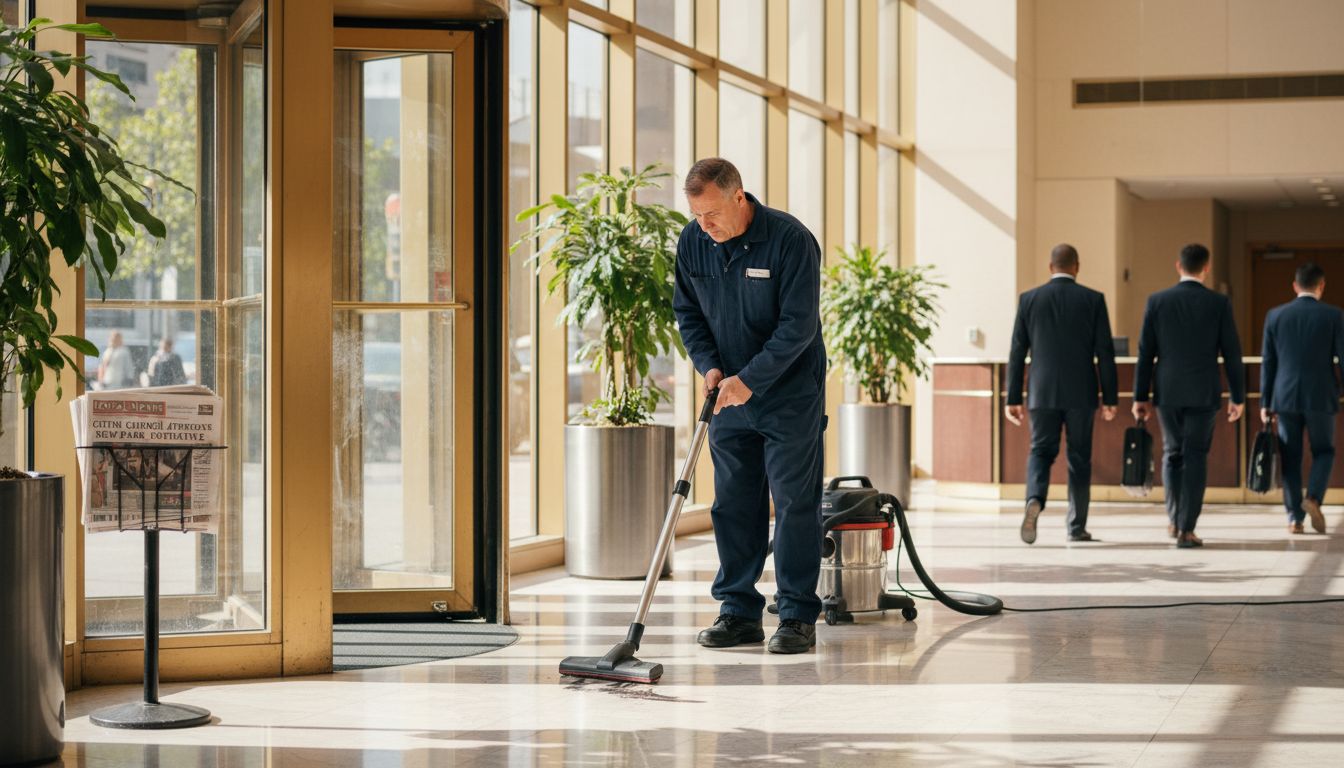
You walk into your office building on Monday morning, and something feels off. The lobby floor has a dull sheen instead of that crisp shine. The elevator buttons look grimy. There's a lingering smell that wasn't there on Friday. Your employees look uncomfortable. And suddenly, that "cheap" cleaning service doesn't seem like such a bargain anymore.
If you manage commercial property in Los Angeles County, you know this story too well. The thing is, commercial office cleaning isn't just about making spaces look presentable. It's about protecting your investment, keeping customers happy, and creating environments where people actually want to work. But here's what nobody tells you upfront: not all cleaning services deliver the same results, and the difference can cost you thousands in tenant turnover and property damage.
Allow me to explain what really works for maintaining clean commercial spaces and why the strategy is more important than you might think.
Why Commercial Office Cleaning Standards Keep Rising
Something shifted after 2020. People became hyper-aware of what "clean" really means, and they're not going back to the old standards. According to recent data, the indoor air quality improves through proper cleaning, and employee productivity increases while sick days decrease, with poor indoor air quality costing tens of billions of dollars yearly in lost productivity and medical care.
That's not just corporate speak. Building managers across West Hollywood, Santa Monica, and El Segundo are dealing with tenants who now expect hospital-grade disinfection as the baseline. Customers know about airborne pathogens and surface contamination. Tenants are now inquiring about your cleaning protocols, and simply having a cleaning crew visit twice a week is no longer sufficient.
The commercial cleaning industry responded. Market projections show the global cleaning services sector growing from USD 415.93 billion in 2024 to an expected growth rate of 6.9% through 2030, driven largely by this heightened focus on indoor air quality and health-conscious cleaning methods.
The Hidden Cost of Inconsistent Commercial Property Maintenance
Here's what happens when your commercial office cleaning falls short. A property management firm in Pasadena experienced this firsthand. They switched to a budget cleaning contractor to save $800 monthly across their three buildings. Seemed smart.
Six months later, they'd lost two anchor tenants who cited "declining property standards" in their exit interviews. What was the cost of replacing those tenants? They incurred over $45,000 in leasing commissions, tenant improvements, and lost rent during the vacancy period. That $800 monthly savings turned into a financial nightmare.
But money isn't even the worst part. When cleaning quality drops, you get this domino effect: carpets wear out faster because dirt isn't being extracted properly, HVAC systems get clogged with dust nobody's removing, and surfaces degrade because harsh chemicals are being used incorrectly. Your property literally ages faster with poor maintenance.
Research indicates that green cleaning methods can reduce employee sick days, generating estimated indirect cost savings of $30 to $170 per employee annually through improved indoor air quality. Multiply that across a 100-person office building, and you're looking at real money your tenants are either saving or losing based on your cleaning standards.
What Actually Makes Commercial Office Cleaning Effective
Let's get specific about what separates reliable cleaning from the services that look fine until you inspect closely. The difference comes down to three things: systems, training, and accountability.
Systems That Scale Across Properties
Random cleaning doesn't work for commercial properties. You need documented protocols that every cleaner follows, every time, in every building. That means checklists for daily tasks, weekly deep-cleaning schedules, and monthly maintenance cycles. When you hire professional commercial office cleaning services, you're not just paying for labor. You're paying for repeatable systems that deliver consistent results, whether your regular crew is working or a backup team fills in.
The best services use digital tracking now. They scan QR codes at checkpoints throughout your building. They document completion times. They photograph problem areas before and after treatment. This isn't overkill; it's accountability that protects both you and your cleaning company.
Training That Goes Beyond the Basics
Here's a question most property managers never ask: How many hours of training do your cleaners receive before they touch your property? The answer should scare you if it's anything less than 40 hours.
Commercial office cleaning requires specialized knowledge. Your cleaners need to understand pH levels in cleaning solutions, dwell times for disinfectants, proper dilution ratios, cross-contamination prevention, and surface-specific techniques. They need to know that the marble in your Santa Monica office lobby requires entirely different care than the porcelain tiles in your El Segundo warehouse floors.
Untrained cleaners cause damage. They use acidic cleaners on natural stone and etch it permanently. They over-wet carpets and create mold problems. They mix chemicals and create toxic fumes. Professional training prevents these expensive mistakes.
Accountability Through Inspection and Feedback
Measuring is essential for improvement. Reliable commercial office cleaning services build in quality control checkpoints. That usually means a supervisor conducts random inspections separate from the cleaning crew. They use standardized evaluation forms. They document deficiencies with photos. And here's the critical part: they follow up within 24 hours to resolve any issues.
But accountability also means listening to your feedback. When your tenant calls about a sticky floor in their break room, the cleaning company should log that complaint, investigate what went wrong, retrain if needed, and report back to you on corrective actions. This closed-loop system creates continuous improvement.
Breaking Down Commercial Property Cleaning by Space Type
Different spaces need different approaches. Using the same methods everywhere is a sign of amateurism.
Office Spaces and Collaborative Areas
Modern offices mix open workspaces, conference rooms, and hot-desking areas. Each requires specific attention. Conference rooms need thorough disinfection of high-touch surfaces: door handles, light switches, table surfaces, and especially those shared remote controls nobody remembers exist. Open workspaces need careful attention to keyboard, mouse, and phone areas without disturbing personal items or paperwork.
Frequency matters here. The industry is seeing increased demand for flexible cleaning schedules, with subscription-based services providing weekly, biweekly, or monthly options, while on-demand services address fluctuating occupancy needs. Your cleaning frequency should match your occupancy patterns, not some arbitrary schedule set years ago.
Lobbies and Common Areas
Your lobby is your first and last impression every single day. It needs to look flawless because it sets the tone for your entire property. That means entrance areas get detailed attention to flooring (which takes the most abuse from foot traffic), glass surfaces (doors and windows showing every fingerprint), and reception areas (where dust accumulates on surfaces everyone sees but nobody thinks to clean).
Professional commercial office cleaning services understand seasonal challenges, too. Winter means dealing with salt tracked in from icy parking lots, which can permanently damage stone floors if not neutralized properly. Summer means more dust from open windows and increased HVAC use, spreading particles around.
Restrooms and High-Traffic Sanitation Zones
Let's be honest, restroom cleanliness makes or breaks your property's reputation. One dirty restroom experience, and your tenant remembers it forever. These spaces require intensive daily attention with hospital-grade disinfectants, proper contact time (most disinfectants need to sit wet on surfaces for 3–10 minutes to actually work), and detailed work on fixtures, partitions, and tile grout.
The commercial cleaning sector is seeing growth in antimicrobial technologies, with the global market for antimicrobial coatings projected to reach $20.1 billion by 2026, up from $9.8 billion in 2020. These protective treatments create surfaces that actively resist bacterial growth between cleanings.
The Green Cleaning Revolution in Commercial Properties
Sustainability isn't just marketing anymore. It's become an operational necessity for commercial properties, especially in environmentally conscious markets like Los Angeles County.
The green cleaning movement is driving the contract commercial cleaning industry's expansion by 6.4% from 2025 to 2030, as businesses increasingly demand environmentally friendly options for healthier living and working conditions.
Green commercial office cleaning means using products certified by Environmental Protection Agency standards or third-party organizations like Green Seal. It means choosing cleaning methods that reduce water waste. It means proper disposal of cleaning materials and using microfiber technology that captures particles instead of just moving them around.
But here's what matters for your bottom line: green cleaning isn't pricier when you factor in the full cost. Yes, some eco-friendly products cost 20%–30% more upfront. But they reduce sick days, create better indoor air quality, and extend the life of your property finishes because they're less caustic. The math works out in your favor.
Technology Transforming Commercial Property Cleaning
The cleaning industry has undergone a significant transformation in the past five years. Industry leaders identify robotics as a transformative force, with CEOs noting that advanced technology and automation will become a key differentiating factor between cleaning companies, increasing revenue while cutting overhead costs.
We're talking about robotic floor scrubbers that work overnight, mapping your space and avoiding obstacles. Robotic floor scrubbers apply disinfectants with microscopic precision, covering 18,000 square feet per hour. UV-C light systems sanitize surfaces without the need for chemicals. These aren't science fiction concepts; they're tools being deployed in commercial properties across Los Angeles County right now.
The industry is also prioritizing proof of service through digital tools like time-stamped reports, sensor-based tracking, and mobile check-ins that verify when, where, and how cleaning tasks are completed. For property managers, this means real-time visibility into cleaning operations. You can see exactly when your cleaners arrived, which areas they serviced, and how long they spent in each zone.
Smart sensors are changing quality control, too. You can now install monitors that track actual cleanliness metrics like particulate levels in the air, surface contamination, and even restroom usage patterns that trigger cleaning alerts when needed, rather than on arbitrary schedules.
How to Evaluate Commercial Office Cleaning Contractors
You need a framework for making this decision, not just phone calls and price quotes. Here's how to separate professional operators from contractors who'll disappear on you six months in.
Verify Their Track Record in Commercial Properties
Ask for references from properties similar to yours in size and type. A company that does great work in small retail spaces might struggle with a 50,000-square-foot office building. Call those references. Ask specific questions about reliability, communication, problem resolution, and whether they'd hire them again.
Verify their online presence beyond their website. What do reviews say on Google and Yelp? How do they respond to negative feedback? Dealing with a contractor who becomes defensive when faced with criticism can be a challenging task.
Understand Their Staffing and Training Model
How do they recruit cleaners? What's their employee turnover rate? (The industry average hovers around 200% annually, but professional companies often keep it below 30%.) Do they employ their cleaners directly or use subcontractors? Direct employment usually means better quality control.
Ask about training programs specifically. If they can't describe a structured onboarding process, you're looking at crews learning on your property. That's not acceptable for commercial office cleaning.
Examine Their Equipment and Supply Quality
Professional commercial property cleaning requires professional tools. Walk through their equipment list. They should have commercial-grade vacuum cleaners with HEPA filtration, floor machines appropriate for your surface types, and modern extraction equipment for carpets.
Check what cleaning products they use by default. If they're bringing dollar-store all-purpose cleaners to your property, that tells you everything about their standards. Professional services use commercial cleaning products with clear specifications, safety data sheets, and proven efficacy testing.
Assess Their Insurance and Liability Coverage
Don't just ask if they have insurance. Get certificates of insurance showing coverage limits. You want to see general liability coverage of at least $2 million, workers' compensation insurance, and bonding against theft. Make sure your property is named as an additional insured on their policy.
Also, verify they're properly licensed for commercial operations in California. Check their contractor license status, business permits, and whether they follow all labor laws, including wage requirements and employee classification rules.
Creating a Commercial Property Cleaning Checklist
Generic cleaning agreements cause problems. You need detailed specifications that define expectations, frequencies, and quality standards. Here's what that document should cover.
Start with a comprehensive space inventory. List every area requiring service: lobbies, corridors, elevators, stairwells, office spaces, conference rooms, restrooms, break rooms, and storage areas. For each space, specify square footage, flooring type, and special considerations.
Then detail the task list for each space with frequencies attached. Daily tasks might include trash removal, restroom sanitation, high-touch surface disinfection, and spot-cleaning. Weekly tasks could cover floor mopping, glass cleaning, and dusting. Monthly tasks might include high dusting, vent cleaning, and baseboard detail work.
Build in quality standards using measurable criteria. Instead of "clean floors," specify: "floors should be free of visible dirt, debris, and spots, with a uniform appearance across all areas." Include inspection procedures and what happens when standards aren't met.
The Real Cost of Commercial Cleaning Services
Let's talk numbers because this is where many property managers make expensive mistakes. The cheapest bid rarely delivers the best value.
Commercial office cleaning typically costs between $0.05 and $0.20 per square foot for basic services. But that range is nearly meaningless without context. A 10,000-square-foot office might pay $500 to $2,000 monthly, depending on frequency, specification level, and building complexity.
Several factors drive costs higher: medical-grade disinfection requirements, after-hours cleaning (paying night shift premiums), geographic location (West Hollywood costs more than areas with lower wages), specialized floor care needs, and frequency of service.
The hidden costs show up when you go too cheaply. You get high turnover in cleaning crews, meaning constantly training new people on your property. You get inconsistent results, requiring your staff time to manage complaints. You suffer damage to property finishes from improper techniques. You get increased tenant complaints and potential lease terminations.
Smart property managers budget for quality commercial office cleaning at realistic rates and view it as a property preservation expense, not a commodity service to squeeze.
Seasonal Considerations for Commercial Properties
Los Angeles County might not have dramatic seasons, but your cleaning needs still fluctuate throughout the year.
Fall and winter bring increased illness transmission, requiring more frequent disinfection of high-touch surfaces. Rain means more moisture tracked into buildings, causing slip hazards and floor damage if not managed properly. You need entrance mats deployed aggressively and more frequent floor maintenance.
Spring means dealing with pollen and allergens that filter into buildings through HVAC systems and open windows. Deep cleaning of air vents and increased surface dusting become critical. This is also ideal timing for annual deep cleans while the weather is mild.
Summer typically sees lower occupancy in many office buildings as people take vacations. This creates perfect opportunities for intensive maintenance projects: carpet extraction, floor stripping and refinishing, and deep furniture cleaning. Property managers strategically plan major cleaning projects to minimize disruption to tenants.
Building Long-Term Partnerships With Cleaning Services
The best commercial office cleaning relationships last years, not months. You want a service that learns your property's quirks, understands your tenants' preferences, and proactively solves problems before you have to call.
That partnership requires effort from both sides. You need to provide clear feedback, both positive and corrective. It’s important to ensure that invoices are paid on time. You need to provide reasonable notice for changes in scope or schedule.
The cleaning company needs to maintain consistent crews familiar with your property. They need to communicate proactively about issues they spot during service. They need to be flexible when urgent situations arise.
Regular partnership reviews help. Quarterly meetings to discuss performance metrics, address concerns, explore service improvements, and plan for future needs will keep the relationship strong. This isn't just monitoring a vendor; it's managing a critical operational partner.
Taking Action on Your Commercial Property Cleaning
You've got the information now. Here's your next step: audit your current commercial office cleaning arrangement honestly. Walk through your properties with fresh eyes this week. Check those corners nobody thinks about. Run your finger along the top of door frames. Look at carpet edges along baseboards. Open a few restroom stall doors.
If you see problems, you've got three choices: work with your current service to fix them (if they're responsive), or find a contractor who delivers the reliable results your property deserves.
Your Property Deserves Reliable Commercial Office Cleaning
Your commercial property represents a significant investment. The tenants who fill it expect professional standards. The employees who work there deserve healthy environments. And you need cleaning services that protect your asset value rather than erode it through shortcuts and inconsistency.
Ready to stop settling for cleaning services that disappoint? MNZ Janitorial Services has been delivering reliable commercial office cleaning across Los Angeles County for years. We serve properties throughout West Hollywood, Santa Monica, El Segundo, and Pasadena with a systematic approach and quality control to meet your property's needs.
Schedule a free property evaluation, and we'll walk your space with you, identify your specific needs, and create a custom cleaning specification designed for your property's exact requirements. No sales pressure. No obligations. Just a straightforward conversation about what reliable commercial property cleaning actually looks like.
Call MNZ Janitorial Services today to schedule your free consultation. Your property deserves better than "good enough" cleaning.
Transform your space into a clean and welcoming environment with MNZ. Contact us today to schedule a consultation and get a quote for our professional cleaning and maintenance services.
.jpg)


