
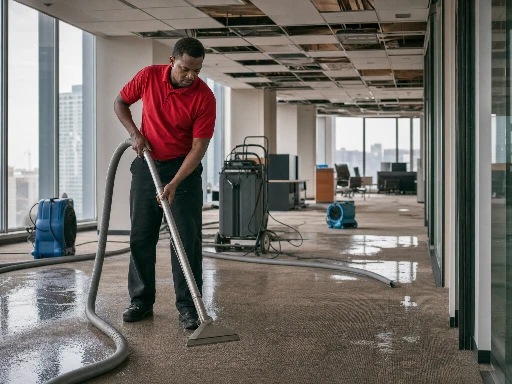
When water breaches a commercial office building, the clock starts immediately. According to the EPA's updated guidance, mold growth can begin on wet surfaces in as little as 24 to 48 hours, making rapid professional response critical to protecting your building, your tenants, and your liability exposure. Water damage restoration is time-sensitive in a way that few other property damage scenarios are, and addressing water damage quickly is the difference between a manageable emergency cleanup and a six-figure remediation bill. The decision that determines which outcome you get: how fast you contact the right water damage restoration company in the Los Angeles area.
We've walked into flooded LA office floors from burst pipes, HVAC condensate overflow, and sprinkler discharges more times than we can count since 1979. MNZ Commercial Cleaning Services specializes in water damage restoration for commercial properties throughout Los Angeles County. This guide walks you through what professional emergency water removal looks like after flood or water damage in a commercial office building, from the first four hours to tenant re-entry, so you know exactly what to expect, what to ask for, and what your restoration company should be doing at every stage of the water damage restoration process.
The First Four Hours Determine the Outcome
Speed matters more than anything else in a water event. The difference between a wet carpet that dries out and a subfloor replacement is often measured in hours, not days. A fast emergency response helps minimize damage, prevents further damage from spreading to unaffected areas, and keeps what could be a contained water leak from becoming structural damage throughout the floor plate.
What to do before the restoration specialists arrive
Your first calls are to stop the source and document the damage. Shut off the water supply valve for the affected line if it's accessible, or have your engineer pull the main. If the water came from an HVAC condensate pan or a sprinkler discharge, get your facilities team or building engineer on-site immediately to isolate the system. Every minute the source runs expands the scope of property damage and increases your restoration costs. Acting to prevent further damage before the crew arrives can significantly reduce the scope of the restoration project.
While you're waiting for the professional emergency restoration crew, start photographing everything: standing water depth, affected areas, visible ceiling tile damage, flooring discoloration. Your insurance company will want that timeline documented from the moment you discovered the intrusion, not from when the crew arrived. Thorough documentation also helps the restoration specialists assess the full scope of damage assessment when they arrive.
Don't try to handle the damage cleanup yourself with a wet-dry vac and mops. Consumer suction equipment can't pull moisture out of concrete, subfloor, or wall cavities. You'll remove surface water and think you're done, and then 10 days later you're dealing with a mold issue behind your drywall. Proper emergency water removal requires commercial-grade equipment that consumer tools simply can't replicate.
What professional water damage restoration crews do first
When our restoration specialists arrive on an emergency water damage call, the first thing we do is map the moisture, not start mopping. We use thermal imaging cameras and moisture meters to identify where water has traveled beyond what's visible. Water follows the path of least resistance, which in a commercial building often means it's tracked 20 or 30 feet from the visible intrusion point before pooling in a wall cavity or under a raised access floor.
Once we have a moisture map, we set up commercial-grade water extraction to remove excess water: truck-mounted or high-capacity portable units that pull water from carpet, pad, concrete, and tile at a rate no consumer equipment can match. Air movers and dehumidifiers go down immediately after the initial emergency water removal to begin the structural drying process, which the EPA recommends completing within 24 to 48 hours to prevent microbial growth that degrades indoor air quality.
If there's any possibility the water source was contaminated, such as a sewer backup, toilet overflow, or any Category 2 or Category 3 water intrusion, the safety protocols are completely different. All affected materials that can't be disinfected to EPA standards get bagged and removed. Staff stay out of the affected zone until clearance testing confirms healthy indoor air quality throughout the space.
Water Damage Scenarios You'll Face in Los Angeles Commercial Buildings
Not all flood or water damage looks the same in a commercial property. Here's what we see most often in the greater Los Angeles area, and why each scenario requires a slightly different restoration approach from your damage restoration company.
Burst pipes and supply line water leaks
You'd think LA's mild winters rule out burst pipes, but they don't. Buildings with older plumbing, buildings that get temperature drops below 40 degrees in the San Gabriel foothills and eastern valleys, and buildings with poorly insulated mechanical rooms all see pipe failures. Supply line water leaks at toilets and sinks, particularly in buildings built before 1990 with braided steel or corrugated supply lines, are even more common year-round. A single supply line failure can discharge 40 to 60 gallons per minute before anyone discovers it overnight or on a weekend, resulting in serious flooding across multiple floors before the water event is even detected.
HVAC condensate overflow
Condensate pan overflow is the single most common water intrusion we see in Class A office buildings across Los Angeles, from Century City to Downtown to Culver City. The drain pan below your air handler catches condensation from cooling coils, and that drain line clogs with algae, mineral deposits, and debris. When it clogs, the pan fills and overflows, sending water down into ceiling plenums, ceiling tiles, onto tenant floors, and sometimes down through electrical conduit.
This type of water intrusion is clean water, which is the good news. The bad news is it's often slow and intermittent, meaning it can saturate ceiling assemblies for days or weeks before anyone notices significant structural damage. Regular condensate drain maintenance, built into your commercial janitorial services program, is the most effective prevention strategy and minimizes the likelihood of a large-scale restoration project.
Sprinkler discharge
Whether from a false alarm, a head malfunction, or actual fire suppression activating during a fire damage event, sprinkler water is the most aggressive scenario you'll face. A single triggered sprinkler head can discharge 15 to 25 gallons per minute. If the system runs for even 10 minutes before anyone can shut it down, you're looking at 150 to 250 gallons in one area, saturating carpet, pad, ceiling tiles, drywall, and any equipment in the zone. Sprinkler water is also often contaminated with rust, biofilm, and chemical treatment agents, which puts it in a different damage restoration category than clean water intrusion and calls for emergency cleanup protocols suited to contaminated flooding.
After a sprinkler event, expect a full water extraction and structural drying protocol plus anti-microbial treatment of all affected surfaces. The water damage restoration process for a sprinkler discharge typically involves more material removal than a clean-water pipe event because the contamination risk is higher, and damage repair to ceiling assemblies and flooring is often required.
Roof leaks and storm damage
Los Angeles gets short but intense storm events, and older flat or low-slope commercial roofs fail at membrane seams, drains, and flashing points. When storm damage causes a roof leak that tracks into the building, it often follows ceiling deck joists and lands 10 to 15 feet from the actual penetration point. Roof leak water is considered contaminated because it picks up bird droppings, debris, and biological matter from the roof surface, so restoration services for storm-related water damage in Los Angeles reflect that contamination classification. A professional restoration company will classify this as Category 2 or Category 3 water and treat it accordingly to protect indoor air quality.
Water Damage Restoration Services in Los Angeles: What's Included
Here's what a qualified damage restoration company should deliver on an emergency water call, and what separates thorough professional water damage restoration from a surface-level response that leaves your building vulnerable to secondary damage.
Pro tip: Ask any emergency cleanup contractor you're considering to show you their moisture readings before and after drying. A professional water damage restoration crew documents final moisture meter readings in every affected area to confirm the structure has reached acceptable dryness levels. If a company can't show you that documentation, they're guessing, not confirming.
Emergency water removal and structural drying
Commercial-grade water extraction is the first step to remove the water from the affected areas — standing water, saturated carpet, and absorbed moisture in concrete and tile. Structural drying is what happens next: high-velocity air movers push dry air across wet surfaces, and commercial dehumidifiers remove moisture from the air and from materials before it can cause secondary damage. The IICRC S500 Standard for Professional Water Damage Restoration (2024 edition) specifies drying goals by material type and is the restoration industry's baseline for what qualified water damage restoration services look like. A qualified restoration crew tracks moisture readings in every affected zone daily until targets are met.
Drying and restoration work for structural assemblies typically takes one to three days for most commercial water events. Severe saturation in concrete slabs, wood subfloors, or enclosed wall cavities can take longer. Rushing that timeline, or declaring the commercial property dry before readings confirm it, is how mold growth problems start. The goal of professional restoration in Los Angeles is to return your property to pre-loss condition, and no legitimate damage restoration company in Los Angeles skips this step.
Anti-microbial treatment and indoor air quality
After water extraction and drying, every surface that contacted the water gets treated with EPA-registered anti-microbial agents. This includes floors, baseboards, wall surfaces, and any structural elements that were exposed. For Category 2 or Category 3 water events, antimicrobial treatment is mandatory in professional water damage restoration, not optional. Our restoration specialists follow commercial sanitation protocols that align with CDC and OSHA guidelines for commercial facility disinfection and for protecting healthy indoor air quality throughout the restoration project.
For post-sprinkler or post-sewage scenarios, you may also need clearance air testing from an independent industrial hygienist before tenants return to the affected area. That's a separate service from the water damage restoration, but your cleaning company should be coordinating with that process, not working around it. Addressing water damage properly at this stage is what separates a complete restoration project from one that creates ongoing indoor air quality problems.
Flooring assessment, damage repair, and salvage decisions
Not every floor needs to be replaced after water damage. The salvage decision depends on the flooring type, how long it was wet, and what water category it was exposed to.
VCT (vinyl composition tile) is the most forgiving: extract the excess water, dry the slab, clean the tile, and in most cases VCT survives a water event with a full recovery. Carpet and pad are the least forgiving: even clean water saturation beyond 24 to 48 hours usually means the pad has to go. Hardwood and engineered wood flooring are situation-dependent, and some can be dried successfully with aggressive air movement if caught quickly enough. Concrete subfloors can absorb significant moisture and need to reach manufacturer-specified moisture content levels before new flooring is installed. An experienced restoration specialist can assess salvageability on-site and recommend the right restoration solutions rather than defaulting to full damage repair and replacement.
If your building has detailed cleaning and maintenance documentation for each floor type and zone, that context helps the restoration crew make faster and more accurate decisions about what's salvageable versus what needs to come out as part of the damage repair scope.
Contents restoration and documentation for insurance claims
Beyond structural surfaces, a comprehensive water damage restoration project often includes contents restoration: assessing, cleaning, and drying equipment, furniture, and documents affected by the flooding. Document restoration for water-damaged paper records, files, and media is a specialized service that your restoration company may handle in-house or coordinate with a specialist, depending on the volume and type of materials affected.
Your damage restoration company should be generating claim documentation you can hand directly to your insurance company: moisture readings with timestamps and locations, photographs of affected areas before, during, and after remediation, a written scope of work, and a final report documenting drying completion. According to the Insurance Institute for Business and Home Safety, documented professional water damage restoration response is one of the most significant factors in claim approval speed and settlement amounts. Commercial and residential property owners alike recover more of their documented losses when working with a credentialed restoration company near Los Angeles.
Getting Your Tenants Back to Work Quickly
Your tenants aren't thinking about moisture meters and drying protocols. They're thinking about when they can get back into their space. Here's how to manage that conversation and compress the timeline without cutting corners on the water damage restoration process.
The first step is isolating the damage zone from unaffected areas. A well-contained water event in a building mechanical room or a single floor zone doesn't have to affect tenants in other areas of the building. Your restoration specialists should establish physical containment, negative air pressure if needed, and a clear perimeter so unaffected tenants don't face disruptions they don't need.
Communicate a realistic timeline: 24 to 48 hours for most single-source water events with a prompt emergency response. Three to five days for more complex scenarios with structural damage, flooring replacement, or ceiling assembly damage repair. Give your tenants a written update with estimated re-entry dates, even if those dates shift, and they'll take the disruption in stride. What tenants don't handle well is silence and uncertainty about when emergency cleanup operations will be complete. Professional restoration services in Los Angeles should include a point of contact who keeps building management updated throughout the process.
Once the area is cleared, confirmed dry, treated, and documented as returned to pre-loss condition, a final deep cleaning of the affected spaces before tenant re-entry makes a significant difference. That means cleaning all surfaces touched during the restoration work, not just the original flood damage zone. This final step removes any residue from the restoration process itself and gives tenants a clean, professional environment to return to.
Frequently Asked Questions
Is emergency water damage cleanup the same as mold remediation?
These are different services. Emergency water damage restoration focuses on water removal, structural drying, and disinfection to prevent mold growth. Mold remediation is the removal of mold that has already established. If flood or water damage is caught within 24 to 48 hours and properly dried by a qualified restoration company, you typically avoid the need for mold remediation entirely. If you're past that window or you discover visible mold growth, you'll need a licensed mold remediation contractor, often working alongside your restoration specialists. The restoration industry distinguishes these as separate disciplines for regulatory and licensing reasons.
How long does commercial water damage restoration take?
Most single-source water events in a commercial office building, such as a burst pipe or HVAC condensate overflow caught within a few hours, take 24 to 72 hours for water extraction and structural drying to complete. Complex restoration projects with significant structural damage, flooring replacement, or ceiling assembly damage repair can take three to seven days or longer. A professional water damage restoration company should provide daily moisture readings that track progress against the drying standard, so you're not guessing about the timeline or when the commercial property will be returned to pre-loss condition.
Do I need to notify my tenants about a water damage event?
Yes, and promptly. Most commercial leases include provisions requiring landlords to notify tenants about conditions that affect the habitability or use of their space. Beyond the lease obligation, tenants who aren't notified tend to discover the flooding or emergency cleanup situation on their own and react worse than those who receive clear, factual communication from building management right away. Keep it simple: what happened, what zones are affected, what damage restoration services are being performed, and your estimated timeline for re-entry. A reputable damage restoration company in Los Angeles should be able to help you with basic communication templates as part of their service.
What certifications should my water damage restoration company have?
Look for IICRC certification (Institute of Inspection, Cleaning and Restoration Certification), which sets the restoration industry standard for professional water damage restoration and cleanup protocols. General liability insurance of at least $1 million per occurrence, workers' compensation, and a valid business license are the baseline requirements. For OSHA-regulated environments, your damage restoration company should also document their safety training and PPE protocols for water-contaminated environments. A certified water damage restoration company available 24 hours a day, 365 days a year for emergency response near Los Angeles is worth identifying before you face a flood or water damage situation. Whether your property is a home or business, certification and licensing matter for both the quality of the restoration work and your insurance claim documentation.
At MNZ Commercial Cleaning Services, we've been responding to commercial building emergencies across Los Angeles since 1979. We specialize in water damage restoration Los Angeles commercial properties rely on, providing comprehensive damage restoration in Los Angeles for commercial and residential property owners throughout the county. Our property damage restoration services are fully documented for insurance claims. We're licensed, bonded, insured, and BBB accredited. Our restoration specialists work directly with building management and insurance companies to document every step of the water damage restoration process, from emergency water removal to final damage repair and deep cleaning. Whether you're addressing water damage from a burst pipe in a Downtown LA tower, an HVAC overflow in a Santa Monica creative office, or a flood restoration project following a sprinkler discharge in a West Hollywood hospitality space, we can be on-site fast and return your property to pre-loss condition with full documentation. We handle commercial and residential properties across Los Angeles County, though commercial water damage restoration is our specialty. Beyond water damage, our emergency services extend to post-fire smoke damage cleanup, fire damage restoration coordination, and any large-scale commercial property emergency requiring rapid professional response.
Call us at (818) 480-9316 or visit mnz.com to get your emergency water removal and water damage restoration plan in place before you need it.
Related Reading
How to Clean a Commercial Building After Wildfire Smoke and Ash in Los Angeles
Transform your space into a clean and welcoming environment with MNZ. Contact us today to schedule a consultation and get a quote for our professional cleaning and maintenance services.


