

Here's something most building managers in Los Angeles learn the hard way.
You hire a cleaning crew. They show up, mop the floors, empty the trash, and wipe down the restrooms. The building looks fine on the surface. Then a tenant complains about a sticky elevator panel. A property inspection flags a stained grout line near the lobby entrance. And a potential new tenant takes one look at the scuffed hallway baseboards and decides to pass.
That's the gap nobody talks about. Commercial building maintenance and janitorial cleaning are related, but they are not the same thing. Treating them as if they were is one of the most common and most costly mistakes property managers make.
This post breaks down what commercial building maintenance actually covers, why the distinction is relevant for your property's value and tenant retention, and what a real maintenance program looks like in practice.
The Problem: You're Paying for Cleaning but Getting a Half-Solution
Most buildings in Los Angeles, West Hollywood, Santa Monica, El Segundo, and Pasadena operate on a janitorial schedule. Floors get swept, restrooms get sanitized, and common areas get spot-wiped. And that's valuable. You need that baseline.
But here's what that routine cleaning misses:
- Hard surface restoration (grout, tile, concrete)
- High-touch surface deep disinfection beyond daily wiping
- Exterior building surfaces, including pressure washing and entry cleaning
- Post-event or post-renovation cleanup
- Ongoing inspection and reporting of building wear, not just cleaning of it
A 2022 study by the Building Owners and Managers Association (BOMA) found that reactive maintenance, meaning fixing things after they break or look awful, costs property owners roughly 3 times more than a planned, preventive approach. That number is difficult to ignore when you're managing a multi-tenant office building or commercial complex in LA County.
Janitorial cleaning handles today's mess. Commercial building maintenance protects the asset for the long term.
What Commercial Building Maintenance Actually Includes
Let's be specific, because this is where the real value lives.
Day-to-Day Cleaning vs. Ongoing Building Upkeep
Day-to-day cleaning handles visible dirt and sanitation. Ongoing building upkeep, which is part of the broader scope of commercial building maintenance, includes:
1. Appearance management beyond mopping
Think floor refinishing, carpet extraction, window cleaning, exterior surface washing, and lobby glass polishing. These are not daily tasks, but they need to happen on a schedule. When they don't, tenants notice before you do.
2. Facility monitoring and reporting
A well-run maintenance program includes teams who actually flag issues: a leaking paper towel dispenser, a burnt-out hallway light, and a lobby mat that's starting to fray. You want a vendor who reports what they see, not just cleans what's in front of them.
3. High-frequency touchpoint sanitation
Elevator buttons, door handles, shared kitchen surfaces, and reception areas in busy commercial buildings can harbor bacteria at rates far higher than most people realize. A 2019 study in the International Journal of Environmental Research and Public Health found that elevator buttons had significantly higher bacterial contamination than most restroom surfaces. Standard cleaning often misses this.
4. Exterior and entryway maintenance
Your building's exterior is the first thing a prospective tenant, client, or investor sees. Pressure washing walkways, cleaning entry glass, and maintaining parking area cleanliness are part of commercial building maintenance. They're rarely covered in a basic janitorial contract.
5. Post-construction and turnover cleaning
Tenant turnover is common in LA County office buildings. What happens between tenants matters. Construction dust, adhesive residues, and HVAC particles require a different level of cleaning than daily maintenance. This is a specialty service, and it belongs under your maintenance umbrella.
Why This Matters More in Los Angeles Than Almost Anywhere Else
Los Angeles has a few factors that make comprehensive commercial building maintenance more critical than in other markets.
First, the real estate market is competitive. Tenants in West Hollywood, Pasadena, and Santa Monica have options. A building that looks worn out, even if it's technically clean, loses ground fast in lease renewals and new tenant attraction.
Second, California has some of the strictest workplace health and safety requirements in the country. Cal/OSHA standards apply to commercial spaces, and property managers are expected to maintain environments that meet those standards. "We have a cleaning crew" is not the same as a documented maintenance program.
Third, outdoor air quality, wildfire smoke, and year-round foot traffic mean exterior surfaces and entryways in LA take more abuse than comparable buildings in most other cities.
A 2023 CBRE report on the Los Angeles commercial real estate market noted that tenant experience scores dropped significantly in buildings where common area maintenance was inconsistent, with cleanliness and upkeep ranking as the top two factors in tenant satisfaction surveys. The buildings scoring highest weren't necessarily newer. They just had better maintenance programs.
The Real Cost of Skipping Comprehensive Commercial Building Maintenance
Let's talk numbers for a second, because this is where the conversation gets real.
If your building has 50,000 square feet of leasable space and you lose one tenant due to maintenance-related dissatisfaction, you're potentially looking at:
- 3 to 6 months of lost rent while you search for a replacement
- Tenant improvement allowances to attract someone new
- Broker commissions, often 4 to 6 percent of total lease value
- Potential deferred maintenance costs that compound over time
On the other hand, industry benchmarks suggest that buildings with proactive maintenance programs see 15 to 20 percent higher tenant retention rates compared to those operating on a reactive model. That's not a marketing claim. That's the math on protecting your real estate investment.
And here's the thing: the cost difference between a basic cleaning contract and a comprehensive commercial building maintenance program is usually far smaller than most managers expect. The scope expands, but so does the protection.
What a Solid Commercial Building Maintenance Program Looks Like
You don't need to reinvent the wheel here. You need a vendor who understands the full scope and can deliver it consistently.
Here's a practical framework for what to look for:
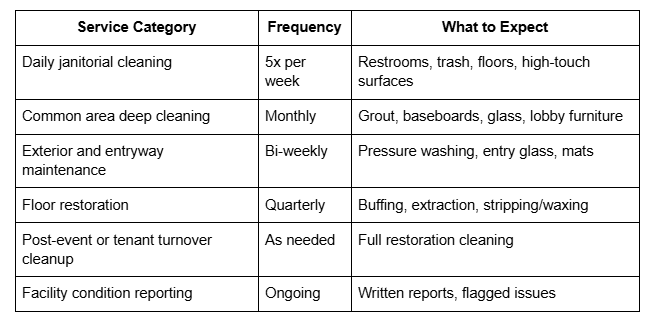
The difference between a vendor who checks boxes and one who actually supports your property management goals is consistency, communication, and scope awareness.
What to Ask Your Current Provider
If you're not sure whether your current setup qualifies as true commercial building maintenance or just cleaning, here are a few questions worth asking:
- Do they provide written reports on building conditions, not just cleaning logs?
- Could you please clarify if they manage exterior surfaces and entryways or if that responsibility falls to another party?
- What's their process for tenant turnover cleaning?
- Are they familiar with Cal/OSHA sanitation requirements for commercial spaces?
- Do they flag maintenance issues they notice, or only clean what's on their checklist?
If the answers are vague, you have a cleaning vendor. You need a maintenance partner.
How MNZ Handles This for Buildings Across Los Angeles County
MNZ Janitorial Services works with building managers, property managers, and office managers across Los Angeles, West Hollywood, Santa Monica, El Segundo, and Pasadena. Our approach to commercial building maintenance starts with the same thing every time: understanding the full scope of your building's needs, not just the floor plan.
That means we show up with a plan that covers daily sanitation and the ongoing upkeep your asset actually requires. We flag what we see. We stay consistent. And we work within your schedule so building operations stay smooth.
We're not the right fit for every building. But if you're managing a commercial property where tenant experience, asset protection, and compliance actually matter, we'd like to talk.
Conclusion: Clean Is a Starting Point, Not the Finish Line
Commercial building maintenance done right is a system, not a service call. It's the difference between a building that looks presentable and one that holds its value, retains tenants, and stays compliant over time.
If your current setup is purely reactive, or if your vendor only shows up with a mop and a schedule, it's worth having a real conversation about what a full-scope maintenance program could look like for your property.
Ready to see what's actually possible for your Los Angeles building? Request a free consultation with the MNZ team at mnz.com/estimates. We'll walk through your current setup, identify the gaps, and provide you a clear picture of what comprehensive commercial building maintenance looks like for your specific property.
Transform your space into a clean and welcoming environment with MNZ. Contact us today to schedule a consultation and get a quote for our professional cleaning and maintenance services.
.jpg)


