
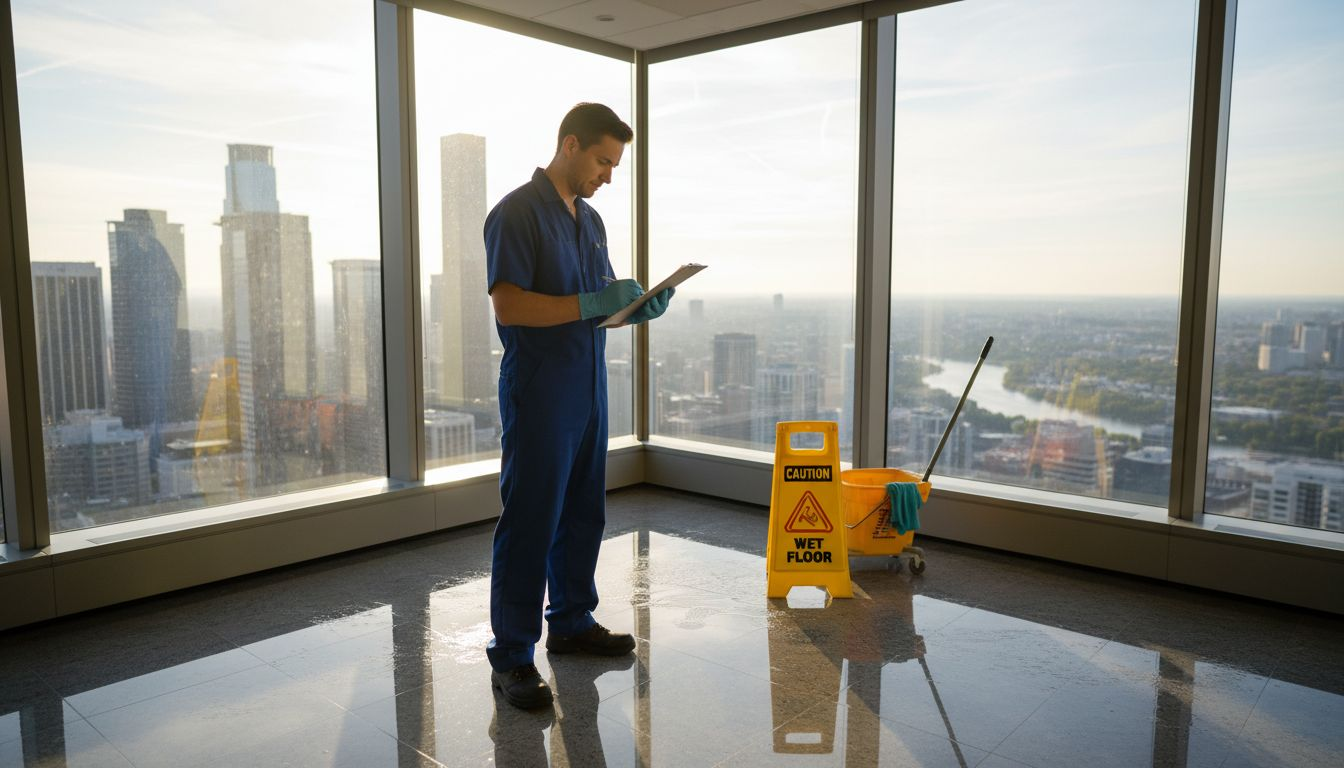
You know that feeling when you walk into an office building at 8 AM, and something just feels off? Maybe there's a coffee stain from yesterday still on the break room counter. Or the restroom soap dispensers are empty again. For building managers and property owners across Los Angeles, these small oversights add up fast, and they're costing you more than you think.
A recent survey by the International Facility Management Association found that 94% of employees say a clean workplace directly affects their productivity. That same research shows tenants are 3.5 times more likely to renew their lease when they're satisfied with building maintenance and cleanliness. So when you're managing office spaces in competitive markets like West Hollywood or Santa Monica, getting the cleaning right isn't just about appearances. It's about retention, reputation, and real dollars.
The problem? Most building managers are working with generic cleaning checklists that don't account for LA's unique challenges. Our city deals with specific environmental factors, from the dust that blows in during Santa Ana winds to the higher foot traffic in mixed-use buildings throughout Downtown and Pasadena. You need a checklist that actually works for California office spaces.
After working with hundreds of commercial properties across Los Angeles County, we've seen what separates mediocre cleaning from the kind that keeps customers happy and inspections stress-free. Let me walk you through the 7 essentials your office cleaning checklist absolutely needs.
1. Daily High-Touch Surface Sanitization
Think about everything people touch between 9 and 5. Consider items such as door handles, elevator buttons, light switches, shared kitchen appliances, and conference room controls. Before 2020, you might have gotten away with weekly attention to these spots. Not anymore.
Your daily checklist needs to specifically call out every high-touch surface in your building. We're talking about doorknobs, handrails, push plates, bathroom faucets, coffee machine buttons, microwave handles, refrigerator doors, and yes, those fingerprint-covered glass doors at your entrance.
Here's what this looks like in practice. When office cleaning services Los Angeles teams work through high-touch protocols, they're using EPA-registered disinfectants with proper dwell times. That means the surface stays wet for the manufacturer's recommended contact time, usually between 30 seconds and 10 minutes, depending on the product. Most cleaning crews rush this step because they're behind schedule. Please ensure that your checklist includes the specific dwell time for the disinfectant your team uses.
A study published in the American Journal of Infection Control found that ATP (adenosine triphosphate) testing showed a 60% reduction in surface contamination when high-touch protocols were followed correctly versus standard cleaning. Translation: you're actually making a measurable difference, not just wiping things down for show.
Action item for your checklist: Create a building-specific map of every high-touch surface. Include quantities (example: 12 office suite doors, 4 elevator button panels, 18 restroom stalls). This gives your cleaning team a clear target and makes quality control much easier.
2. Restroom Deep-Clean Standards That Go Beyond the Obvious
Let's be honest, restroom cleanliness is where most people's complaints start. But here's what most managers miss: tenants don't complain about slightly streaky mirrors. Tenants typically voice their complaints about items that indicate a lack of attention to detail.
Your checklist needs to break down restroom cleaning into two categories: daily essentials and weekly deep tasks. Daily means refilling supplies, wiping surfaces, mopping floors, and emptying trash. We all know that. The difference-maker is the deep, clean list.
Weekly deep cleaning should include scrubbing grout lines, descaling faucets and fixtures, cleaning inside soap and paper towel dispensers (not just refilling them), wiping down stall dividers, including the hinges, and cleaning the often-forgotten areas like the top of toilet partitions and the undersides of sinks.
According to facility management data from BOMA (Building Owners and Managers Association), buildings that implement structured restroom protocols see 40% fewer maintenance calls related to plumbing and fixture issues. That's because regular deep cleaning catches small problems before they become expensive repairs.
For Los Angeles properties specifically, hard water is a real issue. El Segundo, parts of Pasadena, and areas throughout LA County have hard water that leaves mineral deposits. Your checklist should include monthly descaling treatments for all fixtures, not just when they start looking crusty.
Action item for your checklist: Add photo examples of acceptable versus unacceptable cleanliness standards. Your night cleaning crew might have a different definition of "clean" than you do. Pictures eliminate that ambiguity.
3. Floor Care That Matches Your Actual Flooring
Building managers use the same floor care checklist for every floor type in their building. Carpet in the executive suite gets the same treatment as vinyl composite tile in the hallways. This can lead to significant replacement costs.
Your checklist needs to specify care by floor type. For carpeted areas, you need daily vacuuming in high-traffic zones (lobbies, hallways, and around copiers) and weekly vacuuming in private offices. Quarterly deep extraction cleaning prevents that worn traffic pattern look that screams, "we don't invest in this building."
Hard surface floors need different attention. Luxury vinyl plank, which is increasingly common in modern LA offices, can't handle the same harsh chemicals as ceramic tile. Wood floors in executive offices absolutely cannot be wet mopped with standing water. Your checklist should specify the approved cleaning solution and method for each floor type in your building.
The Floor Covering Education Foundation reports that proper maintenance can extend carpet life by 50% and concrete surface floors by up to 100%. That's the difference between replacing carpet every 5 years versus every 7-10 years. On a 50,000-square-foot office building, that's roughly $125,000 in avoided costs.
For LA properties dealing with outdoor spaces, you've also got to address entrance mats. Those first 15 feet inside your building entrance capture 80% of dirt and moisture, according to cleaning industry research. Your checklist should include daily mat cleaning and quarterly deep cleaning or replacement.
Action item for your checklist: Create a floor map of your building with cleaning specs for each zone. Color code it: red for daily deep traffic, yellow for standard traffic, and green for light traffic areas.
4. Kitchen and Break Room Protocols That Prevent Health Hazards
Office kitchens are disgusting. Let me rephrase: office kitchens become disgusting when there's no specific protocol for cleaning them. We've walked into break rooms in Class A buildings where the microwave looks like a crime scene and the refrigerator smells like a biology experiment.
Your checklist needs daily kitchen tasks: wiping down all countertops and tables, cleaning the exterior of appliances, emptying trash and recycling, and mopping floors. But you also need weekly tasks that most buildings skip: cleaning inside the microwave with degreaser, wiping down the interior of the refrigerator, cleaning behind and under appliances where crumbs accumulate, and degreasing the coffee maker area.
Monthly tasks matter too. Deep clean the refrigerator with everything removed, descale the coffee maker, clean light fixtures above food prep areas (grease and dust love to settle there), and sanitize trash cans themselves, not just empty them.
The National Restaurant Association publishes food safety standards that, while designed for commercial kitchens, offer solid guidance for office break rooms too. Their protocols for preventing cross-contamination and maintaining sanitary surfaces should inform your checklist, especially if you're managing medical or food-related office tenants.
Action item for your checklist: Add a monthly refrigerator cleanout notice to tenants. Provide them a week's warning, then have your cleaning team dispose of anything left unmarked. This prevents the science experiments and keeps your team from dealing with hazardous food situations.
5. Air Quality and HVAC Maintenance Integration
This one surprises many building managers because it feels like maintenance, not cleaning. But your janitorial team and your HVAC maintenance schedule need to work together, and your checklist should reflect that.
Dust accumulation on vents, returns, and diffusers doesn't just look bad. It recirculates particles throughout your office space and forces your HVAC system to work harder. The EPA estimates that buildings with poor indoor air quality cost U.S. businesses $168 billion annually in lost productivity and sick days.
Your cleaning checklist should include monthly vent cover cleaning. That means removing registers and diffusers when possible, vacuuming them, wiping them down, and checking for dust buildup. For larger buildings, quarterly professional duct cleaning makes sense.
For Los Angeles properties, this is especially critical during wildfire season. Our air quality can rapidly deteriorate from August to November. Buildings that maintain clean HVAC systems and add temporary air filtration during poor air quality days report significantly fewer tenant complaints and health-related issues.
According to ASHRAE (American Society of Heating, Refrigerating, and Air-Conditioning Engineers), proper ventilation and filtration can reduce airborne contaminants by 50–90%. Your cleaning team can't replace HVAC filters; that's maintenance work, but they can alert you when filters look overloaded or vents are excessively dusty.
Action item for your checklist: Add a simple 1-10 rating system for air vent cleanliness. Please have your cleaning supervisor assess the vents every month and highlight any ratings below a 7 for prompt attention.
6. Window and Glass Surface Standards for Natural Light Optimization
LA offices sell natural light. Those floor-to-ceiling windows in modern buildings throughout Downtown, Century City, and Santa Monica aren't just architectural features; they're a major selling point for tenants. Streaky, dirty glass kills that value.
Your checklist needs to differentiate between interior glass (conference room walls, office partitions, entrance doors) and exterior windows. Interior glass should be cleaned weekly using microfiber cloths and streak-free cleaner. Exterior windows need professional attention quarterly at a minimum, monthly if you're in high-dust areas or near construction.
For buildings in coastal areas like Santa Monica or El Segundo, salt air accelerates window grime buildup. You might need more frequent exterior cleaning than inland properties.
The International Window Cleaning Association found that buildings with regular window maintenance see a 15–20% improvement in tenant satisfaction scores related to workspace quality. Clean windows also reduce the need for artificial lighting, cutting energy costs by approximately 10-15%, according to building efficiency studies.
When you're working with office cleaning services Los Angeles providers, make sure window cleaning protocols specify the tools. Use squeegees for large panes and microfiber for partitions, and use streak-free solutions specifically designed for your glass type. Tinted or coated glass needs different products than standard panes.
Action item for your checklist: Take photos of your cleanest windows and include them in your checklist as the standard. Have your cleaning team replicate that level of clarity throughout the building.
7. Trash and Recycling Management That Meets LA County Requirements
Los Angeles has some of the most stringent waste management requirements in the country. Your cleaning checklist needs to address compliance, not just emptying bins.
Daily tasks include emptying all trash and recycling receptacles, replacing liners, and disposing of waste in the correct containers. But your checklist should also include weekly tasks like sanitizing the interior of trash bins, checking recycling for contamination, and organizing waste areas.
LA County requires most commercial buildings to recycle and compost. Your checklist should specify how your cleaning team sorts and handles different waste streams: landfill, single-stream recycling, compost, and special waste like electronics or batteries.
According to CalRecycle data, commercial buildings that implement proper waste sorting can reduce disposal costs by 25–40% while improving compliance with state mandates. For a mid-size office building, that's $5,000-$8,000 annually in reduced hauling fees.
Your checklist should also address outdoor trash areas. These spaces often remain neglected until they become rodent attractors. Weekly pressure washing of dumpster pads, monthly deep cleaning of enclosures, and quarterly pest monitoring should all be specified.
Action item for your checklist: Create clear signage for waste sorting that your cleaning team can reference. Include photos of acceptable items for each waste stream and post them near utility areas where your team stages trash for disposal.
Building Your Custom Checklist
Here's what most building managers get wrong: they download a generic cleaning checklist template from the internet and expect it to work for their specific property. Your building in Pasadena has different needs than a similar building in West Hollywood. Your building in Pasadena has a different tenant mix, different foot traffic, and different environmental challenges.
Start with these seven essentials, then customize based on your property specifics. Do you have a fitness center? Add equipment sanitization. Do you have a lobby with marble floors? Add daily dust mopping and weekly burnishing. Do you have outdoor patios? Add sweeping and power washing.
The best checklists are living documents. Please review yours quarterly with your cleaning team. What's working? What's consistently missed? In which areas are tenants still expressing concerns? Adjust accordingly.
Making Your Checklist Actually Work
A great checklist on paper means nothing if your cleaning team doesn't follow it. Here's how to get compliance:
Built-in verification. Add checkboxes with spaces for initials and times. This creates accountability and offers you documentation if something goes wrong.
Train thoroughly. Don't just hand the checklist to your night crew and hope for the best. Walk through it together. Show them what "clean" means in your building.
Spot-check regularly. Random inspections tell you whether standards are being maintained. Check one item from the list each day rather than trying to verify everything weekly.
Use technology when it makes sense. Apps like Swept or Cleaning Business Software let teams check off tasks in real time, creating a digital record you can review remotely.
The Real Cost of Skipping These Essentials
A typical Class B office building in Los Angeles County spends approximately $1.50–2.50 per square foot annually on janitorial services. For a 40,000-square-foot building, that's $60,000-$100,000 per year.
When you skip essentials on your checklist, you don't save money. You just shift costs. Carpets wear out faster, requiring an earlier replacement at $3–$7 per square foot. Hard floors lose their finish, needing costly refinishing. HVAC systems work harder and fail sooner. Tenants leave when their leases end.
According to BOMA research, tenant turnover costs building owners an average of $5–15 per square foot in lost revenue, tenant improvements, and marketing costs. For that same 40,000-square-foot building, losing even one tenant costs $200,000–$600,000.
Effective cleaning doesn't cost money. Bad cleaning does.
Conclusion
Your commercial cleaning checklist isn't just a to-do list for the night crew. It's a strategic tool that protects your property value, keeps tenants satisfied, and prevents expensive surprises.
These seven essentials—daily high-touch sanitization, restroom deep-cleaning, floor-specific care, kitchen protocols, air quality integration, window standards, and compliant waste management—form the foundation. But remember, the best checklist is the one customized for your property and your specific tenants.
Ready to upgrade your building's cleaning standards? Review your current checklist against these seven essentials. Identify gaps. Then work with your cleaning team or bring in qualified office cleaning services from Los Angeles providers who understand what modern commercial properties need.
Your tenants might not notice when everything's clean. But they'll definitely notice when it's not. And in LA's competitive office market, that notice usually comes in the form of a non-renewal letter.
Start with one improvement this week. Please consider fixing the high-touch protocol or upgrading your restroom standards this week. Then build from there. Your future self (and your tenants) will thank you.
Transform your space into a clean and welcoming environment with MNZ. Contact us today to schedule a consultation and get a quote for our professional cleaning and maintenance services.
.jpg)


