

In a soft leasing market like Los Angeles, every detail matters. Vacancy rates are higher, tenants have more negotiating power, and property owners are under pressure to preserve value while controlling costs. That’s where The Landlord’s Guide to Janitorial Service Contracts: Protecting Property Value in LA’s Soft Market becomes essential reading.
Well-structured janitorial service contracts Los Angeles landlords rely on more than routine cleaning agreements—they serve as tools for managing risk. From liability clauses and performance standards to scope-of-work definitions and termination terms, your building cleaning agreements directly impact tenant satisfaction, retention, and long-term asset value.
Smart commercial property maintenance isn’t just about keeping lobbies polished and restrooms stocked. It’s about protecting your reputation, preventing deferred maintenance issues, and ensuring consistent service quality across fluctuating occupancy levels. In this guide, we’ll break down what LA landlords must include, avoid, and negotiate in their janitorial contracts to stay competitive and safeguard their investment in today’s shifting market.
Why Your Cleaning Contract Is Suddenly a Competitive Tool
Here's something most landlords don't think about until a tenant gives notice: the building cleaning agreement you signed two years ago might be actively working against you right now.
LA's commercial office market is going through a rough stretch. The overall vacancy rate for office space in Los Angeles has reached 23.4%, and total availability has climbed to 20.1%, up 3.45% year-over-year. A lot of them. First impressions are now your negotiating leverage when someone tours your building.
This isn't about scrubbing harder. It's about what your janitorial service contracts in Los Angeles actually cover, how they're structured, and whether they're built to protect your asset or just to check a box. There's a real difference, and in a soft market, that difference shows up in your lease renewal rate.
The Problem: Most Cleaning Contracts Were Written for a Different Market
A few years ago, the LA commercial real estate market was tight. Landlords dominated the market, tenants fought for space, and a basic cleaning agreement sufficed. Show up three nights a week, empty the trash, and mop the lobbies. Done.
That market is gone. Leasing activity in LA has declined sharply, with total lease transactions falling 44.6% year-over-year. And as cap rates rise, landlords are now using tenant concessions—rent-free months, tenant improvement upgrades, and relocation expenses—just to hold occupancy.
Here's the part most people miss: building cleanliness is a concession you can control without negotiating against yourself. A well-maintained building that consistently looks good is one of the few value-adds you can deliver every single day without giving up rent.
But most building cleaning agreements weren't written with this kind of intention. They were written to minimize cost. So what gets minimized? Scope. Frequency. Accountability. And in a market where tenants have leverage, that's a liability.
Agitating the Issue: What Happens When Contracts Fall Short
Let me walk you through two real scenarios that play out constantly across commercial property maintenance in Los Angeles.
Scenario 1: The Class A Building in West Hollywood Losing Tenants to Itself
Picture a 12-story mixed-use Class A building on Santa Monica Boulevard. The landlord has a solid tenant base, but two tech companies on floors 4 and 7 just downsized. The building now has some vacant space to fill.
A prospective tenant tours on a Tuesday morning. The lobby looks fine. But the shared restrooms on the 6th floor still have streaks from Monday night's cleaning. The elevator glass has fingerprints. The common-area carpet near the elevator bank has a faint smell.
None of these are disasters. But the prospect is also touring a competing building in El Segundo, where the facilities director put in a more aggressive commercial property maintenance schedule after the pandemic.
The result? The landlord in West Hollywood loses a 3,000 SF deal. Not because of rent. Not because of parking. Because the building didn't feel worth the ask.
Scenario 2: The Class B Multi-Tenant Building in Pasadena That Gets It Right
Now picture a 4-story Class B property near Old Pasadena. Not a trophy building by any stretch. But the landlord renegotiated their janitorial service contracts in Los Angeles last year and added three specific things: daily common-area touch-ups, monthly deep cleans of shared restrooms, and quarterly window cleaning on the first and second floors.
The cost increase? Roughly $400 per month.
The result? Two lease renewals that, according to the building manager, were directly influenced by tenants saying the building "always looks clean." Turnover in commercial and residential properties often runs $1,500 to $4,000 per unit once you factor in lost rent, repairs, advertising, and new leasing—so keeping two tenants more than covers that extra annual spend.
The Solution: Building Cleaning Agreements That Work for a Soft Market
So what should your contract actually look like right now? Here's how to think about it based on your building type and tenant mix.
For Class A Buildings: Match the Standard You're Selling
Class A tenants expect a Class A experience every time they walk in. That means your building cleaning agreements need to reflect that consistently, not just when you're showing space.
What to require in your contract:
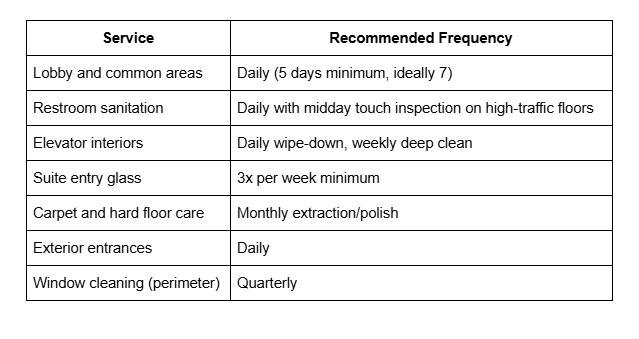
A key clause many Class A landlords miss: performance benchmarking. Your contract should define what "clean" means with measurable language, not just "satisfactory to the landlord." Tie at least a portion of your billing to documented inspection scores. This gives you leverage if service quality drops, and it gives your cleaning vendor a clear target.
For Class B Buildings: Prioritize the Touchpoints Tenant's Notice
Class B buildings often have tighter budgets, but that doesn't mean your commercial property maintenance has to look that way. It means you have to be strategic.
The areas tenants notice most, in order, are lobbies, restrooms, hallways near their suite entrance, and the elevator. Those are your non-negotiables. Everything else can be adjusted by frequency.
A practical approach: instead of spreading a modest cleaning budget evenly across the whole building, concentrate coverage on visible and shared spaces. Negotiate with your vendor for tiered service—daily care in common areas, twice-weekly for individual floor corridors, and monthly for storage or loading areas.
For Multi-Tenant Buildings: Accountability Language Is Everything
Multi-tenant buildings have a unique challenge: one tenant's perception of cleanliness affects the next. If a dental office on the second floor has foot traffic at 7 AM, they're experiencing your building before the cleaning crew from the night before has fully made an impression on the other tenants arriving at 9.
Your building cleaning agreements for multi-tenant properties should include:
- A defined start time for nightly cleaning that accounts for the last-tenant departure
- Named contact points on both sides (your property manager, their account supervisor)
- A documented incident response protocol (something looks wrong, who gets called, how fast)
- Monthly walkthrough inspections with written sign-off from both parties
For Single-Tenant Buildings: Align the Scope to the Lease
Single-tenant commercial properties in LA often operate under a triple-net or modified gross lease, which means the tenant may handle some or all maintenance. But here's where landlords frequently get burned at lease renewal or turnover: there's no established baseline.
If your lease requires the tenant to maintain the premises in "good condition," and you haven't defined what that means for cleaning and sanitation, you're going into that conversation with no documentation. Work with your cleaning vendor to establish a baseline inspection report when the lease begins, and build that into your building cleaning agreements from day one.
The Contract Terms Landlords Often Overlook
Beyond scope and frequency, there are a few contract terms that directly protect your property value in a down market.
Termination for cause, with notice: Make sure your janitorial service contracts in Los Angeles include a clear standard for what constitutes a breach and a reasonable cure period (typically 10 to 15 business days). Without this, you're stuck in a long contract even when performance is slipping.
Insurance and liability: Your cleaning vendor should carry general liability insurance of at least $1 million per occurrence and workers' compensation coverage for their employees. Ask for certificates of insurance naming your LLC or management company as an additional insured. This matters especially in California, where premises liability can attach to the property owner even when a third-party vendor is responsible.
Substitution of personnel: If consistency matters to you (and it should, since your tenants will notice staff changes), add a clause that requires your approval before the vendor reassigns your primary cleaning crew. High staff turnover at your cleaning company means inconsistent quality at your building.
Scope change language: Markets change, building occupancy changes, and your cleaning needs will change, too. Make sure your contract has a clear process for adjusting scope without requiring a full renegotiation. A simple change-order clause with a 30-day notice requirement is enough.
What This Looks Like for Specific LA Markets
Downtown Los Angeles and Mid-Wilshire: These submarkets have the highest vacancy rates in the region. If you own a Class A or B office product here, your commercial property maintenance program is arguably more important than your rent concessions. Tenants choosing between two buildings at similar rents will pick the one that feels better maintained.
Santa Monica and West Hollywood: Creative and tech tenants in these markets are notoriously sensitive to the environment. They care about air quality, restroom conditions, and how the building smells. Your janitorial service contracts in Los Angeles for these buildings should include green cleaning product requirements—certified low-VOC, non-toxic, and clearly documented. This is a selling point in a lease negotiation, not just a feel-good item.
El Segundo and Pasadena: Suburban office markets with more practical, cost-conscious tenants. Here, reliability matters more than premium. A consistent, documented cleaning schedule that you can point to in a lease conversation is worth more than flashy promises.
A Simple Contract Checklist to Use Right Now
Before you renew or sign any new building cleaning agreement, run through this:
- Scope of work is written specifically, not generically ("lobby floors mopped and dry-buffed nightly" vs. "lobby maintained")
- Frequency is spelled out for every area, not left to interpretation
- Supervisor contact is named and available by phone during business hours
- Insurance certificates are current, and name your entity as additional insured
- The inspection process is defined, with written records retained for at least 12 months
- Termination clause includes a cure period and does not require 90-plus days to exit
- The scope change process is documented and does not require full contract renegotiation
- Green/eco-friendly product requirements are noted if relevant to your tenant profile
Conclusion: Your Building Competes Every Day, Not Just at Lease Signing
The LA commercial real estate market right now is asking every landlord a hard question: why should a tenant pick your building? Rent concessions help. Location helps. But both of those are out of your control once the lease is signed.
Your commercial property maintenance program is different. It shows up every single day. It's what your tenants experience every morning when they walk in, every time they use the restroom, and every time they bring a client to their suite.
Structuring your janitorial service contracts in Los Angeles with real performance standards, clear accountability, and a scope that matches your building class isn't an overhead cost. It's a retention strategy.
If you're managing a building in Los Angeles County, West Hollywood, Santa Monica, El Segundo, or Pasadena, and you're not sure your current contract is doing enough, MNZ Janitorial Services will walk through your property with you and give you an honest assessment.
Transform your space into a clean and welcoming environment with MNZ. Contact us today to schedule a consultation and get a quote for our professional cleaning and maintenance services.
.jpg)


