
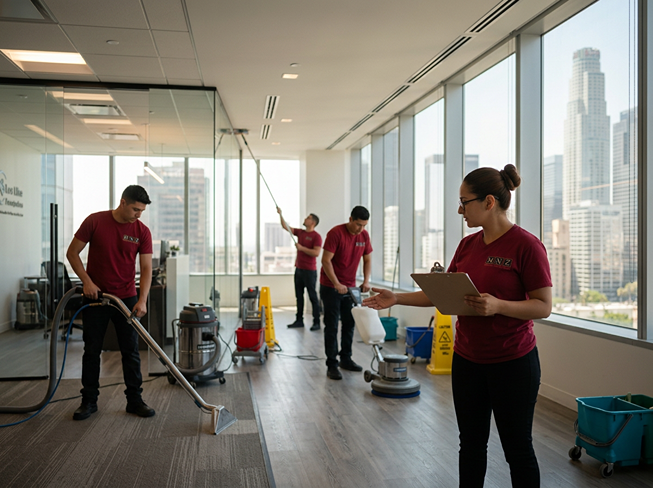
An annual commercial deep-cleaning program for a Los Angeles office building covers the surfaces, systems, and areas that nightly office cleaning can't reach on a regular schedule: high-level dusting above ceiling tiles, carpet cleaning and extraction, VCT floor refinishing, pressure washing of building entrances, and HVAC grille cleaning, among others. According to the 2026 ISSA commercial facilities maintenance benchmarks, buildings that schedule structured deep-cleaning cycles twice a year reduce overall consumable and maintenance costs by an average of 12 to 18 percent compared to buildings relying on nightly office cleaning service alone. At MNZ Commercial Cleaning Services, we've structured annual commercial cleaning programs for Class A office portfolios across Los Angeles since 1979, and here's what a well-built program actually includes. If you're evaluating cleaning services in Los Angeles for a building that needs more than standard nightly janitorial, this guide covers the full scope of how to deep clean a commercial building systematically.
What an Annual Deep-Cleaning Program Actually Covers
Most property managers know their building gets cleaned nightly. Fewer have a documented plan for the tasks that fall outside that daily commercial cleaning service scope. Many commercial buildings rely on nightly janitorial service alone and miss the deep cleaning their surfaces actually need between lease cycles and major renovations. An annual or semi-annual deep-cleaning program is the scheduled layer of service that prevents gradual deterioration of surfaces, finishes, and air quality. Understanding your building's cleaning needs at this deeper level is what separates a well-maintained Class A property from one that shows its age between lease events. Commercial buildings that skip structured deep-cleaning programs pay for it through accelerated surface wear, tenant complaints, and restoration costs that dwarf the price of consistent preventive service.
Beyond Nightly Service: What Deep Cleaning Adds
Nightly janitorial service maintains the daily condition of your building. Deep cleaning restores it. The distinction matters: nightly office cleaning crews are managing what happened today. Deep-cleaning crews are addressing what accumulated over months. Your building type and occupancy density determine which deep-cleaning services belong on which schedule, and the cleaning complexity of a multi-tenant high-rise differs significantly from a single-tenant creative campus. These are different tasks requiring different cleaning equipment, different cleaning methods, and sometimes different scheduling windows to avoid disrupting tenants. A professional commercial cleaning company that understands both scopes builds a detailed cleaning program that complements nightly service rather than duplicating it. Building cleaning at this level is a different discipline from routine janitorial work, and commercial cleaners who specialize in deep-cleaning programs approach the scope accordingly.
The core categories that belong in a formal annual program are high-reach cleaning (above 10 feet, including ceiling-mounted light fixtures, HVAC grilles, and exposed ductwork), hard floor restoration (stripping and recoating VCT, buffing or burnishing concrete or stone), carpet cleaning and extraction (hot water extraction for all carpeted areas, not just spot treatment), window cleaning (interior and exterior where accessible), deep restroom and bathroom surface cleaning (descaling, tile and grout cleaning, fixture replacement review), and pressure washing of all exterior-entry surfaces and loading dock areas.
The Areas That Accumulate Damage Between Deep Cleans
Some surfaces degrade visibly. Others degrade invisibly but affect tenant experience: carpet holds odors long before it looks dirty enough for professional carpet cleaning; HVAC grilles distribute dust even after the filter is changed; VCT floor finish yellows under daily traffic even when the floor appears clean. Areas that need frequent cleaning beyond the nightly routine include bathroom and restroom surfaces that get daily wiping but still develop scale and grout discoloration that only tile and grout cleaning addresses. A property manager who waits until surfaces look damaged has already lost the window when maintenance is cheapest. The annual commercial cleaning program is the early intervention that keeps per-square-foot restoration cleaning cost at the maintenance level rather than the replacement level.
How to Build a Deep-Cleaning Schedule for a Los Angeles Office Building
Scheduling is where most annual office cleaning programs fall apart. The tasks are well-understood, but fitting them around tenant operations, lease renewals, and holiday schedules without disrupting the building's occupants requires advance planning most janitorial service contracts don't build in. A commercial cleaning company that can provide commercial cleaning services across both routine and annual scopes gives your property manager a single point of accountability, and a program that meets the cleaning needs of your building type from day one avoids the gaps that separate deep-cleaning events leave behind. The best cleaning services in Los Angeles for commercial office buildings build this into the contract from the start rather than treating deep-cleaning events as separate one-off requests.
Quarterly vs. Semi-Annual vs. Annual Tasks
Not all deep-cleaning tasks belong on the same cycle. A practical cleaning schedule for a Class A Los Angeles building typically looks like this: quarterly tasks cover high-reach dusting of light fixtures and HVAC grilles, interior window cleaning on high-touch or sun-exposed facades, and pressure washing of main building entries and smoking areas. Semi-annual tasks cover carpet cleaning and hot water extraction for high-traffic zones (lobbies, corridors, conference rooms), VCT floor stripping and recoating, deep restroom and bathroom service including tile and grout cleaning and fixture hardware inspection, and elevator cab deep cleaning. Annual tasks cover full exterior window washing performed by professional window cleaners, parking structure sweeping and pressure washing, roof drain clearing, and a full building condition audit that identifies surfaces approaching the end of their maintenance window. Building maintenance costs decrease when this schedule runs consistently. Some property managers also request green cleaning products for specific tasks, particularly in LEED-certified buildings where documentation of low-VOC cleaning methods is required. Professional carpet cleaners using hot water extraction, commercial window cleaners, and floor restoration crews may be scheduled on separate mobilizations or combined into a single annual event depending on building size. Deferred tasks compound in cost.
How Occupancy Density and Building Use Affect Cleaning Frequency
A 20-story Class A tower with 500 employees per floor has different office cleaning needs than a 3-story creative-office building with 80 people. Standard nightly janitorial service runs five times per week, but the deep-cleaning cycle that's adequate for a low-density building leaves surfaces visibly degraded in a high-density one. The BSCAI's 2026 research on commercial cleaning frequency confirms that per-person daily soil generation is the primary driver of deep-cleaning cycle length. High-density commercial office buildings, those at or above 150 square feet per person, accumulate carpet soil and hard floor wear roughly twice as fast as low-density buildings, and their annual cleaning programs should reflect that with semi-annual commercial carpet cleaning rather than annual-only service, and quarterly VCT maintenance buffing to extend the life of the annual strip-and-recoat. Your commercial cleaning service provider should be able to recommend cleaning frequency based on your facility's occupancy density and surface types.
Pro tip: Build your cleaning schedule backward from your lease renewal calendar. If 30 percent of your leases renew in Q1, your annual floor restoration and carpet cleaning should land in late Q4, so spaces are in peak condition when prospective tenants tour and renewal negotiations begin. The cleaning cost of a deep program before a lease event is a fraction of the cost of a tenant allowance negotiation driven by a tired-looking building.
What Commercial Deep-Cleaning Services Cost in a Los Angeles Building
Commercial cleaning cost varies by task type, floor area, and condition of the surfaces being serviced. Commercial cleaning rates vary based on task complexity, access window requirements, and whether crews are mobilizing for a single deep-cleaning event or as part of an ongoing annual program. Understanding commercial cleaning cost before you sign a service agreement prevents budget surprises when annual tasks come due. The 2026 ISSA benchmarks place regular office cleaning service at $0.12 to $0.18 per square foot for Los Angeles offices. Deep cleaning services carry a different cost structure: they're labor-intensive, equipment-dependent, and typically scheduled for overnight or weekend windows to avoid tenant disruption. A company in Los Angeles that provides both routine and deep commercial cleaning services should be able to give you a pricing guide with per-task unit rates before you commit to a contract.
Per-Task Commercial Cleaning Cost Benchmarks
Carpet cleaning via hot water extraction for a standard office corridor or Class A suite runs $0.18 to $0.28 per square foot depending on soil condition and pile density. VCT floor stripping and recoating runs $0.35 to $0.55 per square foot for a complete strip, two coats of finish, and burnishing. Pressure washing of building entries and loading areas typically ranges from $0.08 to $0.14 per square foot of surface area. High-reach building cleaning with aerial equipment adds a lift rental premium, typically $300 to $600 per day of cleaning equipment use depending on the ceiling height requiring access. Tile and grout cleaning for restroom and bathroom surfaces typically ranges from $0.25 to $0.45 per square foot depending on soil buildup and grout condition. Commercial carpet cleaning for individual conference rooms or office suites can typically be quoted as a flat rate per room when the square footage is small. Request a cleaning quote that itemizes each task by unit rate so you can compare proposals across vendors without ambiguity about what's included.
How to Budget for Deep Cleaning in Your Service Agreement
The most efficient approach is to negotiate deep commercial cleaning services as a line item in your annual janitorial service contract rather than sourcing them as separate one-off projects. A single commercial cleaning company that manages both nightly office cleaning and the annual program has context about your building's specific conditions, knows your tenant schedules, and can sequence cleaning operations efficiently without duplicating mobilization costs. Request a per-task unit price schedule at contract signing so you have a predictable cleaning cost basis for budgeting rather than negotiating each project individually when the task comes due. Consistent cleaning rates written into the contract protect you from price increases mid-program, and regular cleaning built around a documented scope keeps your building's surfaces at a standard that survives lease-event scrutiny. Check customer reviews and verify that the vendor has handled maintenance services for Class A buildings at a similar scale before committing to a multi-year agreement.
Coordinating Deep Cleaning With Tenants and Building Operations
The logistics of executing deep-cleaning tasks in an occupied commercial office building are as important as the technical scope. A carpet cleaning job that runs through the building's busiest corridor at 9 a.m. is a liability, not an office cleaning service. Coordination requires advance tenant notice, a clear window for access, and a professional cleaner who can adapt the sequence if a tenant's schedule changes the day before the job. A trained cleaning team that has performed commercial office cleaning services at scale understands how to sequence these cleaning operations without creating access conflicts across multiple tenant suites.
Scheduling Around Business Hours and Lease Obligations
Most deep-cleaning tasks belong in overnight or weekend windows. For a multi-tenant commercial office building, coordinate with each tenant's facilities contact at least two weeks before any task that affects their suite access. Floor restoration tasks require 6 to 8 hours of drying time before the area can be reopened to foot traffic: a strip-and-recoat that begins at 6 p.m. on a Friday can safely open by Saturday morning, but a strip-and-recoat that begins at midnight on a Wednesday creates a conflict for early-arriving tenants at 7 a.m. Map your access windows carefully, and confirm the cleaning schedule with your commercial cleaning service provider in writing so there's no ambiguity about the cleaning process on the day of service.
For day porter services and ongoing coverage during deep-cleaning events, see our post on day porter services for Class A Los Angeles offices, which covers how to maintain building coverage while crews are working in restoration mode.
What Documentation Your Tenants and Insurers Expect
BOMA certification and most Class A lease agreements require that building owners maintain records of scheduled maintenance activity, including deep-cleaning events. Your annual commercial cleaning program should generate a completion record for each task: date, scope, vendor name, and any findings (for example, a tile and grout cleaning inspection that reveals cracked grout requiring replacement). These records matter when tenants submit maintenance requests, when you're renewing leases, and when you're responding to an insurance claim that involves a building condition question. A professional commercial cleaning company with a documented maintenance program gives your property manager the paper trail that BOMA and sophisticated commercial office tenants expect. Building maintenance documentation is increasingly a lease requirement for Class A properties, not just a best practice.
For building a vendor accountability structure that applies to both nightly office cleaning service and annual cleaning programs, see our post on what a commercial cleaning SLA should include to hold your vendor accountable.
Frequently Asked Questions
The following questions cover the most common decisions Los Angeles property managers face when building or evaluating an annual commercial deep-cleaning program.
How often should carpet cleaning be performed in a Los Angeles Class A office building?
High-traffic areas like lobbies, corridors, and conference rooms benefit from professional carpet cleaning via hot water extraction every six months. Individual suite carpets can typically run on an annual commercial carpet cleaning cycle if nightly office cleaning service includes regular vacuuming. Buildings with food-service areas near carpeted zones need a shorter cleaning frequency: food odor embeds in carpet fiber quickly and doesn't respond well to annual-only commercial carpet cleaning treatment. Your commercial cleaning company should assess cleaning needs by zone rather than applying a single building-wide interval, and the best commercial cleaners serving Los Angeles office buildings build zone-specific cleaning schedules rather than a one-size-fits-all program.
Can deep-cleaning tasks be added to an existing janitorial service contract?
Yes, and that's often the most cost-efficient approach to managing commercial cleaning cost. A commercial cleaning company already servicing your building mobilizes from an existing relationship rather than starting from scratch on building access, contact protocols, and tenant schedules. Request a separate pricing schedule for deep cleaning services when you negotiate your nightly office cleaning service contract, not when the tasks come due. This keeps your cleaning cost predictable and your commercial cleaning service provider accountable to a documented scope. Most commercial cleaning companies that offer cleaning services in Los Angeles can bundle routine and deep-cleaning work under a single service agreement.
How long does a full VCT floor strip-and-recoat take for a typical Los Angeles office floor?
A standard 10,000-square-foot office floor with 4 inches of existing finish buildup requires 6 to 8 hours for a complete strip, two-coat reapplication, and initial dry time. Burnishing typically happens 24 hours later. Plan for an overnight start and a full weekend window for large floor plates above 20,000 square feet. Professional cleaners with commercial office cleaning experience factor this drying window into their cleaning schedule so tenants don't arrive to a wet floor.
Does pressure washing require a water permit in Los Angeles?
Commercial pressure washing in Los Angeles that generates runoff must comply with the City of LA's stormwater discharge requirements under Municipal Code Section 64.70. For most commercial office buildings, this means containing runoff with berms or wet-vacuuming discharge before it reaches storm drains. Your commercial cleaning service provider should have a stormwater management plan for exterior work: ask for it before scheduling any pressure washing job. A qualified commercial cleaning company operating in Los Angeles County already knows these requirements and should provide the documentation without a special request.
At MNZ Commercial Cleaning Services, we've structured annual deep cleaning programs for Class A office portfolios across Los Angeles since 1979. Whether you need a full annual cleaning schedule built into your service agreement or a single deep-cleaning event before a lease renewal, our Los Angeles commercial cleaning team can scope and price the work based on your building's actual condition. We provide commercial cleaning services to office buildings across Downtown Los Angeles, Santa Monica, West Hollywood, El Segundo, Culver City, and throughout the greater Los Angeles area. Call us at (818) 480-9316.
Related Reading
What Does VCT Floor Stripping and Waxing Cost in a Los Angeles Commercial Building?
How Do You Choose the Right Commercial Cleaning Frequency for a Los Angeles Office Building?
Transform your space into a clean and welcoming environment with MNZ. Contact us today to schedule a consultation and get a quote for our professional cleaning and maintenance services.


