
You walk into the office on a Monday, and two people have already called in sick. Again. By Wednesday, the cold had circled the whole team. Productivity tanks. Deadlines shift. And somewhere in the back of your mind, you wonder if there's anything you can do about it or if this is just how offices work.
Here is the thing: it is not just unfortunate luck. Much of it depends on what is happening, or not happening, inside your building between the hours of 6 PM and 7 AM.
This is a story about a company right here in Burbank that figured that out, and the numbers they saw after making one change.
Why Sick Days Are Costing More Than You Think
Before we get to the case study, let us talk about the size of this problem.
According to the CDC Foundation, productivity losses linked to employee absenteeism cost U.S. employers $225.8 billion annually, or roughly $1,685 per employee per year. That figure only covers the days people do not show up. When you include presenteeism, which refers to employees who come to work while sick and underperform, the Harvard Business Review estimates that the total cost rises to between $150 billion and $250 billion in additional lost output each year.
Research from the University of Arizona found that when a single sick employee spends just two to four hours at the office, they can spread germs to more than 50% of the most commonly touched surfaces in the building. Keyboards, door handles, coffee machine buttons, restroom faucets — all of it.
So the real question is not just, "Why are my people getting sick?" It is "what lives on the surfaces they touch every day, and who is responsible for removing it?"
For most building managers and office managers, the honest answer is we are not totally sure.
The Burbank Company That Decided to Find Out
A mid-size professional services firm based in Burbank, with about 60 employees across two floors, had been using a budget cleaning service for about three years. The crew came in nightly, emptied the trash, vacuumed, and wiped down visible surfaces. On the surface, the office looked fine.
But the building manager started noticing a pattern. Every cold and flu season, they would lose an average of 11 sick days per employee across their team. Their HR director had started flagging it. Medical costs and sick pay were increasing. And tenant morale was slipping.
They reached out to MNZ after seeing our work at a neighboring property. What followed became one of the most straightforward case studies on office cleaning. Burbank examples we can point to: a clear before and after, with real financial impact.
What We Found When We Looked Closer
Our team did a walkthrough with the building manager before signing anything. Here is a short version of what we documented:
Common surfaces that were being wiped, but not disinfected:
- Conference room tables (cleaned with a dry cloth)
- Elevator buttons and lobby door handles
- Break room microwave and refrigerator handles
- Shared phone handsets
Areas that were being skipped entirely:
- Air vent registers and returns (no cleaning in over a year)
- Restroom partition hardware and stall hinges
- Under-desk areas and cable management trays
- Light switch plates throughout the building
Maintenance issues that were aggravating air quality:
- Two HVAC filters that had not been replaced in six months
- A broken restroom exhaust fan is creating humidity buildup
- Water staining on a ceiling tile suggests a slow leak
This scenario is where the janitorial-only picture gets complicated. A cleaning crew can disinfect surfaces all night long, but if your air circulation is pushing contaminated air around a recirculated loop and your filters are packed with six months of particulate, you are fighting uphill.
This is exactly why MNZ pairs janitorial cleaning with building maintenance. The two services are not optional extras for each other. They are the same system.
The Solution: Integrated Janitorial and Maintenance Service
We put together a scope that covered both sides of the equation. On the cleaning side, the plan included:
- Nightly disinfection of all high-touch surfaces using EPA-registered disinfectants
- Weekly deep cleaning of restrooms, break rooms, and shared kitchen appliances
- Monthly cleaning of air vents and vent covers
- Quarterly carpet extraction and hard floor restoration
On the maintenance side, we handled:
- HVAC filter replacement on a scheduled calendar (every 60 days)
- Repair of the broken exhaust fan within the first week
- Identification and flagging of the ceiling leak for landlord follow-up
- Ongoing inspection of plumbing fixtures, lighting, and door hardware
The total monthly cost came in at about 18% more than what they had been paying their previous vendor. That number felt significant to the office manager at first.
But let us talk about what happened next.
The Commercial Cleaning Results, Three Months In
Within the first quarter, the building manager started tracking a few things they had not measured before. Here is what they reported back to us at the 90-day check-in:
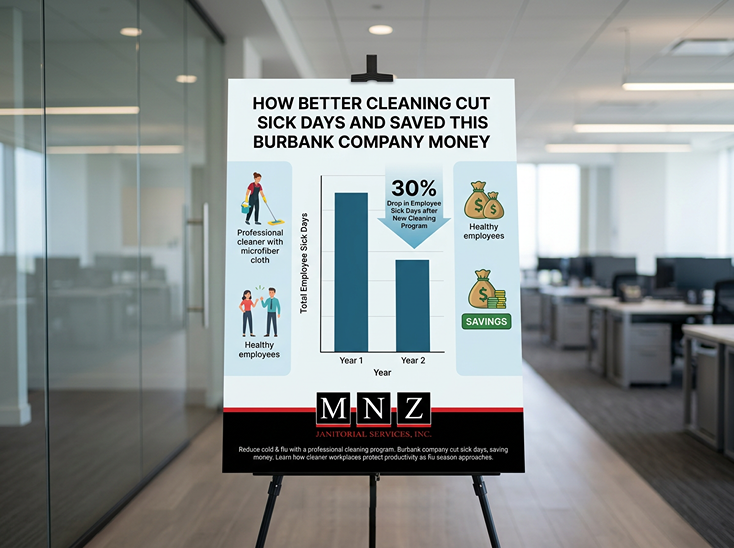
Sick day reduction: Average sick days per employee dropped from 11 annually to around 7. That is a roughly 36% reduction for this team.
Calculating the janitorial ROI: With 60 employees, each earning an average of about $28 per hour, each sick day costs the company roughly $224 in direct wages, not counting temporary coverage, missed output, or client impact. Cutting four sick days per employee across 60 people works out to approximately $53,760 in recovered productivity per year.
Maintenance savings: The HVAC filter upgrade alone extended the expected service life of their rooftop unit by reducing strain on the motor. The property manager estimated that catching the deferred maintenance early saved an estimated $4,000 to $7,000 in what could have been an emergency repair.
The increased cost of the new service: Roughly $3,600 more per year than their old contract.
So the net picture on their office cleaning case study, Burbank snapshot: they spent about $3,600 more and recovered over $57,000 in combined productivity and avoided maintenance expenses. That is not a cleaning expense. That is a business decision.
Why Burbank Offices Face Specific Challenges
Burbank sits in a part of Los Angeles County where commercial buildings tend to be older, often built in the 1980s and 1990s, and the HVAC systems in those buildings were not designed for the occupancy densities that modern open-plan offices create. You have more people per square foot sharing the same recirculated air.
Add to that the dry heat of inland Southern California summers, which pulls particulate matter and allergens through older duct systems, and you have a building environment that needs more intentional maintenance, not less, to stay healthy.
This is the context that matters when you are evaluating your cleaning vendor. A company that only offers janitorial services, with no capacity for building maintenance, will always be solving half the problem.
What the Research Says About Clean Workplaces and Health
This is not just one company's experience. The evidence behind workplace cleaning and employee health is substantial.
A 2012 study published in the American Journal of Infection Control found that regular professional cleaning and disinfection of office environments reduced the incidence of self-reported respiratory illness by up to 80% in some workplace populations.
The CDC's guidance on environmental infection control consistently points to high-touch surface disinfection as one of the most effective non-pharmaceutical interventions for reducing pathogen transmission in shared spaces.
Dr. Charles Gerba, a microbiologist at the University of Arizona who has spent decades studying workplace contamination, has noted that most people are surprised to learn that office break rooms tend to harbor more bacteria per square inch than restrooms, largely because they are cleaned with less rigor.
"The office environment is often treated as low risk," says Gerba. "But it is a space where people spend eight or more hours a day in close contact with shared surfaces. That deserves serious attention."
This is the practical case for taking your cleaning contract seriously and for making sure the people doing the work are using the right products, protocols, and schedules.
What to Look for in an Integrated Cleaning and Maintenance Partner
If you are a building manager, property manager, or office manager evaluating vendors, here are the questions that separate exceptional from average:
Ask about surface-specific protocols. Do they have different procedures for break rooms and conference rooms versus restrooms? They should.
Ask what disinfectants they use and whether those products are EPA-registered. This is not a trick question. It is a basic standard of care.
Ask whether they offer maintenance services alongside cleaning. If the answer is no, ask yourself who is responsible for HVAC filters, exhaust fans, and plumbing inspections in your building. If the answer is "nobody in particular," that is the gap that tends to get expensive.
Ask for references from similar property types in your area. A company that cleans Burbank office buildings knows the building stock, the climate challenges, and the common deferred maintenance issues you are likely to find.
Ask about reporting. Do you get a log of what you did and when? Do they flag issues they notice during their walkthrough? A vigilant vendor is also an extra set of eyes on your property.
This Is the Office Cleaning Case Study Burbank Managers Share
We have seen versions of this story play out with clients across Los Angeles, West Hollywood, Santa Monica, El Segundo, Pasadena, and throughout Los Angeles County. The pattern is almost always the same: a company is spending money on a basic cleaning contract, sick days are higher than they should be, and nobody has connected the two.
When you integrate consistent, protocol-based janitorial service with proactive building maintenance, the math changes fast. The commercial cleaning results are not soft benefits. They show up on the bottom line, and they show up in the attendance report.
Frequently Asked Questions
Q: How quickly can I replicate a Burbank-style office cleaning case study result in my building?
Most clients see measurable changes in sick day frequency within one to two full flu seasons, roughly six to twelve months. HVAC and maintenance improvements can have a faster impact on air quality within weeks of implementation.
Q: What does an integrated janitorial and building maintenance service typically cost compared to janitorial alone?
Integrated service generally runs 15% to 25% higher than a janitorial-only contract. But the janitorial ROI comparison has to account for avoided repair costs, productivity recovery, and tenant retention, not just the line-item cleaning fee.
Q: Do I need a separate maintenance contractor, or can MNZ handle both?
MNZ provides both cleaning and building maintenance services as a combined offering. You manage one point of contact, one contract, and one team that knows your property.
Q: What surfaces should be prioritized for disinfection in a shared office environment?
High-touch surfaces should be disinfected at a minimum daily: door handles, elevator buttons, light switches, shared kitchen and break room appliances, restroom fixtures, and any shared technology like printers or phones. Conference room surfaces should be wiped between meetings in high-traffic facilities.
Conclusion: Your Cleaning Contract Is a Financial Decision
If you are managing a commercial property or office building in Burbank or anywhere in the Los Angeles area, the cleaning contract you sign is not a facilities checkbox. It is a direct input into your operating expenses, your tenant health, and your bottom line.
The Burbank company in this story did not overhaul its HR policy or launch a wellness program. They changed who cleaned their building and added basic maintenance oversight. The numbers followed.
If you want to see what that could look like for your property, MNZ Janitorial Services offers a free walkthrough and assessment for commercial buildings in Los Angeles County. We will tell you what we find, what it would cost to fix, and what you can realistically expect in return.
Ready to stop guessing and start seeing commercial cleaning results? Contact MNZ today at mnz.com/estimates or call (818) 480-9316 to schedule your free building assessment.
Blog Posts Worth Reading
Transform your space into a clean and welcoming environment with MNZ. Contact us today to schedule a consultation and get a quote for our professional cleaning and maintenance services.
.jpg)


