

You know that dripping faucet in the second-floor restroom that's been dripping for three weeks? Or the hallway carpet near the entrance that's started pulling up at the seam? These aren't just eyesores. They're bills waiting to happen.
If you manage a commercial property or an office in Los Angeles, you've probably felt this before: something small gets ignored, and the next thing you know, you're approving an emergency repair invoice that could have been avoided entirely. And honestly, you aren't to blame. You're juggling tenant requests, vendor calls, lease renewals, and a hundred other things. Maintenance issues slip through.
Most costly building repairs don't appear out of nowhere. They start as small, overlooked problems, and the gap between "small fix" and "big bill" is almost always connected to one thing: how consistently your building is being watched.
That's where a good facility maintenance plan, paired with proactive janitorial services, really makes a difference.
Why Small Problems Compound Fast in Commercial Buildings
Let's talk numbers for a second. According to a report by the Building Owners and Managers Association (BOMA), reactive maintenance costs 3 to 5 times more than planned, preventive maintenance. That's not a small gap. That's the difference between a $200 repair and a $1,000 emergency call.
A 2023 survey by Facility Executive magazine found that 67% of facility managers reported that deferred maintenance was their biggest budget drain. Not big capital projects. Not utility costs. Deferred maintenance refers to issues that were noticeable weeks or months earlier but were never addressed.
The pattern is consistent:
- A slow sink drain is ignored. Water backs up, causes moisture buildup, and leads to mold remediation that runs $3,000 to $10,000, depending on the scope.
- A dusty HVAC vent never gets wiped down. Filters clog, the system overworks itself, and you're calling for emergency HVAC repair at $400 an hour.
- A small grout crack in a high-traffic bathroom goes unnoticed. Water seeps through, gets under the tile, and now you need a full tile replacement.
None of these is unusual. They happen in buildings all over Los Angeles, West Hollywood, Santa Monica, Pasadena, and El Segundo every month. And almost all of them could have been caught earlier.
The Role Your Janitorial Team Actually Plays (That Most People Don't Realize)
Here's something most office managers don't fully use to their advantage: your janitorial crew is in your building more than almost anyone else. They're in every restroom, every break room, every hallway, and every office. They see things.
A well-trained, proactive janitorial team isn't just cleaning surfaces. They're your eyes on the ground. When something's off, they're the first to see it, and if they're set up to report it, they become a cost-effective part of your building upkeep strategy.
At MNZ Janitorial Services, this approach is built into how the team operates. Cleaners are trained to flag issues during their rounds, from a leaking supply line under a sink to a light fixture that's flickering in a stairwell. That flag goes to the building manager before it becomes an emergency.
One property manager at a mid-size office building in El Segundo shared this: "Our janitorial crew noticed water staining under a bathroom vanity during their nightly rounds. They flagged it the next morning. Turns out, a supply line fitting was slowly leaking. We fixed it for about $85. If it had gone another two weeks, we were looking at drywall damage and a potential insurance claim."
That's proactive janitorial work in practice. Not just cleaning, but actual building intelligence is built into your regular service.
What a Real Facility Maintenance Plan Looks Like
A facility maintenance plan doesn't have to be complicated. But it does need to be consistent. Here's what a basic working version looks like for an office building in Los Angeles:
Weekly: Restroom hardware inspection (faucets, handles, toilet mechanisms), HVAC vent wipe-down, entry mat condition check, exterior walkway assessment.
Monthly: Interior drain flush and check, light fixture status review, door hardware and lock function, ceiling tile inspection for water staining.
Quarterly: Deep-clean and inspect HVAC filters, window seal and caulking review, parking area and exterior surface pressure wash, and fire safety equipment visual check.
Annually: Full plumbing line check, roof drain inspection, carpet and flooring condition assessment, interior paint and surface review.
When you sync your janitorial schedule with this kind of plan, you're not just cleaning your building. You're actively maintaining it. The two work together.
This is exactly why integrated commercial building maintenance Los Angeles providers, which handle both cleaning and maintenance under one roof, are increasingly what property managers here are asking for. It cuts down on the coordination cost, reduces vendor management headaches, and creates accountability in one place.
The "Two Vendors" Problem Most Office Managers Have
Here's a situation that's probably familiar. You have a cleaning company. You also have a maintenance contractor. They don't talk to each other. The cleaner notices something but figures it's "not their job" to report it. The maintenance contractor only shows up when you call. So nothing is communicated unless you, the office manager, are the middle person.
That's a lot of mental load on you and a lot of potential for things to be missed.
When MNZ handles both janitorial and maintenance for a property, that gap disappears. The team that cleans the building is the same team communicating with the maintenance side. A spotted issue gets flagged immediately, assigned, and tracked. You get a single point of contact, a single report, and a clear record of what we found and what we did.
A building manager in West Hollywood described it this way: "I used to get calls about broken things from tenants, which was embarrassing. Now my team catches it first. It's changed how tenants see the building and, honestly, how I feel about coming to work."
What Commercial Building Maintenance Los Angeles Properties Actually Need
Los Angeles is a unique environment for building upkeep. You've got year-round sun that degrades exterior materials faster than you'd expect. Marine layer moisture from the coast affects Santa Monica and El Segundo properties in ways that inland managers don't deal with. Earthquakes, however minor, create micro-shifts in plumbing and tile over time. And the sheer foot traffic in commercial properties here means wear happens faster.
Good commercial building maintenance Los Angeles accounts for these local factors. It's not a copy-paste approach from a generic checklist. It's knowing that exterior caulking around windows needs to be checked more often in coastal zones and that HVAC systems run harder here year-round and need more frequent filter attention, and high-traffic lobbies in dense commercial corridors need flooring attention on a tighter timeline.
This local knowledge is part of what separates a generalist cleaning company from a true building maintenance partner.
Building Upkeep by the Numbers: What Proactive Saves You
To put this in perspective, here's what the research says about proactive building upkeep versus reactive repair:
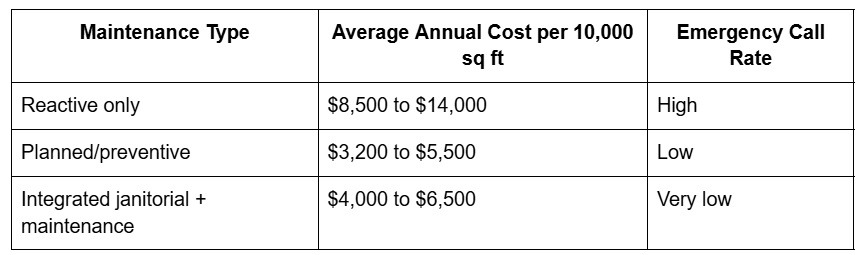
The integrated approach costs slightly more than basic planned maintenance, but the emergency call rate drops significantly because you have daily eyes in the building. That reduction in emergency calls alone tends to more than offset the cost difference.
How to Start If You're Starting From Scratch
If you don't currently have a facility maintenance plan in place, here's a realistic starting point:
Step 1: Walk your building with your janitorial supervisor once a month. Not an inspection, just a walk. Look at the same spaces your cleaners see every night. You'll start to notice patterns.
Step 2: Create a simple issues log. It doesn't need to be software. A shared Google Sheet works fine. Cleaners notice a dripping faucet; they log it with a date and location. You review weekly.
Step 3: Schedule a monthly maintenance walkthrough with a vendor or an in-house person, specifically for mechanical and structural items: drains, fixtures, HVAC, and the exterior. This doesn't have to be long. Even 45 minutes a month creates accountability.
Step 4: Ask your janitorial provider if they offer maintenance coordination or integrated services. Many don't, but some, particularly providers doing commercial building maintenance in Los Angeles, are set up for this.
Step 5: Track what you catch early versus what becomes a repair. After 6 months, you'll have real data on what your proactive approach is saving you.
A Note on Tenant Satisfaction
This matters even beyond the cost savings. Tenants in Los Angeles office properties are increasingly looking at building conditions as a reason to stay or leave. A 2024 CBRE report on LA office market trends found that building quality and upkeep ranked in the top three reasons tenants cited for lease renewal decisions, behind only location and price.
When you consistently maintain your building, tenants notice. Not always consciously, but the absence of problems creates a sense of confidence. The restrooms work. The lobby looks impressive. The lights are all on. There's no lingering odor from a drain issue. Those things add up to how tenants feel about renewing.
Proactive building upkeep isn't just a cost-avoidance strategy. It's a retention strategy.
The Integrated Approach to Commercial Building Maintenance Los Angeles Managers Are Moving Toward
The trend is clear. Building managers and property managers across Los Angeles County are moving away from the "hire separately and hope they coordinate" model toward integrated service providers who handle both cleaning and maintenance.
It reduces friction. It improves communication. It creates clearer accountability. And it means that the people cleaning your building aren't just wiping surfaces; they're actively contributing to its health.
MNZ Janitorial Services offers exactly this kind of integrated service for commercial properties across Los Angeles, West Hollywood, Santa Monica, El Segundo, and Pasadena. The team is trained to do more than clean. They're trained to watch, report, and coordinate so that small issues stay small.
Frequently Asked Questions
Q1: How often should an office building in Los Angeles have a maintenance walkthrough?
A: For most commercial buildings, a monthly walkthrough covering plumbing fixtures, HVAC vents, drains, and visible structural surfaces is a solid baseline. High-traffic properties or older buildings benefit from bi-weekly checks.
Q2: Can my janitorial team actually help catch maintenance problems, or is that a separate service?
A: A trained janitorial team can absolutely serve as your first line of detection. The key is having a reporting system in place so that what they notice is communicated to you quickly, rather than going unmentioned until it becomes urgent.
Q3: What is the real cost difference between reactive and preventive building maintenance?
A: Industry data from BOMA International shows that reactive maintenance typically costs 3 to 5 times more per incident than planned preventive maintenance. Over a year, that gap compounds significantly for any property above 5,000 square feet.
Q4: What should I look for in an integrated janitorial and building maintenance provider in Los Angeles?
A: Look for a provider who has a documented reporting process, not just a cleaning schedule. They should show you how issues are flagged, assigned, and tracked. A single point of contact for both services strongly indicates that they're set up for integrated work.
Conclusion: The Best Repair Is the One You Never Had to Make
You're not going to eliminate all repair costs. Buildings age. Things break. But the difference between a $150 fix and a $5,000 emergency almost always comes down to how quickly someone spots the problem.
A solid facility maintenance plan, a proactive janitorial team that reports what they see, and an integrated service provider who connects those two things; that's how office managers and building managers stay ahead of the bill.
If you manage a commercial property in Los Angeles and you're tired of being surprised by repair costs, let's talk. MNZ Janitorial Services works with office managers, property managers, and landlords across LA County to build cleaning and maintenance routines that actually protect your building.
Get a free building assessment and quote at mnz.com. No pressure, just a real conversation about what your building needs.
Related Reading:
- The Hidden Risks of Skipping Commercial Building Maintenance in Los Angeles
- How Facility Managers Can Use Janitorial Services to Prevent Costly Repairs
- El Segundo's Guide to Choosing a Janitorial Service That Supports Building Maintenance
Transform your space into a clean and welcoming environment with MNZ. Contact us today to schedule a consultation and get a quote for our professional cleaning and maintenance services.
.jpg)


