

You’ve probably been there. You hire a cleaning company, shake hands, and sign something, and 2 months later, the restrooms still smell by Thursday afternoon, and the lobby mats haven't been touched since the first week. You call to complain, and they say, "Well, we clean the lobby weekly," but that should be in the cleaning service contract. You were right. That guess cost you tenant complaints, a thinly spread maintenance team, and a contract dispute no one wanted.
That gap, between what you expected and what was actually written down in the cleaning services contract, is what a janitorial service level agreement template is meant to bridge.
This post is for office managers, building managers, landlords, and property managers in Los Angeles County who are tired of cleaning contracts that seem professional but have too much wiggle room. You’ll get the full picture of what a solid SLA actually contains, a ready-to-use template structure you can fill in before your next vendor conversation, and some real talk about what to watch out for.
Why Cleaning Contracts Fail, And It’s Not Who You Think
Here's the thing: most people don't want to admit that bad cleaning results are rarely ever 100% the vendor's fault. More often than not, the contract said too little.
According to the Building Owners and Managers Association (BOMA), facility cleanliness is one of the top three factors in tenant satisfaction scores for commercial properties. But most cleaning contracts used by mid-size property management firms are under two pages and lack basic performance standards.
Think on that. You own a 50,000-square-foot office building in Pasadena or El Segundo and spend $3,000 to $8,000 a month on janitorial services, but the contract doesn’t spell out what “clean restrooms” actually means, how quickly complaints are handled, or who inspects the work.
When things don’t go right, both sides feel frustrated. The client is disappointed. The vendor says he was blindsided. And the relationship crashes and burns faster than it should.
The solution is easier than you think: a specific, well-defined janitorial service level agreement template that both parties review, negotiate, and fully understand before anyone picks up a mop.
What is a Janitorial Service Level Agreement?
A service level agreement (SLA) is a separate document or a detailed section of a contract that clearly defines what performance is. It’s not just a list of things to do. It describes the standards, timings, quality metrics, and penalties for not attaining the standards.
What’s the difference between a cleaning contract and SLA? SLA is measurable. You're not just agreeing to the kitchen being cleaned. You agree the kitchen will be cleaned each weekday before 7:00 a.m., that surfaces will be sanitized with EPA-approved disinfectants, and that any complaint regarding the kitchen will be addressed within four business hours.
A good janitorial service level agreement template gives you the level of specificity you need without requiring you to write one from scratch each time you hire a new vendor.
7 Sections That Should Be in Every Janitorial SLA
Here’s a practical breakdown of what your SLA should contain, with fillable fields you can bring to your next vendor meeting.
1. Scope of Services
This is the "what gets cleaned" section. Be specific. Vague language like "common areas" causes most disputes.
Template:
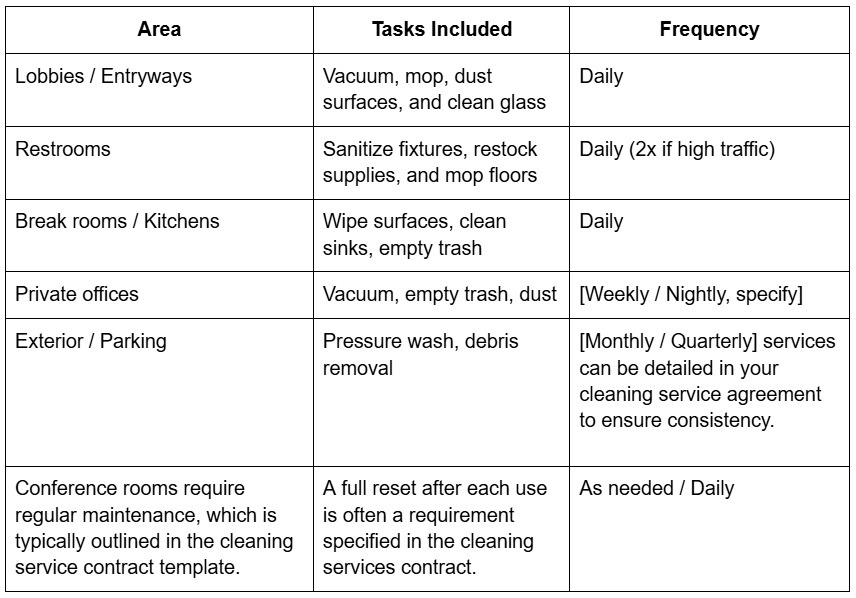
Flag any area NOT included explicitly. If it's not listed, assume it won't be touched.
2. Janitorial Service Level Agreement Template: Performance Standards
This is the heart of any strong office cleaning SLA. You're setting the bar for what "done right" looks like.
Template:
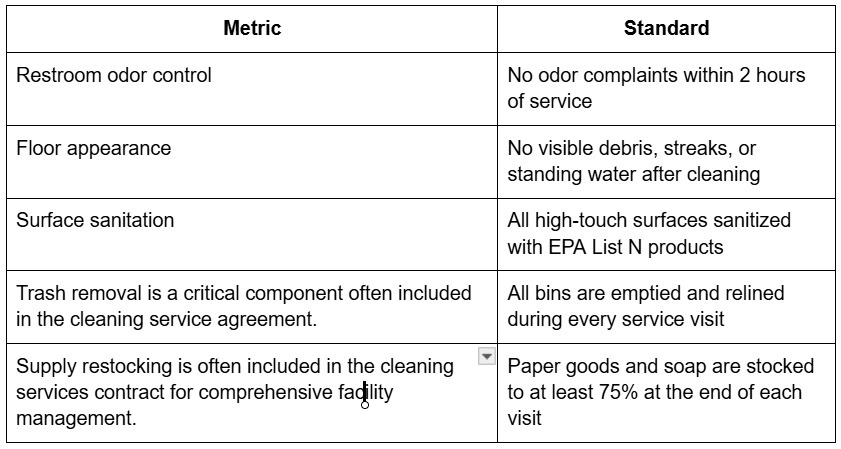
Tip: Walk your building with your vendor before signing and agree on these standards together. It prevents "I thought it was fine" arguments later.
3. Service Schedule
Day, time, and frequency. Be exact.
Template:
- Regular cleaning: Monday through Friday, 6:00 p.m. to 10:00 p.m.
- Deep cleaning: First Saturday of each month, 7:00 a.m. to noon
- Restroom spot checks: [daily / twice daily, specify]
- Emergency cleaning response window: Within [2 / 4 / 8] hours of reported incident
4. Response Times and Escalation
Things go wrong. What matters is how fast the service provider gets repairs fixed, as outlined in the cleaning service contract.
Template:
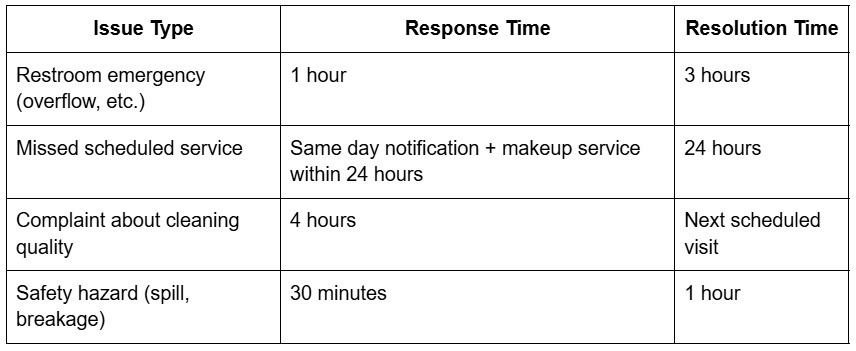
Who do you call? List: primary contact, backup contact, after-hours number. Don't skip this.
5. Inspection and Reporting
How do you know the work is actually being done to standard? You inspect. And you document.
Template:
- Vendor provides a completed service checklist after every visit (paper or digital, specify)
- Monthly quality inspection walk-through with the property manager or building manager
- Quarterly performance review meeting
- Client can request an unscheduled inspection at any time with [24 / 48]-hour notice
- Inspection scoring system: [Pass/Fail by area] or [1-5 rating scale, specify], as outlined in the cleaning service contract template.
6. Service Guarantees and Remedies
This is the section most contracts skip, and it's the most important one for you.
Template:
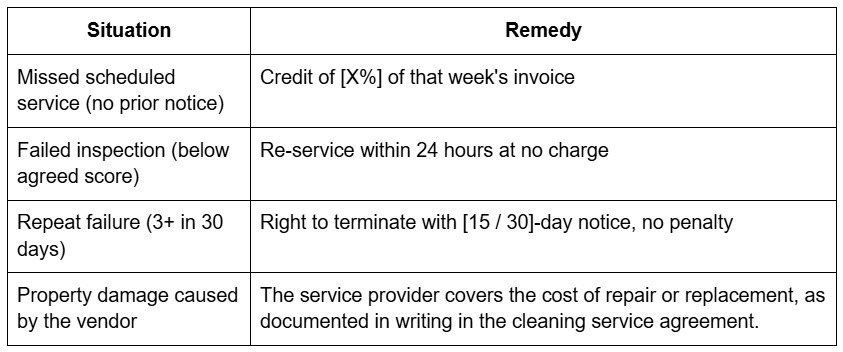
Assumption flagged: these numbers are starting points for negotiation, not industry-fixed standards. Adjust based on your building's risk tolerance and vendor relationship.
7. Janitorial Contract Terms: What Governs the Agreement
This section ties the SLA to the main contract.
Template:
- Contract term: [Month-to-month / 6 months / 1 year, specify]
- Termination notice required: [30 / 60] days' written notice
- Price adjustment: Vendor must give a [60]-day written notice before any rate change
- Insurance minimums: General liability of at least $1,000,000 per occurrence; workers' compensation as required by California law
- Background check: Confirm all cleaning staff have passed background screening
- Confidentiality: Vendor and all staff agree to maintain confidentiality of tenant information
Market Trends You Need to Know
The commercial cleaning industry has undergone a lot of changes over the last few years. As you build out your SLA, here are a few things to consider:
- Health-based cleaning is the new standard, not a luxury. Post-2020, commercial tenants want hospital-grade sanitization of common areas. Now the EPA’s List N disinfectants and OSHA’s bloodborne pathogen standards are part of what a responsible janitorial contract should reference.
- Green cleaning is becoming a contract mandate. Los Angeles County has some of the strictest environmental rules in the nation. Some state buildings already require Green Seal-certified cleaning products, and private-sector tenants, especially in the tech and finance sectors, are demanding the same, the California Department of Public Health said.
- Integrated janitorial and maintenance services are on the rise. In cities like Santa Monica and West Hollywood, building managers are looking more and more for vendors who can clean and maintain the facilities under one contract. It cuts down on vendor management overhead and creates cleaner accountability when something breaks or looks worn.
- Accountability through technology. Larger properties are beginning to see things like QR code check-in systems, digital inspection reports, and real-time service dashboards appear in contracts. If your vendor cannot provide some form of digital verification that the work was done, put that in the cleaning service agreement.
What Makes MNZ Different (And Why It Matters for Your SLA)
MNZ Janitorial Services is serving all of Los Angeles County, including West Hollywood, Santa Monica, El Segundo, Pasadena, and more. Our philosophy is integrated service and direct accountability.
We don’t just clean. Our teams handle janitorial and building maintenance, so you have one point of contact for restroom sanitation, floor care, common area cleaning, and light facility maintenance. That’s fewer vendors, fewer gaps, and a cleaner paper trail when something needs attention.
Real-world example: We were approached by a property management company in El Segundo that manages a multi-tenant office building. Their vendor was consistently missing weekend service calls and providing no documentation. In the first 30 days of working with MNZ, we had digital check-in reports for each visit, a shared communication line for after-hours problems, and a complete deep clean of 3 floors that had been neglected for months. Their building manager told us it was the first time in two years that she felt comfortable walking a prospective tenant through the lobby without apologizing for something.
That kind of confidence comes from a contract that actually spells out what is expected and a vendor that holds themselves to it.
FAQ: Janitorial Service SLAs
Q: Is a janitorial SLA legally binding?
Yes, SLAs are legally binding when attached to or referenced in a signed service agreement. The most important thing to remember is that your main contract must specifically refer to the SLA document so there is no question whether its terms apply to it.
Q: Can I use a janitorial service level agreement template as-is, or does it need to be customized?
Always customize. The template structure gives you the framework, but the specific tasks, frequencies, response times, and remedies need to reflect your building's actual size, use, and traffic patterns. A 10-person office in West Hollywood has very different needs than a 200-person multi-floor building in Pasadena, which is why a tailored cleaning service agreement is essential.
Q: What is the difference between a normal janitorial contract and an office cleaning SLA?
The general contract covers the commercial and legal relationship: payment terms, liability, termination, and scope in broad strokes. An SLA for office cleaning takes it to the operational level—what exactly is done, how often, to what standard, and what happens if it is not met. If you have both, that’s ideal.
Q: How often do we review/update the SLA?
At a minimum, review your cleaning service contract annually to make sure it still meets your needs. But if the occupancy of your building changes significantly, if you add new tenants with different needs, or if you’ve had recurring service issues, review it sooner. It is a good habit to have a quarterly check-in meeting with your vendor, and it makes the annual review much simpler.
Conclusion: Don't gamble on cleanliness
A good janitorial relationship doesn’t start with trust. It begins with clarity. Trust is when both sides do the work they agreed to all the time.
The janitorial service level agreement template sections above provide a real starting point, not a generic checklist you will forget in a drawer. Use this in your next vendor conversation, fill in the blanks for your building, and make sure you’re both signing the same expectations, not just the same paper.
If you are a commercial property manager in Los Angeles County and are in need of a cleaning partner who shows up ready to put performance in writing, MNZ Janitorial Services is ready to talk. We service buildings throughout Los Angeles, West Hollywood, Santa Monica, El Segundo, and Pasadena, and we’ll walk you through your SLA before a single mop hits your floors.
Blog Posts Worth Reading Next
Transform your space into a clean and welcoming environment with MNZ. Contact us today to schedule a consultation and get a quote for our professional cleaning and maintenance services.
.jpg)


