
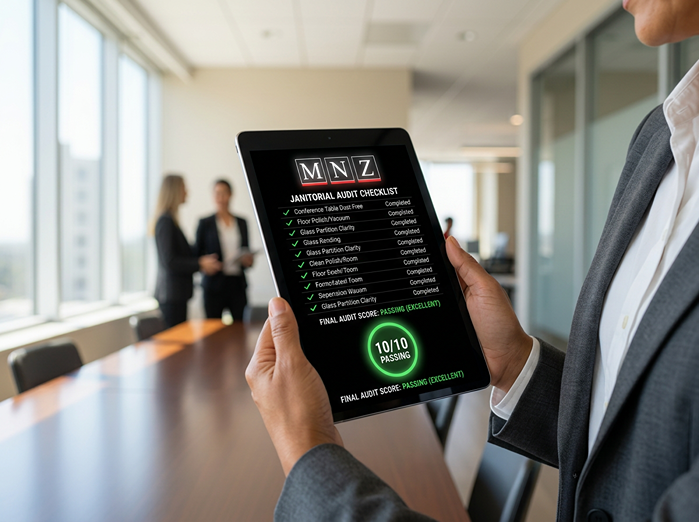
You hired a cleaning company. They show up. They look busy. But if someone asked you right now, "How clean is your building, really?" could you actually answer that?
Most building managers, landlords, and office managers can't. And that's not a knock on you. It's just that "clean" is one of those things that feels obvious until you have to prove it.
Here's what tends to happen: a tenant complains about the restrooms. Or a health inspector flags something. Or a prospective client walks through your lobby, and something just feels a little... off. That's when you realize you've been assuming your facility was in excellent shape without ever actually checking.
A 2023 study from the ISSA (the worldwide cleaning industry association) found that facilities without a formal inspection process had 40% more tenant complaints about cleanliness than those with regular audits. That's a real number tied to a real problem.
So let's fix that right now. Here is a simple, practical janitorial quality audit checklist you can use today to find out your building's actual cleanliness score.
What Is a Janitorial Quality Audit, and Why Does It Matter?
A janitorial quality audit checklist is basically a structured walkthrough of your facility that measures cleaning performance against specific, measurable standards. It's not about catching your cleaning crew doing something wrong. It's about making sure you have documentation, accountability, and a baseline you can actually track over time.
Think of it like a report card. You wouldn't want to run a school without knowing how students are performing. The same logic applies to your building.
For property managers and building owners across Los Angeles County, West Hollywood, Santa Monica, El Segundo, and Pasadena, this kind of documentation also matters for liability reasons. If a tenant slips on a wet floor or a health inspector walks through, you want a paper trail showing regular, verified cleaning.
According to BOMA International, buildings with documented cleaning quality programs report up to 25% higher tenant satisfaction scores. That directly affects lease renewals and property value.
Your 10-Point Janitorial Quality Audit Checklist
Each area below is worth 10 points, giving you a total possible score of 100. Score each area as follows:
- 10: Excellent, exceeds expectations
- 7-9: Good, meets standards with minor gaps
- 4-6: Fair, noticeable deficiencies
- 1-3: Poor, requires immediate attention
- 0: Not completed or completely unacceptable
Point 1: Restrooms
This is the number one area that shapes how people perceive your building. If restrooms are dirty, nothing else matters.
What to check:
- Toilets, urinals, and sinks cleaned and sanitized
- Floors are mopped and free of pooling water or visible debris
- Soap, paper towels, and toilet paper are stocked
- Mirrors streak-free
- Trash emptied and liner replaced
- No odors (the biggest tell)
Your Score (0-10): ___
Point 2: Entrance and Lobby Areas
Your entrance is the first and last impression your building makes. It should be spotless every single day.
What to check:
- Floor mats vacuumed or replaced
- Hard floors are mopped and free of scuff marks
- Glass doors and windows wiped down, no fingerprints or smudges
- Reception desk and surfaces dusted
- No debris or clutter visible from the street
Your Score (0-10): ___
Point 3: Floor Care Throughout the Building
Floors take more abuse than any other surface. They're also the easiest way to see whether a cleaning crew is actually doing their job or just pretending to work.
What to check:
- Carpet vacuumed, no visible crumbs or debris
- Hard floors swept and mopped, no streaks or residue
- Floor corners and edges addressed (not just the middle of the room)
- Elevator floors and tracks cleaned
- Stairwells were swept and mopped
Your Score (0-10): ___
Point 4: Trash and Recycling
This one seems obvious, but it's one of the most commonly missed items in a janitorial inspection.
What to check:
- All bins emptied
- Liners replaced, not just the trash removed
- Recycling separated correctly
- No overflowing bins anywhere in the building
- Dumpster area clean and lids closed
Your Score (0-10): ___
Point 5: Breakroom and Kitchen Areas
Breakrooms are high-traffic, high-mess zones. Food residue and moisture attract pests, which is a serious problem for any commercial facility in Los Angeles County.
What to check:
- Countertops wiped and sanitized
- Sink cleaned and drain clear
- Microwave interior cleaned
- Refrigerator exterior wiped
- Floor mopped, especially under the coffee station
- Tables are wiped after each use
Your Score (0-10): ___
Point 6: Dusting and Surface Cleaning
This step is where a lot of cleaning companies cut corners. Surfaces look clean at a glance, but run your finger along a shelf or window ledge, and you'll know the truth.
What to check:
- Desks, shelves, and filing cabinets were dusted
- Windowsills and blinds were dusted
- Light fixtures and vents are addressed (at least weekly)
- Baseboards wiped
- Elevator interior panels were wiped down
Your Score (0-10): ___
Point 7: High-Touch Point Disinfection
Post-pandemic, such practices became non-negotiable. If your cleaning crew isn't specifically targeting high-touch surfaces with a disinfectant, you're leaving a real health risk unaddressed.
What to check:
- Door handles and push plates disinfected
- Light switches wiped
- Elevator buttons sanitized
- Handrails on stairs and ramps cleaned
- Shared equipment surfaces addressed (copiers, coffee machines)
According to the CDC, high-touch surfaces can harbor common cold and flu viruses for up to 24 hours. Regular disinfection of these points is a core part of any complete janitorial quality audit checklist.
Your Score (0-10): ___
Point 8: Outdoor and Common Area Maintenance
If your building has exterior areas, parking structures, courtyards, or shared amenity spaces, they're part of your cleanliness score too.
What to check:
- Exterior entryways swept
- Parking lot or structure free of visible trash and debris
- Courtyard or outdoor seating areas are maintained
- Exterior glass cleaned
- Cigarette receptacles emptied
Your Score (0-10): ___
Point 9: Janitorial Supply and Equipment Standards
Your cleaning quality score is only as satisfactory as the tools and products being used. This point is often overlooked in a standard facility audit, but it matters.
What to check:
- Cleaning products are EPA-approved and appropriate for each surface
- Mop heads and cleaning cloths are replaced regularly (dirty mops spread bacteria)
- Equipment is in working order and stored properly
- Color-coded cloths are used to prevent cross-contamination (restroom cloths should never be used in the kitchen)
- Cleaning logs or work orders are filled out, and current
Your Score (0-10): ___
Point 10: Communication and Accountability
This last point is about the relationship between you and your cleaning service. A great janitorial team doesn't just clean; they communicate.
What to check:
- Do you have a point of contact you can reach easily?
- Are issues typically reported and resolved within 24 hours?
- Do you receive any kind of inspection report or work log?
- Is there a process for requesting additional cleaning when needed?
- Has your service level agreement been reviewed in the past 12 months?
Your Score (0-10): ___
Your Total Cleanliness Score
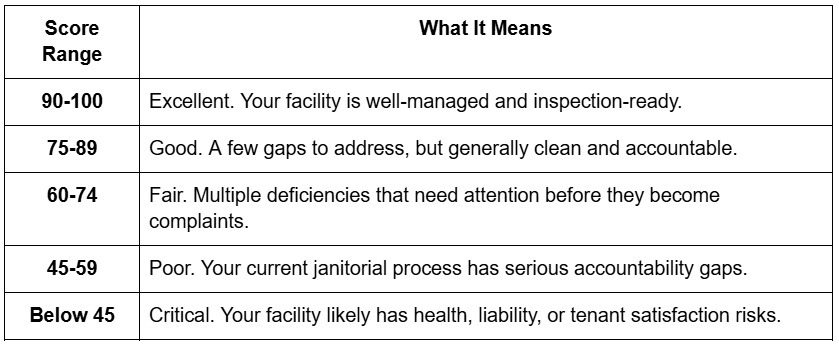
Add up your scores from all 10 points.
What Happens When You Use a Janitorial Quality Audit Checklist Consistently?
The score is just the start. The real value comes from running this audit monthly or quarterly and tracking your numbers over time.
Here's a real example from a property management client MNZ serves in the West Hollywood area. When they first ran a facility audit using a similar format, they scored a 58 out of 100. Within 90 days of implementing a documented system for cleaning quality scores with their janitorial provider, they were at an 84. Tenant complaints about cleanliness declined by over 60%.
That's not magic. That's just accountability.
"You can't manage what you don't measure" is a business principle that applies directly to facility management. When your cleaning company knows there's a formal janitorial inspection process in place, the quality of their work goes up. It's just human nature.
Why Los Angeles Buildings Need This More Than Ever
Buildings across Los Angeles, Pasadena, El Segundo, Santa Monica, and West Hollywood are dealing with a few specific pressures right now:
- Tenant expectations are higher. Remote work made people more conscious of hygiene. When they come back to a building, they notice things they wouldn't have before.
- Health compliance isn't optional. California's occupational health standards and local LA County health codes require maintained, documented cleaning protocols in commercial spaces. A facility audit provides you with something to show if you are ever questioned.
- Property values depend on presentation. A clean, well-maintained building commands higher rents and retains tenants longer. BOMA's 2024 data shows that buildings with formal cleaning accountability programs have lease renewal rates up to 18% higher than those without.
How MNZ Pairs Janitorial and Maintenance for a Complete Score
One thing that makes MNZ different from a standard cleaning company is the integration of janitorial services and building maintenance. A lot of cleaning issues aren't just about dirt; they're about facilities that need repair. A leaking faucet creates moisture damage. A broken floor tile becomes a slip hazard. A malfunctioning HVAC spreads dust faster than any cleaning crew can keep up with.
When you work with MNZ, you receive a team that handles both. That means when an issue shows up during a janitorial inspection, it doesn't just get noted and ignored. It is flagged, reported, and addressed through our maintenance side. Our clients in El Segundo and Pasadena specifically cite this process as one of the biggest differences in how their buildings look and feel month over month.
FAQs About Janitorial Quality Audits
Q: How often should I run a janitorial quality audit in my building?
A: For most commercial buildings, a monthly audit is realistic and effective. High-traffic facilities like medical offices or retail spaces benefit from weekly spot checks on the highest-risk areas, particularly restrooms, breakrooms, and high-touch surfaces.
Q: Should I tell my cleaning crew when I'm doing a facility audit?
A: Both scheduled and unscheduled inspections have value. Scheduled audits give your team a chance to prepare and demonstrate their standards. Unscheduled walk-throughs show you the day-to-day reality. A professional janitorial company should perform well under both conditions.
Q: What's the difference between a janitorial inspection and a facility audit?
A: A janitorial inspection typically focuses on whether cleaning tasks were completed. A facility audit is broader; it also looks at supply management, accountability systems, equipment standards, and communication processes. The 10-point checklist in this post functions as a full facility audit.
Q: Can a cleaning quality score help me if I'm evaluating a new janitorial company?
A: Absolutely. Running this audit at the end of your first month with a new provider gives you concrete data instead of a gut feeling. It also sets clear expectations from the start, which most professional janitorial companies will appreciate.
Conclusion: Your Score Is a Starting Point, Not a Verdict
Running this janitorial quality audit checklist might show you things you'd rather not see. That's okay. The point isn't to make anyone feel awful. The point is to give you real, usable information so you can make better decisions about how your building is managed.
If you scored well, great. Keep the process going and document it.
If you scored in the fair or poor range, the good news is that you know exactly where to focus. And you don't have to figure it out alone.
MNZ Janitorial Services works with building managers, landlords, and property managers across Los Angeles County, West Hollywood, Santa Monica, El Segundo, and Pasadena to build cleaning programs that are documented, accountable, and actually designed around your facility's needs. Our integrated janitorial and maintenance approach means your whole building gets covered, not just the floors and restrooms.
Ready to find out what your building's real score looks like? Get a free facility assessment from MNZ today. We'll walk through your property, run an audit together, and tell you exactly what needs attention and what's already working well.
Related Blog Posts Worth Reading
Transform your space into a clean and welcoming environment with MNZ. Contact us today to schedule a consultation and get a quote for our professional cleaning and maintenance services.
.jpg)


